
Knee special tests cheat sheet
31 knee examination tests, grouped by the condition they test for, each with the published accuracy figures that exist for it. Click a test for what a positive and a negative result mean, and the source.
Before any test: Knee red flags: the serious conditions you cannot afford to miss
Free printable version: this page as a one-page PDF, with the caution notes and sources. Sign up free to download it.
ACL rupture
Compare these tests side by side
| Test | Sensitivity | Specificity | LR+ | LR− | Verdict |
|---|---|---|---|---|---|
| Anterior drawer test | 83% | 85% | 6.34 | 0.2 | Best used to rule in |
| Lachman test | 81% | 85% | 5.72 | 0.24 | Best used to rule in |
| Lever sign (Lelli test) | 81% | 78% | 3.15 | 0.21 | Treat with caution ?The five meta-analyses cited on the test page disagree on both sides (LR+ 3.1 to 9.9; LR− 0.18 to 0.58, the 2018 review pooling a sensitivity of only 55%); a 2025 study with a blinded tester found LR− 0.60–0.93, so a negative lever sign does not rule out an ACL tear. |
| Pivot shift test | 55% | 94% | 10.7 | 0.48 | Best used to rule in |
Verdicts: rule in when LR+ is 5 or more; rule out when LR− is below 0.2; both when both; weak when neither; treat with caution where the study behind the figures is weak enough that the verdict may not hold. A caution can appear with any verdict — tap ? to read it.
Baker's (popliteal) cyst
| Test | Sensitivity | Specificity | LR+ | LR− | Verdict |
|---|---|---|---|---|---|
| Popliteal fossa examination for a cyst (palpable mass / Foucher's sign) | 74% | 88% | 6.3 | 0.3 | Best used to rule in |
Verdicts: rule in when LR+ is 5 or more; rule out when LR− is below 0.2; both when both; weak when neither; treat with caution where the study behind the figures is weak enough that the verdict may not hold. A caution can appear with any verdict — tap ? to read it.
Chondromalacia patellae at arthroscopy (knees without patellofemoral pain)
| Test | Sensitivity | Specificity | LR+ | LR− | Verdict |
|---|---|---|---|---|---|
| Clarke's sign (patellar grind test) | 39% | 67% | 1.2 | 0.91 | Treat with caution ?Studied in people without patellofemoral pain; the authors recommended dropping the test. |
Verdicts: rule in when LR+ is 5 or more; rule out when LR− is below 0.2; both when both; weak when neither; treat with caution where the study behind the figures is weak enough that the verdict may not hold. A caution can appear with any verdict — tap ? to read it.
Knee effusion
| Test | Sensitivity | Specificity | LR+ | LR− | Verdict |
|---|---|---|---|---|---|
| Patellar tap test | 83% | 49% | 1.6 | 0.3 | Treat with caution ?Only one study in recently injured knees (Kastelein 2009); studies in knee osteoarthritis and other rheumatology patients, checked with ultrasound, report very different figures (sensitivity 18–87%, specificity 31–96%). |
Verdicts: rule in when LR+ is 5 or more; rule out when LR− is below 0.2; both when both; weak when neither; treat with caution where the study behind the figures is weak enough that the verdict may not hold. A caution can appear with any verdict — tap ? to read it.
Knee fracture after an acute knee injury (need for X-ray)
| Test | Sensitivity | Specificity | LR+ | LR− | Verdict |
|---|---|---|---|---|---|
| Ottawa knee rule | 99% | 49% | 1.86 | 0.07 | Best used to rule out ?Reviews differ on how low the LR− is (0.05 to 0.12), and there are not enough good data in children under 5. |
| Pittsburgh knee rule | 99% | 60% | 2.48 | 0.02 | Treat with caution ?Validated by the rule's own developers; independent studies found sensitivity of only 77% and 86%. |
Verdicts: rule in when LR+ is 5 or more; rule out when LR− is below 0.2; both when both; weak when neither; treat with caution where the study behind the figures is weak enough that the verdict may not hold. A caution can appear with any verdict — tap ? to read it.
Knee osteoarthritis
| Test | Sensitivity | Specificity | LR+ | LR− | Verdict |
|---|---|---|---|---|---|
| Knee osteoarthritis clinical criteria (ACR decision-tree format) | 41% | 75% | 1.6 | 0.8 | A weak test on its own |
Verdicts: rule in when LR+ is 5 or more; rule out when LR− is below 0.2; both when both; weak when neither; treat with caution where the study behind the figures is weak enough that the verdict may not hold. A caution can appear with any verdict — tap ? to read it.
Lateral patellar instability
| Test | Sensitivity | Specificity | LR+ | LR− | Verdict |
|---|---|---|---|---|---|
| Patellar apprehension test (reversed dynamic version) | 94.9% | 85.7% | 6.6 | 0.06 | Treat with caution ?Case–control study: tends to overestimate accuracy. |
Verdicts: rule in when LR+ is 5 or more; rule out when LR− is below 0.2; both when both; weak when neither; treat with caution where the study behind the figures is weak enough that the verdict may not hold. A caution can appear with any verdict — tap ? to read it.
LCL sprain
Varus stress test: how it is done. No accuracy figures are shown, because none could be confirmed in the published research.
MCL sprain
| Test | Sensitivity | Specificity | LR+ | LR− | Verdict |
|---|---|---|---|---|---|
| Valgus stress test — 30° flexion | 78% | 67% | 2.3 | 0.3 | A weak test on its own |
Verdicts: rule in when LR+ is 5 or more; rule out when LR− is below 0.2; both when both; weak when neither; treat with caution where the study behind the figures is weak enough that the verdict may not hold. A caution can appear with any verdict — tap ? to read it.
Meniscal tear
Compare these tests side by side
| Test | Sensitivity | Specificity | LR+ | LR− | Verdict |
|---|---|---|---|---|---|
| Apley's grind/compression test | 22% | 88% | 1.83 | 0.89 | A weak test on its own |
| Ege's test | 67% | 81% | 3.5 | 0.41 | Treat with caution ?One study, by the test's own developers, could be read only as an abstract; no counts are given, so no confidence intervals could be calculated; patients within 6 weeks of injury or unable to squat were left out (Hing 2009). |
| Joint line tenderness | 76% | 77% | 3.3 | 0.31 | A weak test on its own |
| McMurray's test | 70% | 71% | 2.4 | 0.42 | A weak test on its own |
| Steinmann I test | 70% | 56% | 1.59 | 0.54 | Treat with caution ?Only two small studies, both of patients booked for surgery, and no pooled estimate; the two studies give different figures (LR+ 1.59 in Gobbo 2011, 3.55 in Antunes 2017); the examiners in the main study were doctors in training; and the summary (abstract) of the main study gives a different number of patients (152) from its main text (162). |
| Thessaly test (20° flexion) | 75% | 87% | 5.8 | 0.29 | Treat with caution ?The very high accuracy of the original study (Karachalios 2005) has not been reproduced; an independent arthroscopy study (Goossens 2015) found LR+ only 1.4, and the review reported high heterogeneity between studies. |
Verdicts: rule in when LR+ is 5 or more; rule out when LR− is below 0.2; both when both; weak when neither; treat with caution where the study behind the figures is weak enough that the verdict may not hold. A caution can appear with any verdict — tap ? to read it.
Osteochondritis dissecans (medial femoral condyle)
| Test | Sensitivity | Specificity | LR+ | LR− | Verdict |
|---|---|---|---|---|---|
| Wilson's sign (osteochondritis dissecans of the medial femoral condyle) | 25% | not calculable (no patients without the condition) | not calculable | not calculable | Not enough published figures to judge |
Verdicts: rule in when LR+ is 5 or more; rule out when LR− is below 0.2; both when both; weak when neither; treat with caution where the study behind the figures is weak enough that the verdict may not hold. A caution can appear with any verdict — tap ? to read it.
Patellar tendinopathy (tendon abnormality on ultrasound)
| Test | Sensitivity | Specificity | LR+ | LR− | Verdict |
|---|---|---|---|---|---|
| Single-leg decline squat | 62.5% | 85.1% | 4.2 | 0.4 | A weak test on its own ?Reference standard was tendon abnormality on ultrasound, not the clinical diagnosis; one small study of athletes. |
Verdicts: rule in when LR+ is 5 or more; rule out when LR− is below 0.2; both when both; weak when neither; treat with caution where the study behind the figures is weak enough that the verdict may not hold. A caution can appear with any verdict — tap ? to read it.
Patellofemoral pain
| Test | Sensitivity | Specificity | LR+ | LR− | Verdict |
|---|---|---|---|---|---|
| Patellar tilt test | 43% | 92% | 5.4 | 0.6 | Treat with caution ?A single small, low-quality study (Haim 2006, 61 patients and 25 controls); the review describes only a trend towards usefulness. |
Verdicts: rule in when LR+ is 5 or more; rule out when LR− is below 0.2; both when both; weak when neither; treat with caution where the study behind the figures is weak enough that the verdict may not hold. A caution can appear with any verdict — tap ? to read it.
Posterolateral corner injury
| Test | Sensitivity | Specificity | LR+ | LR− | Verdict |
|---|---|---|---|---|---|
| Dial test | 95% | 83% | 5.7 | 0.06 | Treat with caution ?One retrospective study in which the examiners and surgeon were not blinded; the figures are calculated by turning round the printed row for an intact posterolateral corner, using counts that were inferred, not printed; reading the 30° and 90° results together to tell injury types apart worked poorly; and agreement between examiners was only fair (Slichter 2018). |
Verdicts: rule in when LR+ is 5 or more; rule out when LR− is below 0.2; both when both; weak when neither; treat with caution where the study behind the figures is weak enough that the verdict may not hold. A caution can appear with any verdict — tap ? to read it.
Commonly taught, no reliable figures yet
These tests are widely taught, but no reliable accuracy figures have been published for them, so they have no verdict and are left out of the calculator and the strongest-tests list. Each page shows how the test is done and what the research says.
- Bounce home test (Meniscal tear): No study of the test as usually described could be found. A different, forced over-straightening version has been studied, but its figures could be seen only as reported in a review, and they belong to that version, so they are not shown.
- Medial patellar plica (MPP) test (Medial plica syndrome): The only figures come from the developers' own study, which compared knees with pain at the front and inner side with knees that had pain on the outer joint line and did not take patients in order, a design that makes a test look better than it is; no independent study has been found.
- Noble's compression test (Iliotibial band (ITB) syndrome): No study measuring its accuracy against a reference standard could be found; a 2022 review states that its likelihood ratios are unknown.
- Patellar tendon palpation (Patellar tendinopathy): The one study in patients checked it against a clinician's final diagnosis that may itself have used the tenderness, it is not confirmed that everyone had imaging, and the paper's printed predictive values do not match its own counts; a study using ultrasound found palpation only moderately sensitive and not specific.
- Posterior drawer test (Posterior cruciate ligament (PCL) tear): The only study giving sensitivity and specificity is a small 1994 case-control study whose paper could not be read, the figures quoted from it differ between sources, and a systematic review found the accuracy of PCL tests largely unknown.
- Posterior sag sign (Posterior cruciate ligament (PCL) tear): Only one small 1994 case-control study reports specificity, its paper could not be read, and with a reported specificity of 100% a positive likelihood ratio cannot be worked out.
- Quadriceps active test (Posterior cruciate ligament (PCL) tear): The only study with figures is the developers' small case-control study, which measured the movement of the tibia with a measuring device rather than by eye, and a systematic review found the accuracy of PCL tests largely unknown.
- Sweep test (Knee effusion): The only study read in full that prints its accuracy is one small study in knee osteoarthritis; it conflicts with the only study in injured knees, and a larger osteoarthritis study and a meta-analysis could be read only as abstracts.
LR+ says how much a positive result moves the probability up; LR− how much a negative moves it down. Tests for the same problem are rarely independent, so their figures should not be multiplied together. To turn a figure into a probability for your patient, use the probability calculator.
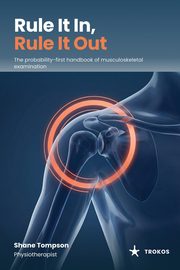
Get the book for the clinical reasoning behind each knee test it covers, and which ones to trust for the ACL, meniscus and kneecap
These pages give the published figures. Rule It In, Rule It Out adds, for the tests in the chapter ‘The knee’: captioned drawings with the exact positions, the Rule-In / Rule-Out bar and evidence dots, a fuller interpretation of each test, and the clinical reasoning on which tests to use and in what order.
Look inside the book: free sample pages
Coming November 2026: 330 pages, paperback and PDF. Launch offer: subscribers get the PDF for A$39 instead of A$49, for the first two weeks after publication. Be first to know at launch
Condition pages: ACL rupture · Baker's (popliteal) cyst · Iliotibial band (ITB) syndrome · Knee effusion · Knee fracture after an acute knee injury (need for X-ray) · Knee osteoarthritis · Lateral patellar instability · LCL sprain (lateral collateral ligament) · MCL sprain (medial collateral ligament) · Medial plica syndrome · Meniscal tear · Patellar tendinopathy (tendon abnormality on ultrasound) · Patellofemoral pain · Posterior cruciate ligament (PCL) tear · Posterolateral corner injury · all, A to Z
One study, one test, once a month
Rule It In is a free evidence letter for musculoskeletal clinicians: one recent study explained, one examination test with its real numbers. From Trokos, publisher of Rule It In, Rule It Out.
Free when you confirm your email: this page as a one-page printable PDF, the same sheet for every other body region, and the one-page sheet of the strongest special tests to rule in and rule out.
Launch offer for subscribers: the PDF edition of Rule It In, Rule It Out for A$39 instead of A$49, for the first two weeks after publication. Sign up free to get the code on launch day.
By subscribing you agree to receive Rule It In by email, about once a month. You will get a confirmation email first, and nothing is sent until you click it. Your address is stored by Kit (Kit.com, United States) and used only for this newsletter and the subscriber launch offer; Kit records which issues are opened and which links are clicked. Unsubscribe with one click in any issue. Privacy.