
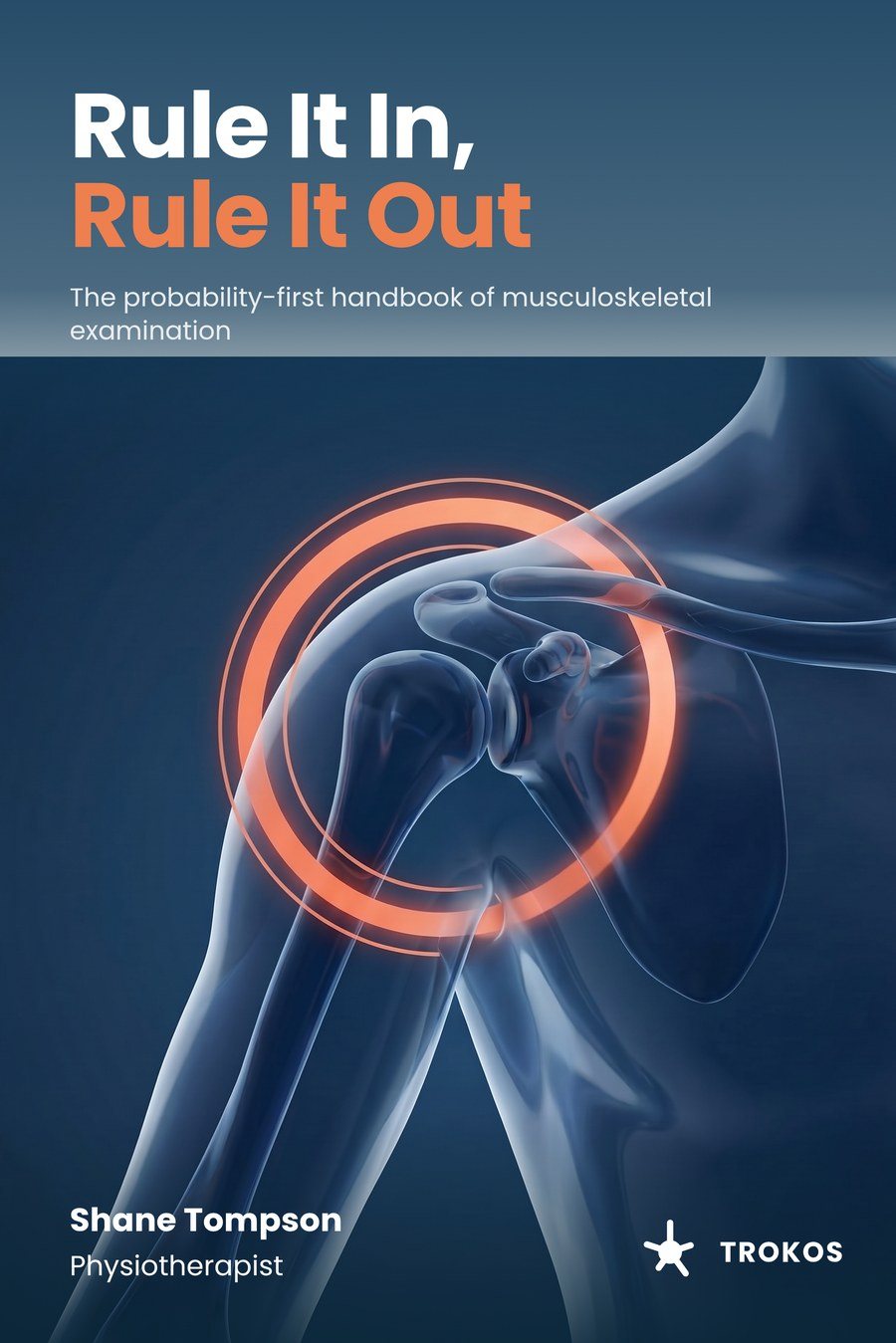
Rule It In, Rule It Out
The probability-first handbook of musculoskeletal examination, by Shane Tompson, physiotherapist.
Coming November 2026 · 330 pages · paperback and PDF
A positive test is only half the story.
Each test card with likelihood ratios has a Rule-In / Rule-Out bar that shows, at a glance, how far a positive or negative result moves the probability of the diagnosis, and every card carries one to three evidence dots for how solid the research behind it is, so you can judge a test in seconds.
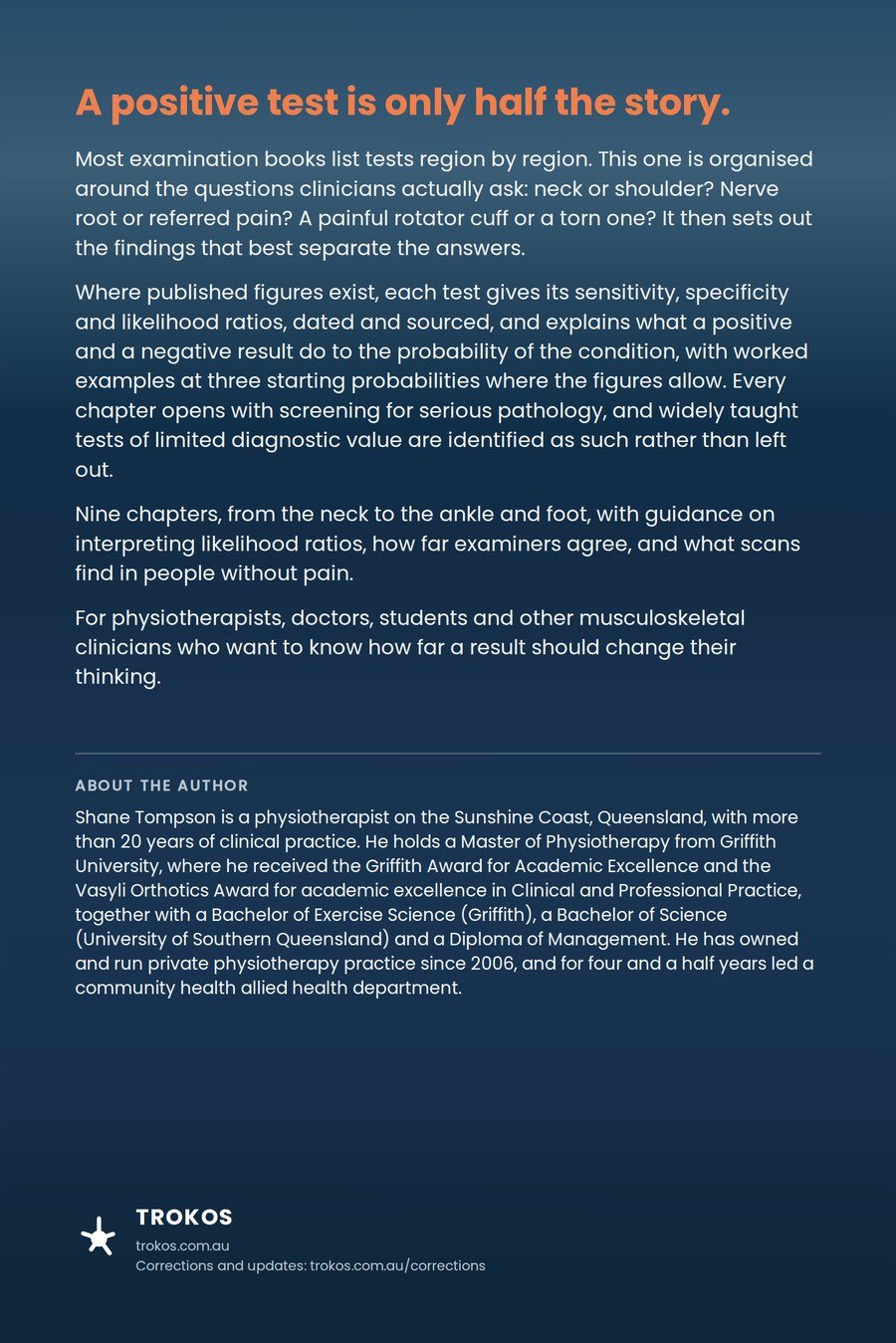
Most examination books list tests region by region. This one is organised around the questions clinicians actually ask: neck or shoulder? Nerve root or referred pain? A painful rotator cuff or a torn one? It then sets out the findings that best separate the answers.
Where published figures exist, each test gives its sensitivity, specificity and likelihood ratios, dated and sourced, and explains what a positive and a negative result do to the probability of the condition, with worked examples at three starting probabilities where the figures allow. Every chapter opens with screening for serious pathology, and widely taught tests of limited diagnostic value are identified as such rather than left out.
Nine chapters, from the neck to the ankle and foot, with guidance on interpreting likelihood ratios, how far examiners agree, and what scans find in people without pain.
For physiotherapists, doctors, students and other musculoskeletal clinicians who want to know how far a result should change their thinking.
About the author
Shane Tompson is a physiotherapist on the Sunshine Coast, Queensland, with more than 20 years of clinical practice. He holds a Master of Physiotherapy from Griffith University, where he received the Griffith Award for Academic Excellence and the Vasyli Orthotics Award for academic excellence in Clinical and Professional Practice, together with a Bachelor of Exercise Science (Griffith), a Bachelor of Science (University of Southern Queensland) and a Diploma of Management. He has owned and run private physiotherapy practice since 2006, and for four and a half years led a community health allied health department.
Look inside
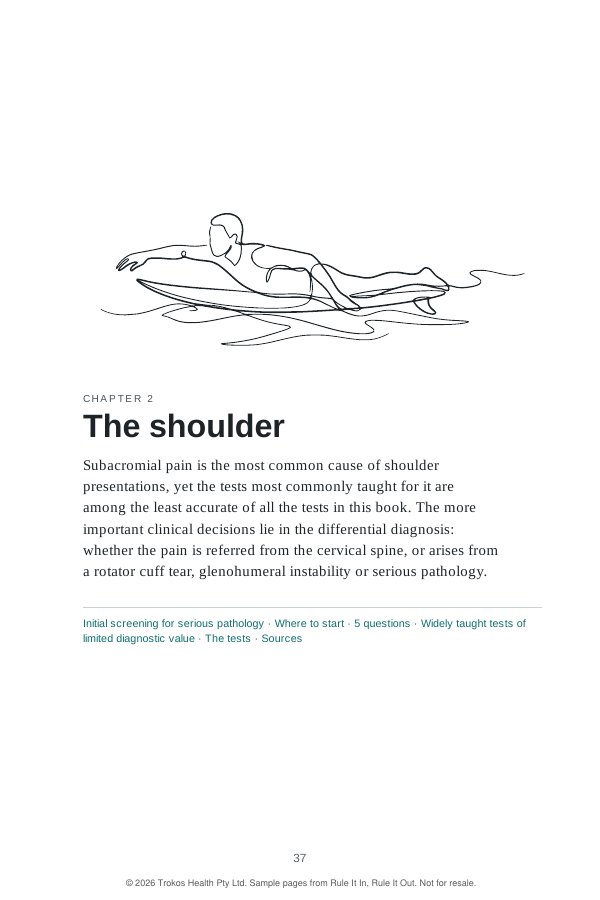
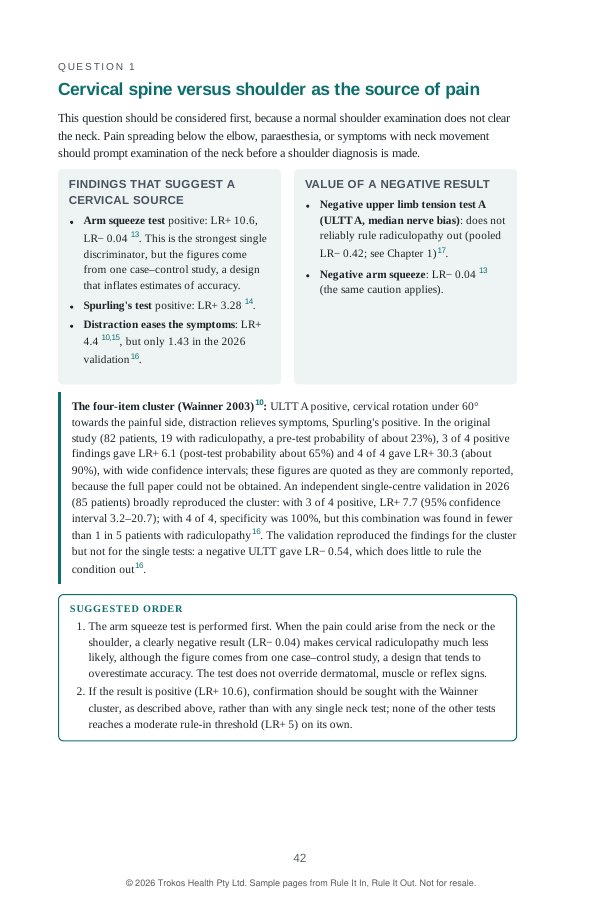
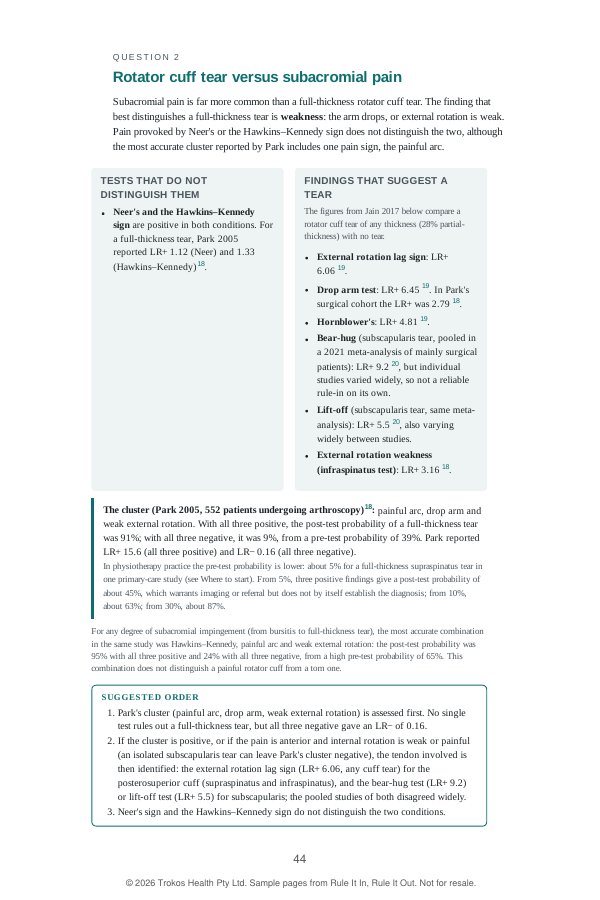
Three of the five free sample pages: the opening of the shoulder chapter, and its first two clinical questions: neck or shoulder, and rotator cuff tear or subacromial pain. The sample also has the contents and the approach of the book.
Get the free sample pages: join the launch list below; the download link appears as soon as you confirm your email.
What the book does
Each chapter starts from the questions a clinician actually faces in the clinic, then shows how much each examination test changes the answer. For every test with published figures you get how to do it, what counts as positive, how far a positive or negative result moves the likelihood of the diagnosis, and, where it has been studied, whether combining tests helps. Widely taught tests of limited diagnostic value are identified as such.
It is written for physiotherapists, exercise physiologists, chiropractors, osteopaths, doctors (including orthopaedic surgeons and sports physicians) and students.
Nine chapters, forty-three clinical questions
Two from each chapter:
- 1. The neck: Cervical radiculopathy or referred pain? · Cervical myelopathy: the clinically informative signs
- 2. The shoulder: Cervical spine or shoulder as the source of pain? · Rotator cuff tear or subacromial pain?
- 3. The elbow: Elbow injury after a fall: when is an X-ray needed? · Distal biceps tendon rupture
- 4. The wrist and hand: Carpal tunnel syndrome: which clinical tests are informative · Scaphoid imaging after a fall on the outstretched hand
- 5. The thoracic spine and chest wall: Chest wall pain or cardiac, pulmonary or aortic pain? · Mechanical mid-back pain or osteoporotic fracture?
- 6. The low back and pelvis: Radicular or somatic referred leg pain? · Cauda equina syndrome and serious pathology: when to refer, and how urgently
- 7. The hip and groin: Hip joint pain or lateral hip pain? · Groin pain in a runner: excluding a stress fracture first
- 8. The knee: Anterior cruciate ligament tear · Meniscal tear
- 9. The ankle and foot: The rolled ankle: lateral ligament sprain or high ankle sprain? · Achilles tendon rupture
The free special tests library already has the published figures for over 130 examination tests.
How it is written
The book is drafted with AI assistance. Every figure is checked against its source wherever the paper can be obtained, in a check separate from the drafting. Before publication, the chapters are being reviewed by two practising physiotherapists. Corrections after publication will be listed and dated on the corrections page.
Be first to know at launch
Leave your email address to get the free sample pages as soon as you confirm your email, and we will tell you when the book is published and how to get it. Launch offer for subscribers: the PDF edition for A$39 instead of A$49, for the first two weeks after publication. Sign up free to get the code on launch day.
You will get a confirmation email first, and nothing else is sent until you click it. Your address is stored by Kit (Kit.com, United States) and used only to tell you about the book; Kit records whether emails are opened and links clicked. This list does not subscribe you to the newsletter. Unsubscribe with one click in any email. Privacy.
Would you also like the free monthly newsletter, Rule It In? Read it and subscribe here.