
Patellar tilt test
For: Patellofemoral pain
Pain around or behind the patella, where it glides on the femur. It is typically worse with squatting, stairs and prolonged sitting.
Treat with caution (see below)Short answer: Treat results with caution when testing for patellofemoral pain: read the notes below before relying on one. In the source cited below, sensitivity was 43% and specificity 92%.
How it is done
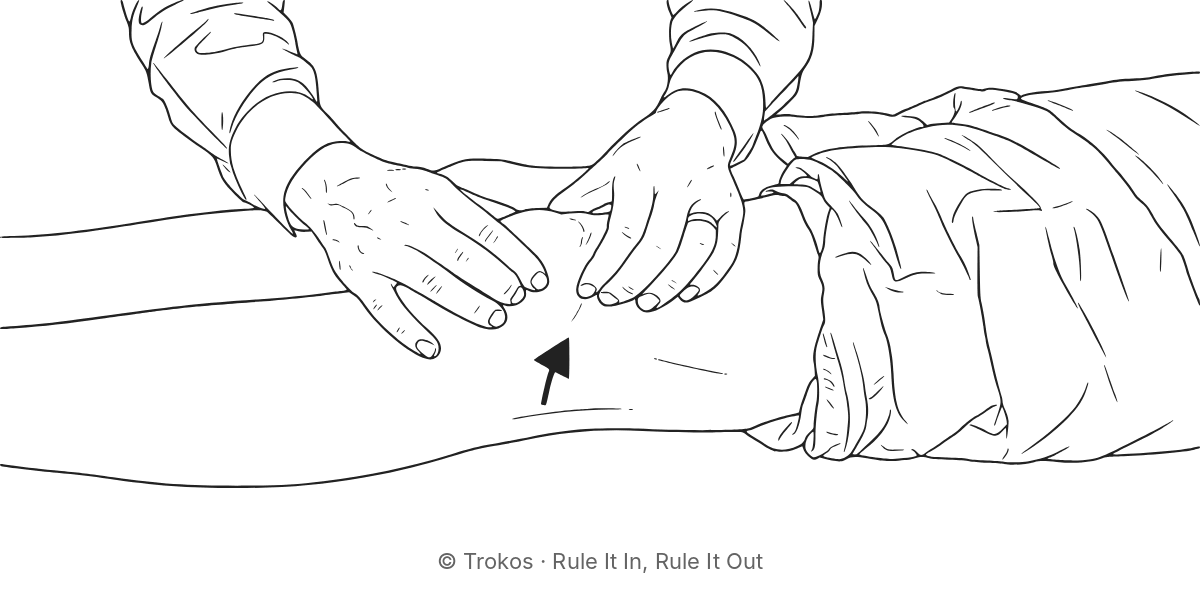
With the knee extended and the quadriceps relaxed, the examiner grips the patella and attempts to lift its lateral edge away from the femur, comparing sides. Positive: The lateral edge cannot be raised to at least horizontal.
What the numbers mean
- Positive result: see the caution above before relying on this result.
- Negative result: barely informative: a negative result changes little.
The ladder: what a result does to your estimate
| If you thought | After a positive | After a negative |
|---|---|---|
| 10% | 38% | 6% |
| 30% | 70% | 20% |
| 50% | 84% | 37% |
Calculated from the likelihood ratios above, as in the book. Read the caution above before relying on these. For any other starting estimate, use the probability calculator.
Work out what a result means for your patient: probability calculator
Sensitivity, specificity and both likelihood ratios as printed in the review (Table 3), all from one study (Haim 2006). Checked against the full paper on 15 October 2026.
Caution: A single small, low-quality study (Haim 2006, 61 patients and 25 controls); the review describes only a trend towards usefulness.
Do two examiners agree?
Slight to fair (kappa 0.20-0.35 across examiner pairs; 55 people, 99 knees, 1 study) (abstract source only). Source: Watson 2001.
Rule It In, Rule It Out gives the full reliability detail: every study, the same examiner versus two examiners, and the patients tested.
Study details: patients, setting, confidence intervals, what was read
| Study | Nunes 2013 (systematic review; the patellar tilt figures come from ONE included study (Haim 2006, a case-control comparison with healthy controls), not from a meta-analysis) |
|---|---|
| Patients | 86 people; 61 infantry soldiers with patellofemoral pain compared with 25 controls described as healthy, in Haim 2006 (the one study the review attributes these figures to); a military population, per the Haim abstract |
| Compared against | not stated in the review; Haim 2006 compared people diagnosed with patellofemoral pain against healthy controls (the review rates it low quality, QUADAS 10/14, spectrum not representative, blinding unclear) |
| 95% confidence intervals | sensitivity 31–55%, specificity 75–98% (as published) |
| Counts | true positives 26, false positives 2, false negatives 35, true negatives 23 |
| Likelihood ratios | published (LR+ 5.4 / LR− 0.6 as printed in the review for Haim 2006) |
| What we read | Full paper (Phys Ther Sport 2013;14:54–59), Table 3 row Haim et al. 2006 'Patellar tilt': sens 43% (31–55), spec 92% (75–98), LR+ 5.4 (1.4–20.8), LR− 0.6 (0.5–0.8); the only meta-analysis in the paper is of the patellar apprehension test (Haim + Nijs) |
| Things to bear in mind | The LR+ 5.4 is a single-study result (Haim 2006: 61 people with patellofemoral pain versus 25 healthy controls), which the review itself rates low quality and says to treat with caution because the controls were healthy people. Comparing patients with healthy people inflates specificity, and the review notes its five studies used different test methods, so this is thin evidence rather than a pooled estimate. |
How these details are gathered and checked: Methods.
Source
Nunes GS, Stapait EL, Kirsten MH, de Noronha M, Santos GM. Clinical test for diagnosis of patellofemoral pain syndrome: Systematic review with meta-analysis. Phys Ther Sport. 2013;14(1):54–59. PubMed · Single study (2006), in a 2013 review
The study behind the figures: Haim A, Yaniv M, Dekel S, Amir H. Patellofemoral pain syndrome: validity of clinical and radiological features. Clin Orthop Relat Res. 2006;451:223–228. Journal article (DOI) · PubMed
Figures as they will appear in Rule It In, Rule It Out (Trokos, forthcoming). If a newer or better study changes them, this page changes with the book. Figures last updated from the book on 13 October 2026.
How to cite
Citing a figure? Cite the study it comes from. The main figures on this page come from:
Nunes GS, Stapait EL, Kirsten MH, de Noronha M, Santos GM. Clinical test for diagnosis of patellofemoral pain syndrome: Systematic review with meta-analysis. Phys Ther Sport. 2013;14(1):54–59.
Citing this page as a summary:
APA 7: Tompson, S. (2026, October 13). Patellar tilt test for patellofemoral pain. Trokos special tests library. Retrieved October 28, 2026, from https://trokos.com.au/tests/knee-patellartilt.html
Vancouver: Tompson S. Patellar tilt test for patellofemoral pain [Internet]. Sunshine Coast (QLD): Trokos; 2026 [updated 2026 Oct 13; cited 2026 Oct 28]. Available from: https://trokos.com.au/tests/knee-patellartilt.html
Citing the whole library:
APA 7: Tompson, S. (2026). Trokos special tests library (Version November 2026) [Online reference library]. Zenodo. https://doi.org/10.5281/zenodo.23932041
Vancouver: Tompson S. Trokos special tests library [Internet]. Version November 2026. Geneva: Zenodo; 2026 [cited 2026 Nov 4]. Available from: https://doi.org/10.5281/zenodo.23932041
Get the book for the clinical reasoning behind each knee test it covers, and which ones to trust for the ACL, meniscus and kneecap
This page gives the published figures. Rule It In, Rule It Out adds captioned drawings with the exact positions, the Rule-In / Rule-Out bar and evidence dots, a fuller interpretation of each test, and the clinical reasoning on which tests to use and in what order.
Look inside the book: free sample pages
Coming November 2026: 330 pages, paperback and PDF. Launch offer: subscribers get the PDF for A$39 instead of A$49, for the first two weeks after publication. Be first to know at launch
One study, one test, once a month
Rule It In is a free evidence letter for musculoskeletal clinicians: one recent study explained, one examination test with its real numbers. From Trokos, publisher of Rule It In, Rule It Out.
Free when you confirm your email: a one-page PDF of the strongest special tests to rule in and rule out, with tests that carry a caution flagged separately.
Launch offer for subscribers: the PDF edition of Rule It In, Rule It Out for A$39 instead of A$49, for the first two weeks after publication. Sign up free to get the code on launch day.
By subscribing you agree to receive Rule It In by email, about once a month. You will get a confirmation email first, and nothing is sent until you click it. Your address is stored by Kit (Kit.com, United States) and used only for this newsletter and the subscriber launch offer; Kit records which issues are opened and which links are clicked. Unsubscribe with one click in any issue. Privacy.