
Valgus stress test — 30° flexion
Also called: MCL stress test, abduction stress test
For: MCL sprain
An injury to the medial collateral ligament on the inside of the knee, usually from a force pushing the knee inwards.
A weak test on its ownShort answer: On the published figures, a weak test on its own for MCL sprain. In the source cited below, sensitivity was 78% and specificity 67%.
How it is done
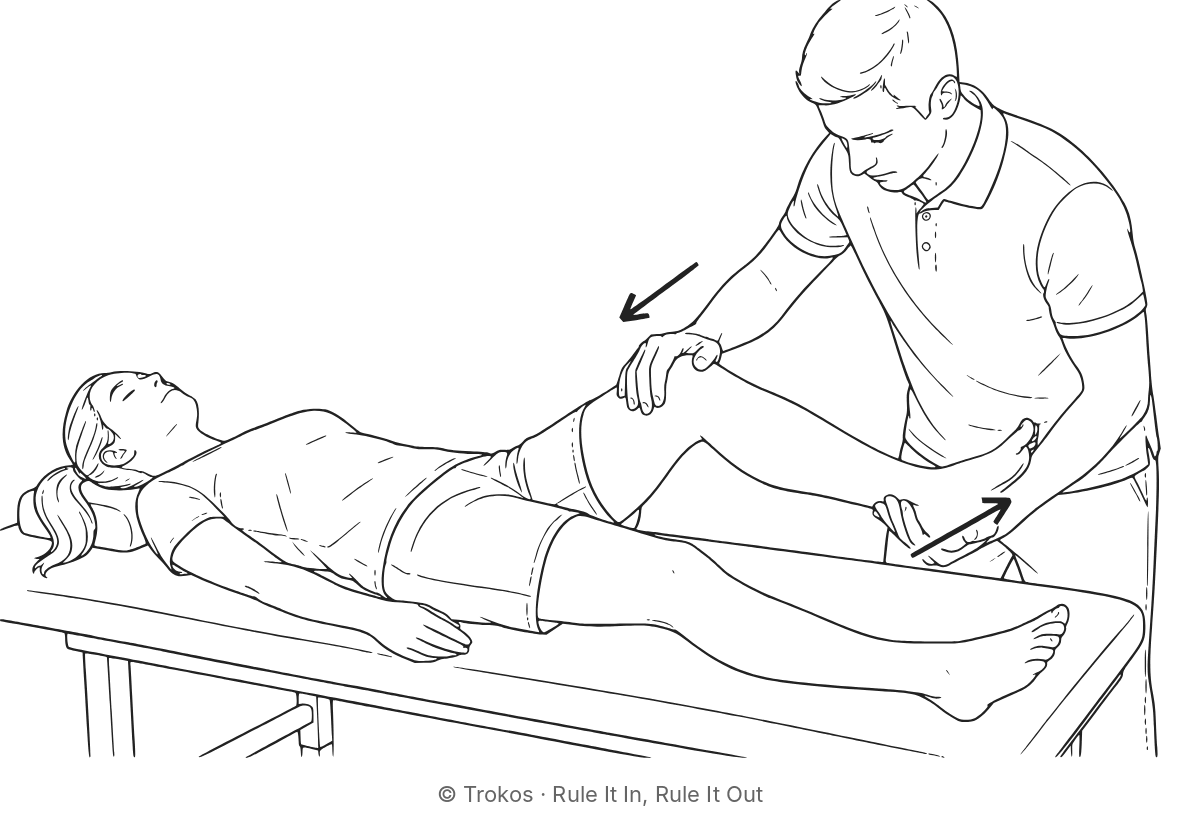
The patient lies supine with the knee flexed to about 30° over the examiner's forearm or the edge of the plinth. The examiner applies a valgus force at the knee with counter-pressure at the ankle. Positive: Medial pain (the criterion the study used for these figures). Any additional opening compared with the other side is recorded separately.
What the numbers mean
- Positive result: a small shift: a positive result nudges the diagnosis up, but does not settle it.
- Negative result: a small shift: a negative result nudges the diagnosis down, but does not exclude it.
The ladder: what a result does to your estimate
| If you thought | After a positive | After a negative |
|---|---|---|
| 10% | 20% | 3% |
| 30% | 50% | 11% |
| 50% | 70% | 23% |
Calculated from the likelihood ratios above, as in the book. For any other starting estimate, use the probability calculator.
Studied combinations: this test as part of a published cluster
The valgus stress test at 30° has been studied in a combination for medial collateral ligament (MCL) lesions in general practice (Kastelein 2008): history findings (trauma by an external force to the leg, rotational trauma) plus pain and laxity on valgus stress at 30°. In 134 patients aged 18–65 seen within 5 weeks of a knee injury (reference standard: MRI; 35 had an MCL lesion), adding pain and laxity on the test to the history gave an LR+ of 6.4 (95% CI 2.7–15.2, as printed in the first author's doctoral thesis, which reproduces the paper's table). The items were selected from the same patients' data, and no independent validation study was found. These figures come from the tests as performed and scored in that study.
Sources: Kastelein M et al. Am J Med 2008;121:982–8.
Rule It In, Rule It Out covers how this cluster fits into the examination.
Work out what a result means for your patient: probability calculator
Figures checked against Kastelein 2008, Table 5, as reproduced in the first author's doctoral thesis: pain on valgus stress at 30°, 134 patients, 35 with an MCL lesion on MRI. Likelihood ratios as published (95% CI: LR+ 1.7–3.3, LR− 0.2–0.6); the rounded sensitivity and specificity (78% and 67%) give LR− 0.33.
Do two examiners agree?
Slight to fair (weighted kappa 0.16 for the amount of opening; kappa 0.33 for pain and 0.38 for end-feel, at 30 degrees; 50 patients, 1 study) (abstract source only). Source: McClure 1989.
Rule It In, Rule It Out gives the full reliability detail: every study, the same examiner versus two examiners, and the patients tested.
Study details: patients, setting, confidence intervals, what was read
| Study | Kastelein 2008 (prospective cohort) |
|---|---|
| Patients | 134 patients; general practice (GP) patients aged 18–65 seen within 5 weeks of a knee injury, Netherlands; 35 had an MCL lesion on MRI; the test was available in 128 |
| Compared against | MRI |
| 95% confidence intervals | sensitivity 64–92%, specificity 57–76% (as published) |
| Counts | true positives 25, false positives 32, false negatives 7, true negatives 64 |
| Likelihood ratios | as published by the study |
| What we read | Full thesis; Kastelein doctoral thesis, Erasmus University (repub.eur.nl/pub/39212, chapter 2 = Am J Med 2008 paper), Tables 3 and 5: pain on valgus stress 30°, Se 0.78 (0.64–0.92), Sp 0.67 (0.57–0.76), LR+ 2.3 (1.7–3.3), LR− 0.3 (0.2–0.6); journal PDF paywalled |
| Things to bear in mind | Smallish study (134 patients, 35 with an MCL lesion) but in real GP patients with blinded physiotherapist examiners and MRI for everyone, so it is more trustworthy for everyday clinic use than surgical studies. Counts come from the 128 patients who had the test recorded. |
How these details are gathered and checked: Methods.
Source
Kastelein M, Wagemakers HP, Luijsterburg PA, Verhaar JA, Koes BW, Bierma-Zeinstra SM. Assessing medial collateral ligament knee lesions in general practice. Am J Med. 2008;121(11):982–988.e2. Journal article (DOI) · single study
Figures as they will appear in Rule It In, Rule It Out (Trokos, forthcoming). If a newer or better study changes them, this page changes with the book. Figures last updated from the book on 11 November 2026.
How to cite
Citing a figure? Cite the study it comes from. The main figures on this page come from:
Kastelein M, Wagemakers HP, Luijsterburg PA, Verhaar JA, Koes BW, Bierma-Zeinstra SM. Assessing medial collateral ligament knee lesions in general practice. Am J Med. 2008;121(11):982–988.e2.
Citing this page as a summary:
APA 7: Tompson, S. (2026, October 13). Valgus stress test — 30° flexion for MCL sprain. Trokos special tests library. Retrieved October 28, 2026, from https://trokos.com.au/tests/knee-valgus30.html
Vancouver: Tompson S. Valgus stress test — 30° flexion for MCL sprain [Internet]. Sunshine Coast (QLD): Trokos; 2026 [updated 2026 Nov 11; cited 2026 Oct 28]. Available from: https://trokos.com.au/tests/knee-valgus30.html
Citing the whole library:
APA 7: Tompson, S. (2026). Trokos special tests library (Version November 2026) [Online reference library]. Zenodo. https://doi.org/10.5281/zenodo.23932041
Vancouver: Tompson S. Trokos special tests library [Internet]. Version November 2026. Geneva: Zenodo; 2026 [cited 2026 Nov 4]. Available from: https://doi.org/10.5281/zenodo.23932041

Get the book for the clinical reasoning behind each knee test it covers, and which ones to trust for the ACL, meniscus and kneecap
This page gives the published figures. Rule It In, Rule It Out adds captioned drawings with the exact positions, the Rule-In / Rule-Out bar and evidence dots, a fuller interpretation of each test, and the clinical reasoning on which tests to use and in what order.
Look inside the book: free sample pages
Coming November 2026: 330 pages, paperback and PDF. Launch offer: subscribers get the PDF for A$39 instead of A$49, for the first two weeks after publication. Be first to know at launch
One study, one test, once a month
Rule It In is a free evidence letter for musculoskeletal clinicians: one recent study explained, one examination test with its real numbers. From Trokos, publisher of Rule It In, Rule It Out.
Free when you confirm your email: a one-page PDF of the strongest special tests to rule in and rule out, with tests that carry a caution flagged separately.
Launch offer for subscribers: the PDF edition of Rule It In, Rule It Out for A$39 instead of A$49, for the first two weeks after publication. Sign up free to get the code on launch day.
By subscribing you agree to receive Rule It In by email, about once a month. You will get a confirmation email first, and nothing is sent until you click it. Your address is stored by Kit (Kit.com, United States) and used only for this newsletter and the subscriber launch offer; Kit records which issues are opened and which links are clicked. Unsubscribe with one click in any issue. Privacy.