
Elbow & forearm special tests cheat sheet
17 elbow & forearm examination tests, grouped by the condition they test for, each with the published accuracy figures that exist for it. Click a test for what a positive and a negative result mean, and the source.
Before any test: Elbow & forearm red flags: the serious conditions you cannot afford to miss
Free printable version: this page as a one-page PDF, with the caution notes and sources. Sign up free to download it.
Any elbow fracture after injury
| Test | Sensitivity | Specificity | LR+ | LR− | Verdict |
|---|---|---|---|---|---|
| Elbow extension test | 96.8% | 48.5% | 1.88 | 0.06 | Best used to rule out ?Full extension does not exclude an olecranon fracture: in adults who could fully extend, both fractures that needed an operation were olecranon fractures; in children the LR− was 0.11 against 0.03 in adults, a moderate rather than strong rule-out; patients who are not X-rayed should return if symptoms have not settled within 7–10 days. |
Verdicts: rule in when LR+ is 5 or more; rule out when LR− is below 0.2; both when both; weak when neither; treat with caution where the study behind the figures is weak enough that the verdict may not hold. A caution can appear with any verdict — tap ? to read it.
Complete distal biceps tendon rupture
| Test | Sensitivity | Specificity | LR+ | LR− | Verdict |
|---|---|---|---|---|---|
| Biceps crease interval (BCI) | 81% | 90.9% | 8.9 | 0.21 | Best used to rule in |
| Hook test | 71.4% | 95.5% | 15.71 | 0.3 | Best used to rule in |
Verdicts: rule in when LR+ is 5 or more; rule out when LR− is below 0.2; both when both; weak when neither; treat with caution where the study behind the figures is weak enough that the verdict may not hold. A caution can appear with any verdict — tap ? to read it.
Cubital tunnel syndrome
| Test | Sensitivity | Specificity | LR+ | LR− | Verdict |
|---|---|---|---|---|---|
| Elbow flexion–compression test | 61% | 40% | 1 | 0.99 | A weak test on its own |
| Scratch collapse test | 60.5% | 97.8% | 27.4 | 0.40 | Treat with caution ?Most of the data come from the developers' own clinic, including a study that compared patients with a control group; one independent study is counted four times in the pooled figures; and the only blinded independent study found sensitivity 10% and specificity 90%, so a result told the examiner almost nothing (Montgomery 2020, abstract source only). |
| Tinel's sign (at the elbow) | 62% | 53% | 1.3 | 0.72 | A weak test on its own |
Verdicts: rule in when LR+ is 5 or more; rule out when LR− is below 0.2; both when both; weak when neither; treat with caution where the study behind the figures is weak enough that the verdict may not hold. A caution can appear with any verdict — tap ? to read it.
Lateral elbow tendinopathy
Compare these tests side by side
| Test | Sensitivity | Specificity | LR+ | LR− | Verdict |
|---|---|---|---|---|---|
| Cozen's test | 85% | 0% (only 4 people without the condition; see test page) | not shown (see test page) | not shown (see test page) | Not enough published figures to judge |
| Grip strength difference ≥10% (elbow extended vs flexed) | 78% | 90% | 7.8 | 0.24 | Treat with caution ?Single retrospective study; specificity was not measured in people with other causes of lateral elbow pain, which can inflate accuracy. |
| Maudsley's test | 88% | 0% (only 4 people without the condition; see test page) | not shown (see test page) | not shown (see test page) | Not enough published figures to judge |
| Mills' test | 54% | 100% (only 4 people without the condition; see test page) | not calculable (specificity 100%) | 0.46 | Treat with caution ?Specificity rests on only 4 people without the condition; the true figure could be much lower. |
Verdicts: rule in when LR+ is 5 or more; rule out when LR− is below 0.2; both when both; weak when neither; treat with caution where the study behind the figures is weak enough that the verdict may not hold. A caution can appear with any verdict — tap ? to read it.
Posterolateral rotatory instability
| Test | Sensitivity | Specificity | LR+ | LR− | Verdict |
|---|---|---|---|---|---|
| Chair sign (chair push-up test) | 88% | not calculable (no patients without the condition) | not calculable | not calculable | Not enough published figures to judge |
| Lateral pivot shift (apprehension) test | 38% | not calculable (no patients without the condition) | not calculable | not calculable | Not enough published figures to judge |
Verdicts: rule in when LR+ is 5 or more; rule out when LR− is below 0.2; both when both; weak when neither; treat with caution where the study behind the figures is weak enough that the verdict may not hold. A caution can appear with any verdict — tap ? to read it.
UCL injury
| Test | Sensitivity | Specificity | LR+ | LR− | Verdict |
|---|---|---|---|---|---|
| Milking manoeuvre | 77% | 85% | 5.1 | 0.28 | Treat with caution ?LR+ 5.1 sits right on the threshold for a moderate rule-in, and it comes from one study in which every patient went on to surgery, so the figures may not apply to a general sports caseload. |
| Moving valgus stress test | 98% | 75% | 3.94 | 0.02 | Best used to rule out ?One study in which every patient went on to surgery, so the figures may not apply to a general sports caseload. |
Verdicts: rule in when LR+ is 5 or more; rule out when LR− is below 0.2; both when both; weak when neither; treat with caution where the study behind the figures is weak enough that the verdict may not hold. A caution can appear with any verdict — tap ? to read it.
Commonly taught, no reliable figures yet
These tests are widely taught, but no reliable accuracy figures have been published for them, so they have no verdict and are left out of the calculator and the strongest-tests list. Each page shows how the test is done and what the research says.
- Froment's sign (Cubital tunnel syndrome): No study comparing it against a reference standard in a group that included people without the condition could be found.
- Golfer's elbow test (Medial elbow tendinopathy (golfer's elbow)): No study of its diagnostic accuracy could be found: a 2018 systematic review of elbow examination found none for medial epicondylitis, and later searches found only imaging studies.
- Valgus stress test (elbow, static) (UCL injury): The only figures found come from one surgical study in which only 4 patients did not have the injury, and they could be read only as reported in other papers; the one larger study that included this test does not give its figures in its published abstract, and they have not been checked in the full paper.
LR+ says how much a positive result moves the probability up; LR− how much a negative moves it down. Tests for the same problem are rarely independent, so their figures should not be multiplied together. To turn a figure into a probability for your patient, use the probability calculator.
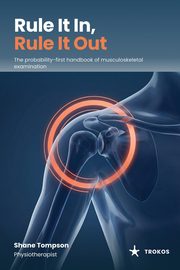
Get the book for deciding which elbows need an X-ray after a fall, and whether the distal biceps is torn
These pages give the published figures. Rule It In, Rule It Out adds, for the tests in the chapter ‘The elbow’: captioned drawings with the exact positions, the Rule-In / Rule-Out bar and evidence dots, a fuller interpretation of each test, and the clinical reasoning on which tests to use and in what order.
Look inside the book: free sample pages
Coming November 2026: 330 pages, paperback and PDF. Launch offer: subscribers get the PDF for A$39 instead of A$49, for the first two weeks after publication. Be first to know at launch
Condition pages: Any elbow fracture after injury · Complete distal biceps tendon rupture · Cubital tunnel syndrome · Elbow UCL injury (ulnar collateral ligament) · Lateral elbow tendinopathy · Medial elbow tendinopathy (golfer's elbow) · all, A to Z
One study, one test, once a month
Rule It In is a free evidence letter for musculoskeletal clinicians: one recent study explained, one examination test with its real numbers. From Trokos, publisher of Rule It In, Rule It Out.
Free when you confirm your email: this page as a one-page printable PDF, the same sheet for every other body region, and the one-page sheet of the strongest special tests to rule in and rule out.
Launch offer for subscribers: the PDF edition of Rule It In, Rule It Out for A$39 instead of A$49, for the first two weeks after publication. Sign up free to get the code on launch day.
By subscribing you agree to receive Rule It In by email, about once a month. You will get a confirmation email first, and nothing is sent until you click it. Your address is stored by Kit (Kit.com, United States) and used only for this newsletter and the subscriber launch offer; Kit records which issues are opened and which links are clicked. Unsubscribe with one click in any issue. Privacy.