
Special tests library › Elbow & forearm
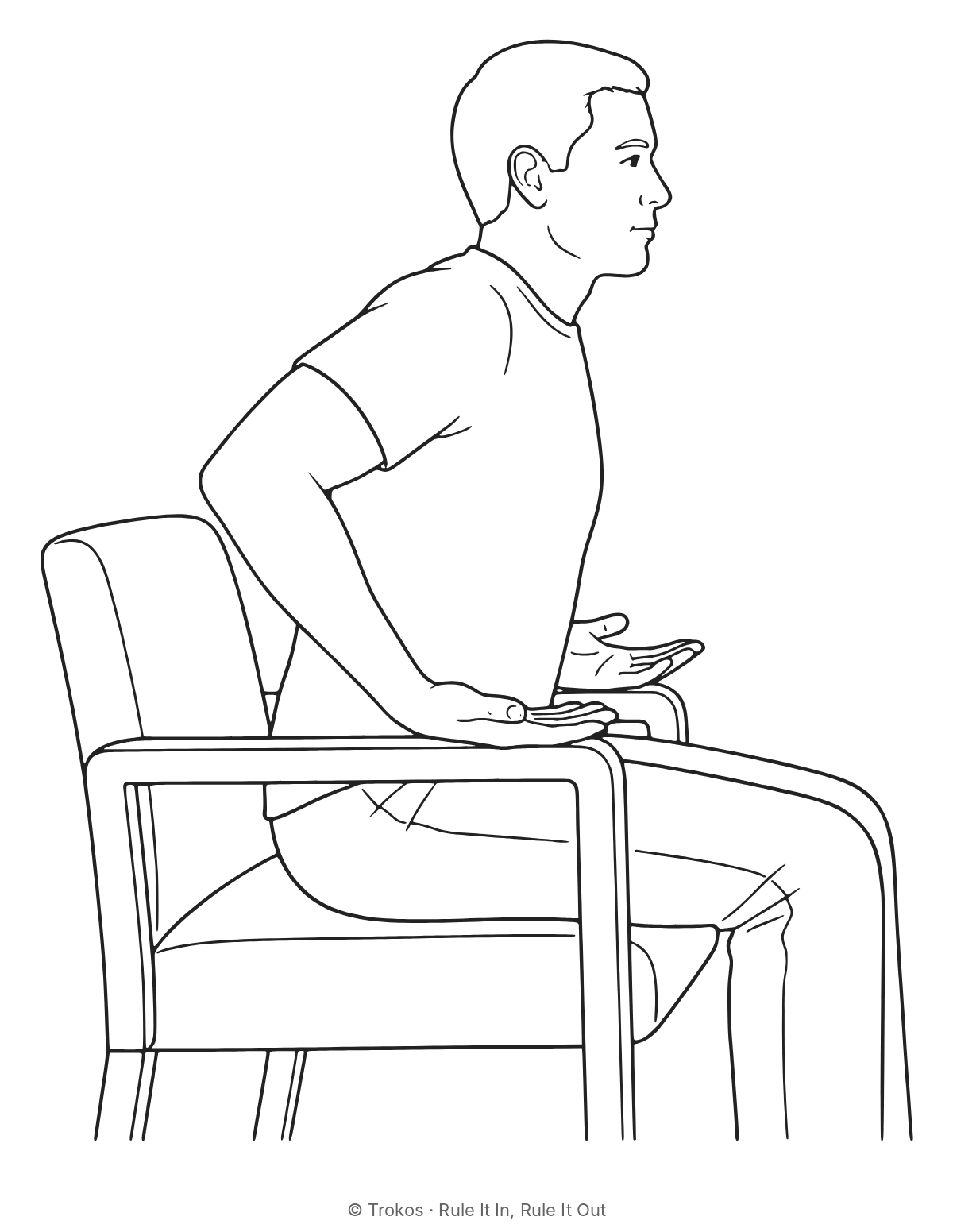
Chair sign (chair push-up test)
Also called: chair push-up sign
For: Posterolateral rotatory instability
Laxity of the ligaments on the outside of the elbow that allows the forearm bones to rotate and partly subluxate, usually after a dislocation or injury.
Not enough published figures to judgeShort answer: Not enough published figures to judge this test for posterolateral rotatory instability. The source cited below gives a sensitivity of 88% only.
How it is done
The patient pushes up from a chair using the armrests, with the forearms fully supinated and the elbows initially flexed. Positive: Apprehension, reluctance or the feeling of instability, often with the palms turning inward to avoid it.
What the numbers mean
- Too few published figures to say how much a result changes the picture.
Only 8 patients, all with the condition, so no specificity. Checked against the full paper (Table I): positive in 7 of 8; with the push-up sign added, all 8 were positive on at least one sign.
Study details: patients, setting, confidence intervals, what was read
| Study | Regan 2006 (prospective case series (no controls)) |
|---|---|
| Patients | 8 patients; eight patients with posterolateral rotatory instability already booked for ligament reconstruction surgery |
| Compared against | surgical findings (all had the condition) |
| 95% confidence intervals | sensitivity 53–98% (calculated from the study’s counts) |
| What we read | Full paper (Regan 2006), Table I, read for the book’s accuracy review on 24 October 2026 |
| Things to bear in mind | Only 8 patients, all of whom were known to have the condition and were already booked for surgery, so specificity cannot be calculated and the sensitivity figure is very imprecise. |
How these details are gathered and checked: Methods.
Other tests in the library for posterolateral rotatory instability
Red flags to screen for before testing the elbow & forearm
Source
Regan W, Lapner PC. Prospective evaluation of two diagnostic apprehension signs for posterolateral instability of the elbow. J Shoulder Elbow Surg. 2006;15(3):344–346. PubMed · single study
Figures as they will appear in Rule It In, Rule It Out (Trokos, forthcoming). If a newer or better study changes them, this page changes with the book. Figures last updated from the book on 13 October 2026.
How to cite
Citing a figure? Cite the study it comes from. The main figures on this page come from:
Regan W, Lapner PC. Prospective evaluation of two diagnostic apprehension signs for posterolateral instability of the elbow. J Shoulder Elbow Surg. 2006;15(3):344–346.
Citing this page as a summary:
APA 7: Tompson, S. (2026, October 13). Chair sign (chair push-up test) for posterolateral rotatory instability. Trokos special tests library. Retrieved October 28, 2026, from https://trokos.com.au/tests/elbow-chairsign.html
Vancouver: Tompson S. Chair sign (chair push-up test) for posterolateral rotatory instability [Internet]. Sunshine Coast (QLD): Trokos; 2026 [updated 2026 Oct 13; cited 2026 Oct 28]. Available from: https://trokos.com.au/tests/elbow-chairsign.html
Citing the whole library:
APA 7: Tompson, S. (2026). Trokos special tests library (Version November 2026) [Online reference library]. Zenodo. https://doi.org/10.5281/zenodo.23932041
Vancouver: Tompson S. Trokos special tests library [Internet]. Version November 2026. Geneva: Zenodo; 2026 [cited 2026 Nov 4]. Available from: https://doi.org/10.5281/zenodo.23932041

Get the book for deciding which elbows need an X-ray after a fall, and whether the distal biceps is torn
This page gives the published figures. Rule It In, Rule It Out adds captioned drawings with the exact positions, evidence dots, a fuller interpretation of each test, and the clinical reasoning on which tests to use and in what order.
Look inside the book: free sample pages
Coming November 2026: 330 pages, paperback and PDF. Launch offer: subscribers get the PDF for A$39 instead of A$49, for the first two weeks after publication. Be first to know at launch
One study, one test, once a month
Rule It In is a free evidence letter for musculoskeletal clinicians: one recent study explained, one examination test with its real numbers. From Trokos, publisher of Rule It In, Rule It Out.
Free when you confirm your email: a one-page PDF of the strongest special tests to rule in and rule out, with tests that carry a caution flagged separately.
Launch offer for subscribers: the PDF edition of Rule It In, Rule It Out for A$39 instead of A$49, for the first two weeks after publication. Sign up free to get the code on launch day.
By subscribing you agree to receive Rule It In by email, about once a month. You will get a confirmation email first, and nothing is sent until you click it. Your address is stored by Kit (Kit.com, United States) and used only for this newsletter and the subscriber launch offer; Kit records which issues are opened and which links are clicked. Unsubscribe with one click in any issue. Privacy.