
Special tests library › Elbow & forearm
Elbow extension test
For: Any elbow fracture after injury
A fracture of any of the bones at the elbow after a fall or injury.
Best used to rule outShort answer: Best used to rule out any elbow fracture after injury. In the source cited below, sensitivity was 96.8% and specificity 48.5%. See the notes below before relying on it.
How it is done
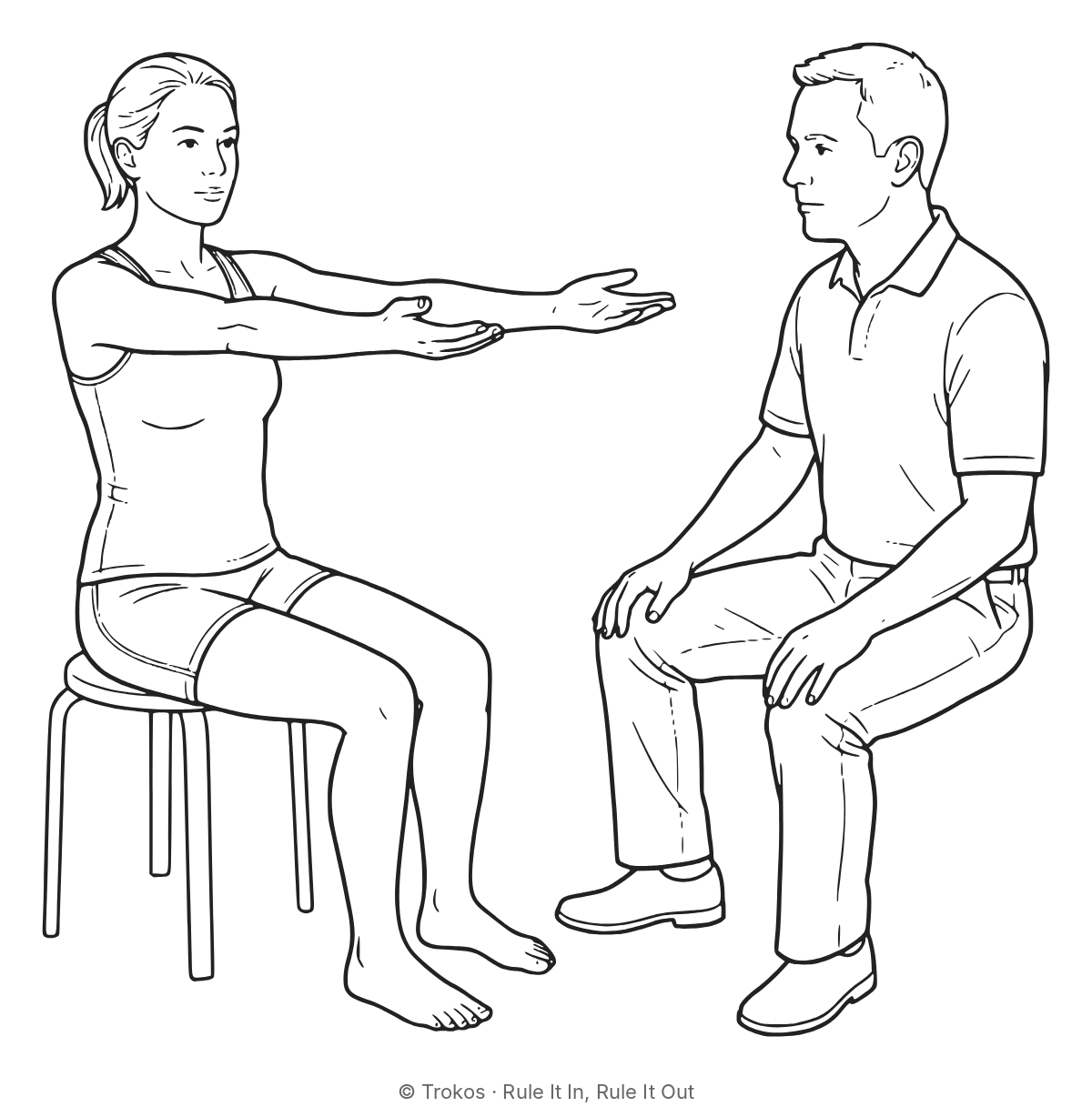
The patient sits with both arms bare, holds both arms out in front at shoulder height with the palms up, and straightens and locks both elbows fully; the two sides are compared by eye. Positive: Inability to extend the injured elbow fully.
What the numbers mean
- Positive result: barely informative: a positive result changes little.
- Negative result: a strong rule-out: a negative result makes the diagnosis very unlikely.
The ladder: what a result does to your estimate
| If you thought | After a positive | After a negative |
|---|---|---|
| 10% | 17% | under 1% |
| 30% | 45% | 3% |
| 50% | 65% | 6% |
Calculated from the likelihood ratios above, as in the book. Read the caution above before relying on these. For any other starting estimate, use the probability calculator.
Work out what a result means for your patient: probability calculator
Likelihood ratios as published (Table 3, adults and children combined); LR− was 0.03 in adults and 0.11 in children. Checked against the full paper.
Caution: Full extension does not exclude an olecranon fracture: in adults who could fully extend, both fractures that needed an operation were olecranon fractures; in children the LR− was 0.11 against 0.03 in adults, a moderate rather than strong rule-out; patients who are not X-rayed should return if symptoms have not settled within 7–10 days.
Study details: patients, setting, confidence intervals, what was read
| Study | Appelboam 2008 (multicentre prospective validation study) |
|---|---|
| Patients | 1,740 patients; adults and children with an acute elbow injury attending five emergency departments in south-west England |
| Compared against | X-ray report (radiologist blinded to the test) or orthopaedic clinic diagnosis; patients not X-rayed were followed up by telephone at 7–10 days |
| 95% confidence intervals | sensitivity 95–98%, specificity 46–51% (as published) |
| Counts | true positives 521, false positives 617, false negatives 17, true negatives 581 |
| Likelihood ratios | as published by the study |
| What we read | Full paper; PMC2600962 full text (Europe PMC), Table 2 (adults 311/336/5/306 and children 210/281/12/275, fracture outcome) and Table 3 published 95% CI 95.0–98.2 and 45.6–51.4; a reference standard was available for 1736 of 1740 |
| Things to bear in mind | Large study in real emergency departments, so the figures should hold up in practice. Not everyone had an X-ray: those who could straighten the elbow were checked by phone a week later, so a few small fractures could have been missed, which would make the test look slightly better than it is. |
How these details are gathered and checked: Methods.
Source
Appelboam A, Reuben AD, Benger JR, et al. Elbow extension test to rule out elbow fracture: multicentre, prospective validation and observational study of diagnostic accuracy in adults and children. BMJ. 2008;337:a2428. Journal article (DOI) · single study
Figures as they will appear in Rule It In, Rule It Out (Trokos, forthcoming). If a newer or better study changes them, this page changes with the book. Figures last updated from the book on 13 October 2026.
How to cite
Citing a figure? Cite the study it comes from. The main figures on this page come from:
Appelboam A, Reuben AD, Benger JR, et al. Elbow extension test to rule out elbow fracture: multicentre, prospective validation and observational study of diagnostic accuracy in adults and children. BMJ. 2008;337:a2428.
Citing this page as a summary:
APA 7: Tompson, S. (2026, October 13). Elbow extension test for any elbow fracture after injury. Trokos special tests library. Retrieved October 28, 2026, from https://trokos.com.au/tests/elbow-elbowextensiontest.html
Vancouver: Tompson S. Elbow extension test for any elbow fracture after injury [Internet]. Sunshine Coast (QLD): Trokos; 2026 [updated 2026 Nov 11; cited 2026 Oct 28]. Available from: https://trokos.com.au/tests/elbow-elbowextensiontest.html
Citing the whole library:
APA 7: Tompson, S. (2026). Trokos special tests library (Version November 2026) [Online reference library]. Zenodo. https://doi.org/10.5281/zenodo.23932041
Vancouver: Tompson S. Trokos special tests library [Internet]. Version November 2026. Geneva: Zenodo; 2026 [cited 2026 Nov 4]. Available from: https://doi.org/10.5281/zenodo.23932041
Get the book for deciding which elbows need an X-ray after a fall, and whether the distal biceps is torn
This page gives the published figures. Rule It In, Rule It Out adds captioned drawings with the exact positions, the Rule-In / Rule-Out bar and evidence dots, a fuller interpretation of each test, and the clinical reasoning on which tests to use and in what order.
Look inside the book: free sample pages
Coming November 2026: 330 pages, paperback and PDF. Launch offer: subscribers get the PDF for A$39 instead of A$49, for the first two weeks after publication. Be first to know at launch
One study, one test, once a month
Rule It In is a free evidence letter for musculoskeletal clinicians: one recent study explained, one examination test with its real numbers. From Trokos, publisher of Rule It In, Rule It Out.
Free when you confirm your email: a one-page PDF of the strongest special tests to rule in and rule out, with tests that carry a caution flagged separately.
Launch offer for subscribers: the PDF edition of Rule It In, Rule It Out for A$39 instead of A$49, for the first two weeks after publication. Sign up free to get the code on launch day.
By subscribing you agree to receive Rule It In by email, about once a month. You will get a confirmation email first, and nothing is sent until you click it. Your address is stored by Kit (Kit.com, United States) and used only for this newsletter and the subscriber launch offer; Kit records which issues are opened and which links are clicked. Unsubscribe with one click in any issue. Privacy.