
Special tests library › Elbow & forearm
Tinel's sign (at the elbow)
Also called: Tinel's test at the elbow, Tinel sign
For: Cubital tunnel syndrome
Compression of the ulnar nerve as it passes behind the inside of the elbow (the 'funny bone'). It causes tingling or numbness in the ring and little fingers.
A weak test on its ownShort answer: On the published figures, a weak test on its own for cubital tunnel syndrome. In the source cited below, sensitivity was 62% and specificity 53%.
How it is done
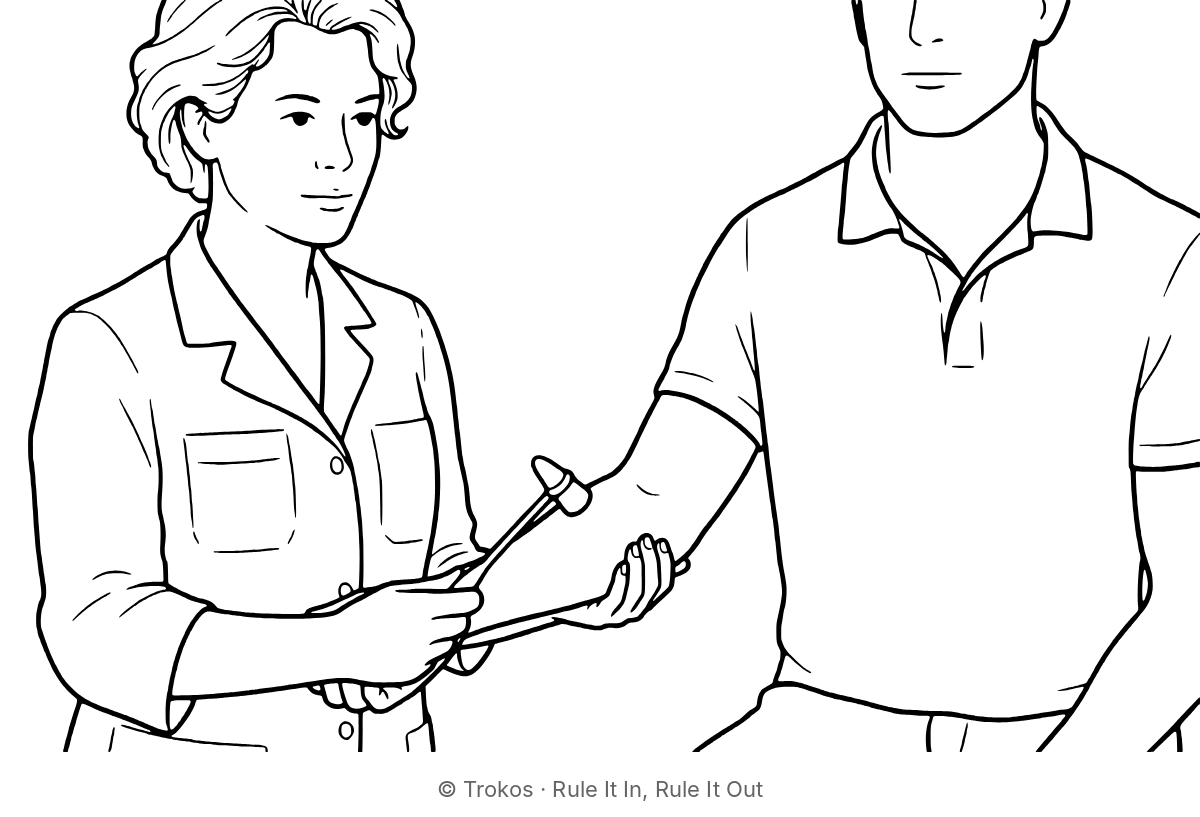
The examiner taps several times over the ulnar nerve in the groove behind the medial epicondyle (between it and the olecranon). Positive: Tingling into the ring and little fingers.
What the numbers mean
- Positive result: barely informative: a positive result changes little.
- Negative result: barely informative: a negative result changes little.
The ladder: what a result does to your estimate
| If you thought | After a positive | After a negative |
|---|---|---|
| 10% | 13% | 7% |
| 30% | 36% | 24% |
| 50% | 57% | 42% |
Calculated from the likelihood ratios above, as in the book. For any other starting estimate, use the probability calculator.
Work out what a result means for your patient: probability calculator
Likelihood ratios as published. Checked against the full paper on 15 October 2026.
Study details: patients, setting, confidence intervals, what was read
| Study | Beekman 2009 (prospective cohort) |
|---|---|
| Patients | 192 patients; consecutive patients referred to the neurology outpatient clinic of a large general teaching hospital (Heerlen, Netherlands) in whom ulnar neuropathy at the elbow was suspected after the history; 137 had it, 55 had another diagnosis |
| Compared against | nerve conduction studies plus ulnar nerve ultrasound, each read by a different examiner unaware of the clinical findings; every patient had both |
| 95% confidence intervals | sensitivity 54–70%, specificity 40–65% (as published) |
| Counts | true positives 85, false positives 26, false negatives 52, true negatives 29 |
| Likelihood ratios | as published by the study |
| What we read | Full paper (J Neurol Neurosurg Psychiatry 2009;80:1369-74, author-deposited PDF, Amsterdam UMC repository), counts in Table 2, sensitivity/specificity/CIs/LRs in Table 3 |
| Things to bear in mind | Good-sized study (192) of the realistic mix of people a clinic sees, with the nerve tests and ultrasound read without knowing the clinical findings and done in everyone. Only 55 patients did not have the condition, so the specificity is imprecise (95% CI 40–65%), and the examining neurologist had already taken the history and done the neurological exam, which may have coloured the provocative tests. Two experienced neurologists examined; results not given per examiner. |
How these details are gathered and checked: Methods.
Other tests in the library for cubital tunnel syndrome
Red flags to screen for before testing the elbow & forearm
Source
Beekman R, Schreuder AH, Rozeman CA, Koehler PJ, Uitdehaag BM. The diagnostic value of provocative clinical tests in ulnar neuropathy at the elbow is marginal. J Neurol Neurosurg Psychiatry. 2009;80(12):1369–1374. PubMed · single study
Figures as they will appear in Rule It In, Rule It Out (Trokos, forthcoming). If a newer or better study changes them, this page changes with the book. Figures last updated from the book on 13 October 2026.
How to cite
Citing a figure? Cite the study it comes from. The main figures on this page come from:
Beekman R, Schreuder AH, Rozeman CA, Koehler PJ, Uitdehaag BM. The diagnostic value of provocative clinical tests in ulnar neuropathy at the elbow is marginal. J Neurol Neurosurg Psychiatry. 2009;80(12):1369–1374.
Citing this page as a summary:
APA 7: Tompson, S. (2026, October 13). Tinel's sign (at the elbow) for cubital tunnel syndrome. Trokos special tests library. Retrieved October 28, 2026, from https://trokos.com.au/tests/elbow-tinelselbow.html
Vancouver: Tompson S. Tinel's sign (at the elbow) for cubital tunnel syndrome [Internet]. Sunshine Coast (QLD): Trokos; 2026 [updated 2026 Oct 13; cited 2026 Oct 28]. Available from: https://trokos.com.au/tests/elbow-tinelselbow.html
Citing the whole library:
APA 7: Tompson, S. (2026). Trokos special tests library (Version November 2026) [Online reference library]. Zenodo. https://doi.org/10.5281/zenodo.23932041
Vancouver: Tompson S. Trokos special tests library [Internet]. Version November 2026. Geneva: Zenodo; 2026 [cited 2026 Nov 4]. Available from: https://doi.org/10.5281/zenodo.23932041

Get the book for deciding which elbows need an X-ray after a fall, and whether the distal biceps is torn
This page gives the published figures. Rule It In, Rule It Out adds captioned drawings with the exact positions, the Rule-In / Rule-Out bar and evidence dots, a fuller interpretation of each test, and the clinical reasoning on which tests to use and in what order.
Look inside the book: free sample pages
Coming November 2026: 330 pages, paperback and PDF. Launch offer: subscribers get the PDF for A$39 instead of A$49, for the first two weeks after publication. Be first to know at launch
One study, one test, once a month
Rule It In is a free evidence letter for musculoskeletal clinicians: one recent study explained, one examination test with its real numbers. From Trokos, publisher of Rule It In, Rule It Out.
Free when you confirm your email: a one-page PDF of the strongest special tests to rule in and rule out, with tests that carry a caution flagged separately.
Launch offer for subscribers: the PDF edition of Rule It In, Rule It Out for A$39 instead of A$49, for the first two weeks after publication. Sign up free to get the code on launch day.
By subscribing you agree to receive Rule It In by email, about once a month. You will get a confirmation email first, and nothing is sent until you click it. Your address is stored by Kit (Kit.com, United States) and used only for this newsletter and the subscriber launch offer; Kit records which issues are opened and which links are clicked. Unsubscribe with one click in any issue. Privacy.