
Special tests library › Elbow & forearm
Moving valgus stress test
Also called: MVST
For: UCL injury
An injury to the ulnar collateral ligament on the inside of the elbow, which resists the forearm being forced outwards away from the body. It is common in throwing athletes.
Best used to rule outShort answer: Best used to rule out UCL injury. In the source cited below, sensitivity was 98% and specificity 75%. See the notes below before relying on it.
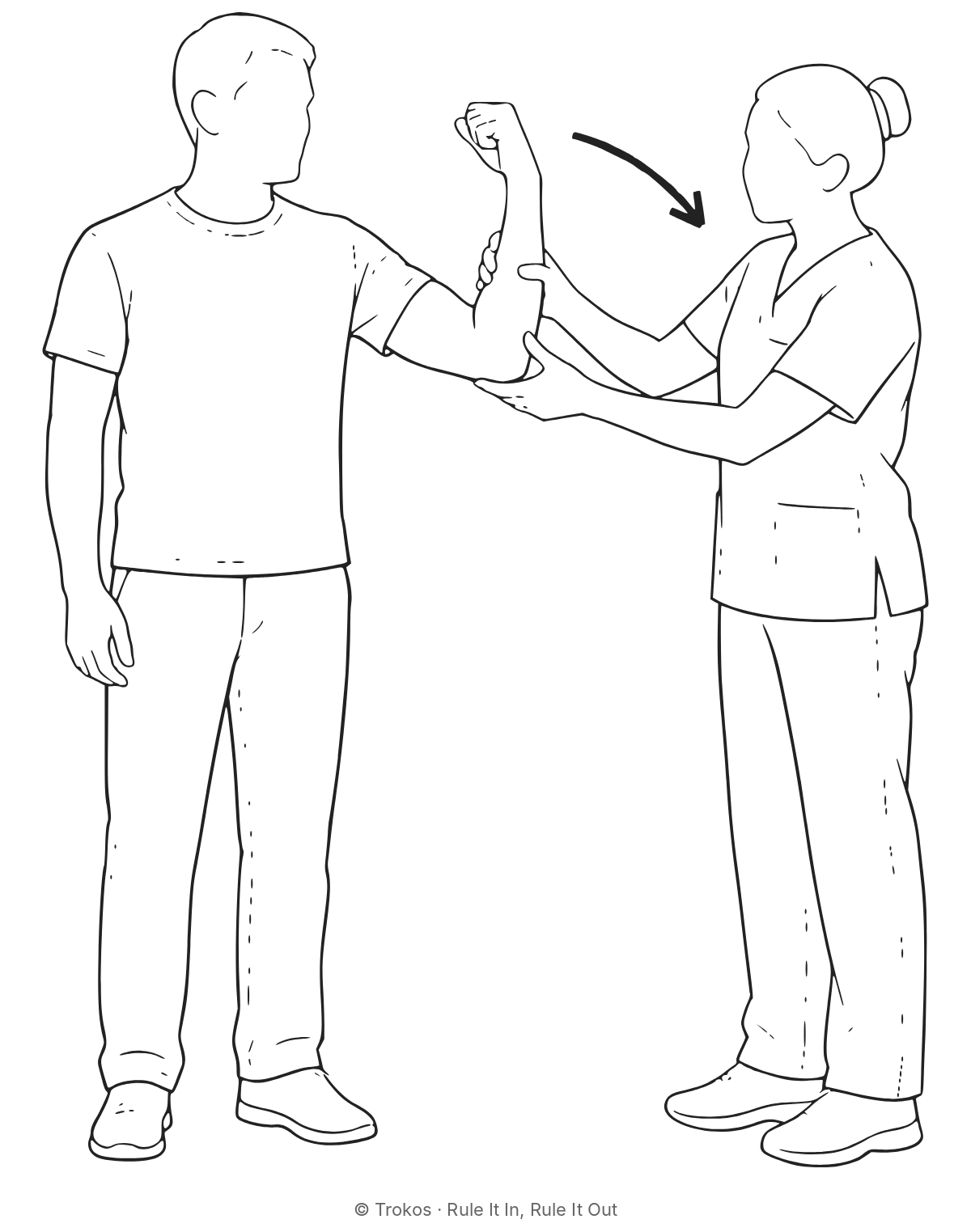
How it is done
With the shoulder at 90° abduction and full external rotation, the examiner applies a steady valgus force from full elbow flexion and extends the elbow briskly. Positive: Reproduction of the familiar medial pain, worst between about 120° and 70° of flexion.
What the numbers mean
- Positive result: a small shift: a positive result nudges the diagnosis up, but does not settle it.
- Negative result: a strong rule-out: a negative result makes the diagnosis very unlikely.
The ladder: what a result does to your estimate
| If you thought | After a positive | After a negative |
|---|---|---|
| 10% | 30% | under 1% |
| 30% | 63% | under 1% |
| 50% | 80% | 2% |
Calculated from the likelihood ratios above, as in the book. Read the caution above before relying on these. For any other starting estimate, use the probability calculator.
Work out what a result means for your patient: probability calculator
Single study of 84 consecutive athletes with sports-related elbow pain, all of whom had surgery (surgical reference standard). Checked against the full paper on 15 October 2026.
Caution: One study in which every patient went on to surgery, so the figures may not apply to a general sports caseload.
Study details: patients, setting, confidence intervals, what was read
| Study | Sciascia 2026 (cross-sectional diagnostic accuracy study drawn from a prospective multicentre registry (only patients who had surgery were included)) |
|---|---|
| Patients | 84 patients (all had elbow surgery); 84 consecutive athletes with sports-related elbow pain in a US multicentre registry, mean age 18, 75% baseball players; all went on to surgery |
| Compared against | surgical findings (ligament injury seen at surgery) |
| 95% confidence intervals | sensitivity 92–100%, specificity 53–89% (calculated from the study’s counts) |
| Counts | true positives 63, false positives 5, false negatives 1, true negatives 15 |
| Likelihood ratios | as published by the study |
| What we read | Full paper (Am J Sports Med 2026;54(8):1993–2002), Table 3. Counts are not printed; 64 with and 20 without a UCL injury at surgery is the only split that reproduces every published value (sensitivity, specificity, accuracy, PPV, NPV, LR+, LR−) exactly, and matches the 64 UCL operations in Table 1. |
| Things to bear in mind | Single study of 84 young athletes, all of whom had elbow surgery, so the mix of patients is skewed towards clear ligament injuries (64 of 84 had one) and accuracy may be lower in a general clinic. The surgeon who recorded the surgical findings was usually the same person who did the examination and knew the clinical diagnosis (not fully blinded). Not yet repeated by an independent group. |
How these details are gathered and checked: Methods.
Other tests in the library for UCL injury
Red flags to screen for before testing the elbow & forearm
Source
Sciascia AD, Bowman EN, Camp C, et al. Clinical Utility of the Moving Valgus Stress Test and Milking Maneuver for Medial Ulnar Collateral Ligament Injuries of the Elbow. Am J Sports Med. 2026;54(8):1993–2002. Journal article (DOI) · single study
Figures as they will appear in Rule It In, Rule It Out (Trokos, forthcoming). If a newer or better study changes them, this page changes with the book. Figures last updated from the book on 13 October 2026.
How to cite
Citing a figure? Cite the study it comes from. The main figures on this page come from:
Sciascia AD, Bowman EN, Camp C, et al. Clinical Utility of the Moving Valgus Stress Test and Milking Maneuver for Medial Ulnar Collateral Ligament Injuries of the Elbow. Am J Sports Med. 2026;54(8):1993–2002.
Citing this page as a summary:
APA 7: Tompson, S. (2026, October 13). Moving valgus stress test for UCL injury. Trokos special tests library. Retrieved October 28, 2026, from https://trokos.com.au/tests/elbow-movingvalgusstress.html
Vancouver: Tompson S. Moving valgus stress test for UCL injury [Internet]. Sunshine Coast (QLD): Trokos; 2026 [updated 2026 Oct 13; cited 2026 Oct 28]. Available from: https://trokos.com.au/tests/elbow-movingvalgusstress.html
Citing the whole library:
APA 7: Tompson, S. (2026). Trokos special tests library (Version November 2026) [Online reference library]. Zenodo. https://doi.org/10.5281/zenodo.23932041
Vancouver: Tompson S. Trokos special tests library [Internet]. Version November 2026. Geneva: Zenodo; 2026 [cited 2026 Nov 4]. Available from: https://doi.org/10.5281/zenodo.23932041
Get the book for deciding which elbows need an X-ray after a fall, and whether the distal biceps is torn
This page gives the published figures. Rule It In, Rule It Out adds captioned drawings with the exact positions, the Rule-In / Rule-Out bar and evidence dots, a fuller interpretation of each test, and the clinical reasoning on which tests to use and in what order.
Look inside the book: free sample pages
Coming November 2026: 330 pages, paperback and PDF. Launch offer: subscribers get the PDF for A$39 instead of A$49, for the first two weeks after publication. Be first to know at launch
One study, one test, once a month
Rule It In is a free evidence letter for musculoskeletal clinicians: one recent study explained, one examination test with its real numbers. From Trokos, publisher of Rule It In, Rule It Out.
Free when you confirm your email: a one-page PDF of the strongest special tests to rule in and rule out, with tests that carry a caution flagged separately.
Launch offer for subscribers: the PDF edition of Rule It In, Rule It Out for A$39 instead of A$49, for the first two weeks after publication. Sign up free to get the code on launch day.
By subscribing you agree to receive Rule It In by email, about once a month. You will get a confirmation email first, and nothing is sent until you click it. Your address is stored by Kit (Kit.com, United States) and used only for this newsletter and the subscriber launch offer; Kit records which issues are opened and which links are clicked. Unsubscribe with one click in any issue. Privacy.