
Shoulder & upper arm special tests cheat sheet
44 shoulder & upper arm examination tests, grouped by the condition they test for, each with the published accuracy figures that exist for it. Click a test for what a positive and a negative result mean, and the source.
Before any test: Shoulder & upper arm red flags: the serious conditions you cannot afford to miss
Free printable version: this page as a one-page PDF, with the caution notes and sources. Sign up free to download it.
AC joint pathology
| Test | Sensitivity | Specificity | LR+ | LR− | Verdict |
|---|---|---|---|---|---|
| Cross-body adduction (scarf) test | 77% | 79% | 3.7 | 0.29 | A weak test on its own |
| Paxinos sign | 79% | 50% | 1.58 | 0.42 | Treat with caution ?One small study (38 patients, only 10 of them without AC joint pain) by the group that described the sign, read only as an abstract; the specificity and likelihood ratios come from a later review (Krill 2018), whose predictive values do not fit the study's numbers; and no independent study has tested the sign. |
Verdicts: rule in when LR+ is 5 or more; rule out when LR− is below 0.2; both when both; weak when neither; treat with caution where the study behind the figures is weak enough that the verdict may not hold. A caution can appear with any verdict — tap ? to read it.
Anterior instability
Compare these tests side by side
| Test | Sensitivity | Specificity | LR+ | LR− | Verdict |
|---|---|---|---|---|---|
| Apprehension test | 72% | 96% | 20.2 | 0.29 | Best used to rule in |
| Relocation test | 81% | 92% | 10.4 | 0.2 | Best used to rule in |
| Surprise / anterior release test | 63.9% | 98.9% | 58.6 | 0.37 | Treat with caution ?Very small case-control study (18 people with instability, 28 without) whose diagnoses were already known; figures are counted per examination by four examiners, and the specificity rests on about one false-positive examination, so the LR+ of 58.6 is very imprecise. |
Verdicts: rule in when LR+ is 5 or more; rule out when LR− is below 0.2; both when both; weak when neither; treat with caution where the study behind the figures is weak enough that the verdict may not hold. A caution can appear with any verdict — tap ? to read it.
Cervical radiculopathy
Compare these tests side by side
| Test | Sensitivity | Specificity | LR+ | LR− | Verdict |
|---|---|---|---|---|---|
| Spurling's test | 53% | 92% | 3.28 | 0.51 | A weak test on its own |
Verdicts: rule in when LR+ is 5 or more; rule out when LR− is below 0.2; both when both; weak when neither; treat with caution where the study behind the figures is weak enough that the verdict may not hold. A caution can appear with any verdict — tap ? to read it.
Full-thickness rotator cuff tear
| Test | Sensitivity | Specificity | LR+ | LR− | Verdict |
|---|---|---|---|---|---|
| Rent test (transdeltoid palpation) | 95.7% | 96.8% | 30.1 | 0.045 | Treat with caution ?One study in which a single surgeon examined his own surgical patients; the findings were analysed retrospectively, no blinding was reported, and no other study reporting its accuracy was found. |
Verdicts: rule in when LR+ is 5 or more; rule out when LR− is below 0.2; both when both; weak when neither; treat with caution where the study behind the figures is weak enough that the verdict may not hold. A caution can appear with any verdict — tap ? to read it.
Long head of biceps problems
| Test | Sensitivity | Specificity | LR+ | LR− | Verdict |
|---|---|---|---|---|---|
| Bicipital groove tenderness | 75% | 42% | 1.29 | 0.60 | A weak test on its own |
| Upper cut test | 73% | 78% | 3.38 | 0.34 | Treat with caution ?One study, by the test's developers, read only as an abstract; only 101 of the 325 patients examined had surgery to confirm the diagnosis; the specificity and LR− come from a later review, not the developers' abstract; and the only independent study (Cardoso 2019) found much higher sensitivity but far lower specificity (about 38%, LR+ about 1.5, calculated). |
| Yergason's test | 32% | 71% | 1.12 | 0.95 | A weak test on its own |
Verdicts: rule in when LR+ is 5 or more; rule out when LR− is below 0.2; both when both; weak when neither; treat with caution where the study behind the figures is weak enough that the verdict may not hold. A caution can appear with any verdict — tap ? to read it.
Posteroinferior labral lesion
| Test | Sensitivity | Specificity | LR+ | LR− | Verdict |
|---|---|---|---|---|---|
| Jerk test | 73% | 97.9% | 34.7 | 0.27 | Treat with caution ?Single study (the Kim test developers' comparison) with only 30 lesions; the LR+ rests on about 3 false positives. |
| Kim test | 80% | 93.7% | 12.6 | 0.21 | Treat with caution ?Single study by the test's developers, with only 30 lesions; not independently re-tested. |
Verdicts: rule in when LR+ is 5 or more; rule out when LR− is below 0.2; both when both; weak when neither; treat with caution where the study behind the figures is weak enough that the verdict may not hold. A caution can appear with any verdict — tap ? to read it.
Rotator cuff tear
Compare these tests side by side
| Test | Sensitivity | Specificity | LR+ | LR− | Verdict |
|---|---|---|---|---|---|
| Belly-press test | 28% | 87% | 2.2 | 0.82 | A weak test on its own |
| Drop arm test | 24% | 96% | 6.45 | 0.79 | Best used to rule in |
| Empty can / Jobe's test | 88% | 62% | 2.3 | 0.19 | Best used to rule out |
| External rotation lag sign | 10% | 98% | 6.06 | 0.92 | Best used to rule in |
| Full can test | 70% | 81% | 3.75 | 0.37 | A weak test on its own |
| Hornblower's sign | 17% | 96% | 4.81 | 0.86 | A weak test on its own |
| Lateral Jobe test | 81.4% | 89% | 7.43 | 0.21 | Treat with caution ?Single study by the surgeons who first published the test, in surgical patients of whom 58% had a tear. |
Verdicts: rule in when LR+ is 5 or more; rule out when LR− is below 0.2; both when both; weak when neither; treat with caution where the study behind the figures is weak enough that the verdict may not hold. A caution can appear with any verdict — tap ? to read it.
Shoulder instability
| Test | Sensitivity | Specificity | LR+ | LR− | Verdict |
|---|---|---|---|---|---|
| Sulcus sign | 31% | 89% | 2.8 | 0.78 | A weak test on its own |
Verdicts: rule in when LR+ is 5 or more; rule out when LR− is below 0.2; both when both; weak when neither; treat with caution where the study behind the figures is weak enough that the verdict may not hold. A caution can appear with any verdict — tap ? to read it.
Shoulder labral injury
| Test | Sensitivity | Specificity | LR+ | LR− | Verdict |
|---|---|---|---|---|---|
| Modified dynamic labral shear (M-DLS) test | 72% | 98% | 31.57 | 0.29 | Treat with caution ?Single study by the test's developers; only the 101 of 325 patients who had surgery were checked against the reference. |
Verdicts: rule in when LR+ is 5 or more; rule out when LR− is below 0.2; both when both; weak when neither; treat with caution where the study behind the figures is weak enough that the verdict may not hold. A caution can appear with any verdict — tap ? to read it.
SLAP lesion
Compare these tests side by side
| Test | Sensitivity | Specificity | LR+ | LR− | Verdict |
|---|---|---|---|---|---|
| Anterior slide test | 10% | 85% | 0.67 | 1.06 | A weak test on its own |
| Crank test | 46% | 72% | 1.64 | 0.75 | A weak test on its own |
| O'Brien's / active compression test | 65% | 50% | 1.3 | 0.7 | A weak test on its own |
| Passive distraction test | 53% | 94% | 8.83 | 0.5 | Treat with caution ?Retrospective single study by the test's developers; shoulders that could not reach the test position were excluded. |
| Resisted supination external rotation test | 14.3% | 80.8% | 0.74 | 1.06 | A weak test on its own |
| Speed's test | 20% | 88% | 1.67 | 0.91 | A weak test on its own |
Verdicts: rule in when LR+ is 5 or more; rule out when LR− is below 0.2; both when both; weak when neither; treat with caution where the study behind the figures is weak enough that the verdict may not hold. A caution can appear with any verdict — tap ? to read it.
Subacromial pain
| Test | Sensitivity | Specificity | LR+ | LR− | Verdict |
|---|---|---|---|---|---|
| Hawkins–Kennedy sign | 71% | 59% | 1.64 | 0.53 | A weak test on its own |
| Neer's sign | 73% | 52% | 1.54 | 0.47 | A weak test on its own |
| Painful arc test | 53% | 76% | 2.2 | 0.62 | A weak test on its own |
Verdicts: rule in when LR+ is 5 or more; rule out when LR− is below 0.2; both when both; weak when neither; treat with caution where the study behind the figures is weak enough that the verdict may not hold. A caution can appear with any verdict — tap ? to read it.
Subscapularis tear
Compare these tests side by side
| Test | Sensitivity | Specificity | LR+ | LR− | Verdict |
|---|---|---|---|---|---|
| Bear-hug test | 55% | 94% | 9.2 | 0.48 | Treat with caution ?Pooled from 4 of the 5 studies of this test in the review, whose results disagreed widely: sensitivity 19% to 74%, and LR+ (calculated from each study's sensitivity and specificity) about 3.5 in two studies and 7.5 to 25 in the other three, so the pooled LR+ is not a reliable guide. |
| Belly-off sign | 87% | 91% | 10.1 | 0.15 | Treat with caution ?Single study of 50 patients (15 tears) by the group that described the sign; a later study (Kappe 2018) found sensitivity only 31%. |
| Internal rotation lag sign | 32% | 92% | 4.0 | 0.74 | A weak test on its own |
| Lift-off test | 33% | 94% | 5.5 | 0.71 | Treat with caution ?Pooled from 8 studies that disagreed widely: in the review's table of individual studies (Table 4), LR+ calculated from each study's sensitivity and specificity ranged from about 1.4 to 1.9 in four studies up to no false positives in several others, so the pooled LR+ is not a reliable guide. |
Verdicts: rule in when LR+ is 5 or more; rule out when LR− is below 0.2; both when both; weak when neither; treat with caution where the study behind the figures is weak enough that the verdict may not hold. A caution can appear with any verdict — tap ? to read it.
Commonly taught, no reliable figures yet
These tests are widely taught, but no reliable accuracy figures have been published for them, so they have no verdict and are left out of the calculator and the strongest-tests list. Each page shows how the test is done and what the research says.
- Adson's test (Thoracic outlet syndrome): No study giving its own sensitivity and specificity against an independent reference standard could be read; it is often positive in people with other arm problems.
- Apley's scratch test (Restricted shoulder movement): It is a quick check of shoulder movement with no defined target diagnosis, and no study measuring its accuracy for any shoulder condition could be found.
- Biceps load I test (SLAP lesion in shoulders with recurrent anterior dislocation): Studies flatly disagree: the developers' study gives a positive likelihood ratio of about 29, while an independent study gives 0.80, and an independent study in the same kind of patients found that the biceps load I test and most of the other tests it studied had poor predictive value, so no single figure applies.
- Biceps load II test (SLAP lesion): Studies flatly disagree: the developers' study gives a positive likelihood ratio of about 26, while three independent studies give 1.2 to 1.7, so no single figure applies.
- Coracoid pain test (Frozen shoulder (adhesive capsulitis)): Studies conflict: the developers' study (read only as an abstract, and with numbers that do not add up) suggests a strong test, but the only independent study found that it did not help (LR+ 0.60, LR− 1.07).
- Drop sign (Infraspinatus and other rotator cuff tears): Studies conflict: in the two largest usable studies the sign picked up only 5–8% of tears and was never positive without one, so no positive likelihood ratio can be worked out, while one small study (37 patients, read only as an abstract) found sensitivity 73% and specificity 77%.
- Infraspinatus test (Subacromial pain and rotator cuff tear): Studies flatly disagree: positive likelihood ratios run from below 1 to about 10 depending on the study and the condition looked for, so no single figure applies.
- Load and shift test (Anterior shoulder instability): The only accuracy study found could be read only as an abstract, which gives no figures for this test, and the figures quoted in reviews come from a 2002 narrative review whose source for them could not be checked.
- Roos test (Thoracic outlet syndrome): The largest study found it separates thoracic outlet syndrome from look-alikes poorly, and it is often positive in people without the condition.
- Wright's test (hyperabduction test) (Thoracic outlet syndrome): No study giving its own sensitivity and specificity against an independent reference standard could be found; the one patient study gives only a positive predictive value in its abstract, and the arm-overhead position often changes the pulse in healthy people.
LR+ says how much a positive result moves the probability up; LR− how much a negative moves it down. Tests for the same problem are rarely independent, so their figures should not be multiplied together. To turn a figure into a probability for your patient, use the probability calculator.
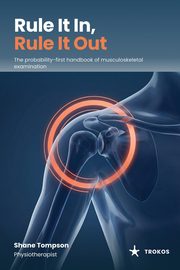
Get the book for the shoulder questions that matter: neck or shoulder, a painful cuff or a torn one, and an unstable joint or the labrum
These pages give the published figures. Rule It In, Rule It Out adds, for the tests in the chapter ‘The shoulder’: captioned drawings with the exact positions, the Rule-In / Rule-Out bar and evidence dots, a fuller interpretation of each test, and the clinical reasoning on which tests to use and in what order.
Look inside the book: free sample pages
Coming November 2026: 330 pages, paperback and PDF. Launch offer: subscribers get the PDF for A$39 instead of A$49, for the first two weeks after publication. Be first to know at launch
Condition pages: AC joint pain (acromioclavicular joint) · Anterior instability · Cervical radiculopathy · Frozen shoulder (adhesive capsulitis) · Long head of biceps problems · Posteroinferior labral lesion · Rotator cuff tear · SLAP lesion · Subacromial pain · Subscapularis tear · Thoracic outlet syndrome · all, A to Z
One study, one test, once a month
Rule It In is a free evidence letter for musculoskeletal clinicians: one recent study explained, one examination test with its real numbers. From Trokos, publisher of Rule It In, Rule It Out.
Free when you confirm your email: this page as a one-page printable PDF, the same sheet for every other body region, and the one-page sheet of the strongest special tests to rule in and rule out.
Launch offer for subscribers: the PDF edition of Rule It In, Rule It Out for A$39 instead of A$49, for the first two weeks after publication. Sign up free to get the code on launch day.
By subscribing you agree to receive Rule It In by email, about once a month. You will get a confirmation email first, and nothing is sent until you click it. Your address is stored by Kit (Kit.com, United States) and used only for this newsletter and the subscriber launch offer; Kit records which issues are opened and which links are clicked. Unsubscribe with one click in any issue. Privacy.