
Special tests library › Shoulder & upper arm
Cross-body adduction (scarf) test
Also called: scarf test, cross-arm adduction test, horizontal adduction test
For: AC joint pathology
Pain arising from the acromioclavicular (AC) joint, where the clavicle (collarbone) meets the acromion (the tip of the shoulder blade), as a result of arthritis, sprain or separation.
A weak test on its ownShort answer: On the published figures, a weak test on its own for AC joint pathology. In the source cited below, sensitivity was 77% and specificity 79%. See the notes below before relying on it.
How it is done
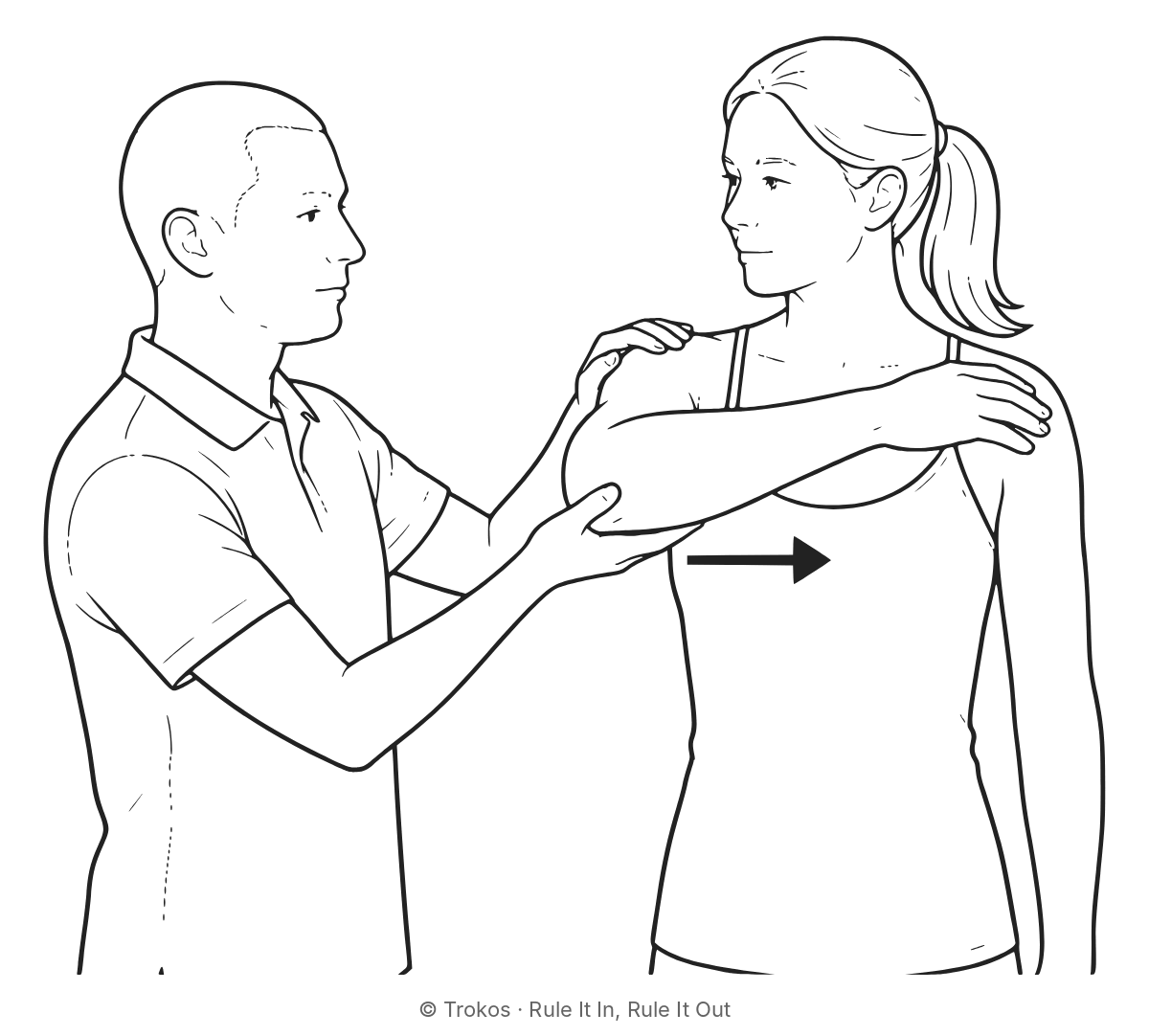
The examiner flexes the shoulder to 90°, then passively adducts it across the chest. Positive: Pain felt over the AC joint itself.
What the numbers mean
- Positive result: a small shift: a positive result nudges the diagnosis up, but does not settle it.
- Negative result: a small shift: a negative result nudges the diagnosis down, but does not exclude it.
The ladder: what a result does to your estimate
| If you thought | After a positive | After a negative |
|---|---|---|
| 10% | 29% | 3% |
| 30% | 61% | 11% |
| 50% | 79% | 22% |
Calculated from the likelihood ratios above, as in the book. For any other starting estimate, use the probability calculator.
Studied combinations: this test as part of a published cluster
The cross-body adduction test has been studied as one of four tests for acromioclavicular joint pain in primary care (Cadogan 2013): cross-body adduction, O'Brien's active compression test, the Hawkins–Kennedy test and AC joint tenderness. In 153 patients analysed (208 enrolled; reference standard: at least 80% pain relief after an AC joint injection), all four positive gave a sensitivity of 5% and a specificity of 99% (LR+ 5.70, 95% CI 0.60–52.63), and none of the four positive gave an LR− of 0.65 (0.11–3.54). Overall, the number of positive tests did not separate patients with and without AC joint pain (area under the curve 0.51). No independent validation study was found. These figures come from the tests as performed and scored in that study.
Sources: Cadogan A et al. BMC Musculoskelet Disord 2013;14:156 (Table 4).
Rule It In, Rule It Out covers how this cluster fits into the examination.
Work out what a result means for your patient: probability calculator
How common is it? Starting probabilities by setting
Red flags to screen for before testing the shoulder & upper arm
Sensitivity 77% checked against the published abstract (35 patients); specificity and the likelihood ratios could not be checked because the full paper could not be accessed.
Not yet confirmed against the full paper.
Study details: patients, setting, confidence intervals, what was read
| Study | Chronopoulos 2004 (retrospective case-control) |
|---|---|
| Patients | 35 patients with AC joint lesions (number of controls not in the abstract); people who had surgery (distal clavicle excision) for an isolated chronic AC joint problem, 1994-2002; controls from the same orthopaedic surgical practice (Cadogan 2013 lists recruitment as 'orthopaedic surgical waiting list') |
| Compared against | surgery (distal clavicle excision) for the cases; how controls were confirmed is not in the abstract |
| 95% confidence intervals | sensitivity 61–88% (calculated from the study’s counts) |
| Likelihood ratios | published (as tabulated from the paper by Cadogan 2013: LR+ 3.67, LR- 0.29) |
| What we read | Open-access review that tabulates the original study; Abstract (PMID 15090381; SAGE page restricted) gives sens 77% and overall accuracy 79% only; specificity 79, LR+ 3.67, LR- 0.29 read from Cadogan 2013 (PMC3646690, open access) Table 1, which tabulates the Chronopoulos full text. Sens CI from 27/35 |
| Things to bear in mind | Small retrospective case-control study (35 cases chosen because they had surgery) in a specialist surgical practice, so accuracy is likely higher than in a general clinic. The abstract does not say how many controls there were or how they were confirmed. In primary care (Cadogan 2013, 153 patients, checked against an AC joint injection), the test on its own did not help: sensitivity 64%, specificity 26%, LR+ 0.86. |
How these details are gathered and checked: Methods.
Source
Chronopoulos E, Kim TK, Park HB, Ashenbrenner D, McFarland EG. Diagnostic value of physical tests for isolated chronic acromioclavicular lesions. Am J Sports Med. 2004;32(3):655–661. Journal article · single study
Figures as they will appear in Rule It In, Rule It Out (Trokos, forthcoming). If a newer or better study changes them, this page changes with the book. Figures last updated from the book on 13 October 2026.
How to cite
Citing a figure? Cite the study it comes from. The main figures on this page come from:
Chronopoulos E, Kim TK, Park HB, Ashenbrenner D, McFarland EG. Diagnostic value of physical tests for isolated chronic acromioclavicular lesions. Am J Sports Med. 2004;32(3):655–661.
Citing this page as a summary:
APA 7: Tompson, S. (2026, October 13). Cross-body adduction (scarf) test for AC joint pathology. Trokos special tests library. Retrieved October 28, 2026, from https://trokos.com.au/tests/shoulder-crossbody.html
Vancouver: Tompson S. Cross-body adduction (scarf) test for AC joint pathology [Internet]. Sunshine Coast (QLD): Trokos; 2026 [updated 2026 Oct 13; cited 2026 Oct 28]. Available from: https://trokos.com.au/tests/shoulder-crossbody.html
Citing the whole library:
APA 7: Tompson, S. (2026). Trokos special tests library (Version November 2026) [Online reference library]. Zenodo. https://doi.org/10.5281/zenodo.23932041
Vancouver: Tompson S. Trokos special tests library [Internet]. Version November 2026. Geneva: Zenodo; 2026 [cited 2026 Nov 4]. Available from: https://doi.org/10.5281/zenodo.23932041
Get the book for the shoulder questions that matter: neck or shoulder, a painful cuff or a torn one, and an unstable joint or the labrum
This page gives the published figures. Rule It In, Rule It Out adds captioned drawings with the exact positions, the Rule-In / Rule-Out bar and evidence dots, a fuller interpretation of each test, and the clinical reasoning on which tests to use and in what order.
Look inside the book: free sample pages
Coming November 2026: 330 pages, paperback and PDF. Launch offer: subscribers get the PDF for A$39 instead of A$49, for the first two weeks after publication. Be first to know at launch
One study, one test, once a month
Rule It In is a free evidence letter for musculoskeletal clinicians: one recent study explained, one examination test with its real numbers. From Trokos, publisher of Rule It In, Rule It Out.
Free when you confirm your email: a one-page PDF of the strongest special tests to rule in and rule out, with tests that carry a caution flagged separately.
Launch offer for subscribers: the PDF edition of Rule It In, Rule It Out for A$39 instead of A$49, for the first two weeks after publication. Sign up free to get the code on launch day.
By subscribing you agree to receive Rule It In by email, about once a month. You will get a confirmation email first, and nothing is sent until you click it. Your address is stored by Kit (Kit.com, United States) and used only for this newsletter and the subscriber launch offer; Kit records which issues are opened and which links are clicked. Unsubscribe with one click in any issue. Privacy.