
Special tests library › Shoulder & upper arm
Yergason's test
For: Long head of biceps problems
Problems of the long head of the biceps tendon in the shoulder: inflammation, tearing, slipping out of its groove, or a SLAP tear where it attaches.
A weak test on its ownShort answer: A weak test on its own for long head of biceps problems: in the source cited below a positive or a negative result barely changed the probability (LR+ 1.12, LR− 0.95).
How it is done
The elbow is bent to 90° with the forearm turned palm-down. The patient turns the palm up (supination) against the examiner's resistance. Positive: pain (as defined in Guery 2025).
What the numbers mean
- Positive result: barely changes the probability (LR+ 1.12).
- Negative result: barely changes the probability (LR− 0.95).
The ladder: what a result does to your estimate
| If you thought | After a positive | After a negative |
|---|---|---|
| 10% | 11% | 10% |
| 30% | 32% | 29% |
| 50% | 53% | 49% |
Calculated from the likelihood ratios above. For any other starting estimate, use the probability calculator.
Work out what a result means for your patient: probability calculator
Sensitivity and specificity as printed in Guery 2025 (Table 3; 95% CI 24–42% and 63–79%); likelihood ratios calculated from the printed counts (LR+ 95% CI 0.77–1.64, LR− 0.80–1.13). The technique wording above is the standard description; the study gives only the positive criterion.
What the studies found
Long head of biceps problems seen at arthroscopy (inflammation, instability, partial or complete tears and SLAP lesions counted together) in 243 patients having keyhole repair of a supraspinatus tear (Guery 2025). Yergason's test picked up 32% of those with a biceps problem and was positive in 29% of those without, so it barely changed the probability. For SLAP lesions alone, an earlier study of 60 shoulders having arthroscopy found that Yergason's test picked up 12% of them, with specificity 96% (Guanche 2003, as tabulated in Luime 2004, full paper). A 2023 meta-analysis pooled Yergason's test for SLAP lesions alone (Dean 2023), but its figures are not in the abstract and the full paper could not be read. A larger prospective study in the same setting (361 patients; Boble 2025) does not give Yergason's own figures in its abstract, and the full paper could not be read.
Study details: patients, setting, confidence intervals, what was read
| Study | Guery 2025 (retrospective analysis of a consecutive surgical series, 14 surgeons) |
|---|---|
| Patients | 243 of 246 patients having arthroscopic rotator cuff repair for an isolated supraspinatus tear (108 with a long head of biceps problem), France |
| Compared against | what the surgeon saw at arthroscopy |
| 95% confidence intervals | sensitivity 24–42%, specificity 63–79% (as printed) |
| Counts | true positives 35, false positives 39, false negatives 73, true negatives 96 |
| Likelihood ratios | calculated from the counts |
| What we read | Full papers: Guery 2025, Luime 2004 (for Guanche 2003). Dean 2023 and Boble 2025: abstracts only. |
| Things to bear in mind | Retrospective; only people already having cuff repair surgery; the surgeon who did the tests also judged the biceps at surgery; all biceps problems counted together (not SLAP alone); surgeons were not blinded to the ultrasound; reliability between the 14 surgeons was not measured. |
How these details are gathered and checked: Methods.
Red flags to screen for before testing this region
Source
Guery J, Antoni M, ReSurg, Gallinet D. Ultrasound findings and clinical testing for preoperative diagnosis of long head of the biceps pathology. J Exp Orthop. 2025;12(3):e70430. Journal article (DOI)
Also cited: Dean RS, Onsen L, Lima J, Hutchinson MR. Physical Examination Maneuvers for SLAP Lesions: A Systematic Review and Meta-analysis of Individual and Combinations of Maneuvers. Am J Sports Med. 2023;51(11):3042–3052. PubMed
Also cited: Boble M, Charousset C, Samargandi R, Dordain F, Gadéa F, Gallinet D, Barth J, Guery J, Bonnevialle N, Jacquot A, Berhouet J; Francophone Arthroscopy Society. What is the clinical value of long head of biceps tendon tests in distal supraspinatus tendon rupture? A prospective multicenter study. J Shoulder Elbow Surg. 2025;34(8):1949–1960. Journal article (DOI)
Also cited: Guanche CA, Jones DC. Clinical testing for tears of the glenoid labrum. Arthroscopy. 2003;19(5):517–523. PubMed
Also cited: Luime JJ, Verhagen AP, Miedema HS, Kuiper JI, Burdorf A, Verhaar JA, Koes BW. Does this patient have an instability of the shoulder or a labrum lesion? JAMA. 2004;292(16):1989–1999. PubMed
Website only: not in the book.
Figures checked against the sources cited above, in a check separate from the drafting; any note above says where only the abstract could be checked. If a newer or better study changes them, this page will be updated.
How to cite
Citing a figure? Cite the study it comes from. The main figures on this page come from:
Guery J, Antoni M, ReSurg, Gallinet D. Ultrasound findings and clinical testing for preoperative diagnosis of long head of the biceps pathology. J Exp Orthop. 2025;12(3):e70430.
Figures quoted in the notes from other studies are cited under Source above.
Citing this page as a summary:
APA 7: Tompson, S. (2026, November 15). Yergason's test for long head of biceps problems. Trokos special tests library. Retrieved November 15, 2026, from https://trokos.com.au/tests/shoulder-yergason.html
Vancouver: Tompson S. Yergason's test for long head of biceps problems [Internet]. Sunshine Coast (QLD): Trokos; 2026 [updated 2026 Nov 15; cited 2026 Nov 15]. Available from: https://trokos.com.au/tests/shoulder-yergason.html
Citing the whole library:
APA 7: Tompson, S. (2026). Trokos special tests library (Version November 2026) [Online reference library]. Zenodo. https://doi.org/10.5281/zenodo.23932041
Vancouver: Tompson S. Trokos special tests library [Internet]. Version November 2026. Geneva: Zenodo; 2026 [cited 2026 Nov 15]. Available from: https://doi.org/10.5281/zenodo.23932041
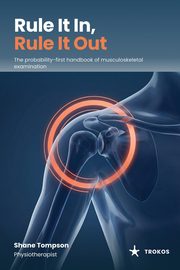
Get the book for the shoulder questions that matter: neck or shoulder, a painful cuff or a torn one, and an unstable joint or the labrum
Rule It In, Rule It Out covers the tests it includes in its ‘The shoulder’ chapter: how to do each one, what counts as positive, and how to read the result.
Look inside the book: free sample pages
Coming November 2026: 330 pages, paperback and PDF. Launch offer: subscribers get the PDF for A$39 instead of A$49, for the first two weeks after publication. Be first to know at launch
One study, one test, once a month
Rule It In is a free evidence letter for musculoskeletal clinicians: one recent study explained, one examination test with its real numbers. From Trokos, publisher of Rule It In, Rule It Out.
Free when you confirm your email: a one-page PDF of the strongest special tests to rule in and rule out, with tests that carry a caution flagged separately.
Launch offer for subscribers: the PDF edition of Rule It In, Rule It Out for A$39 instead of A$49, for the first two weeks after publication. Sign up free to get the code on launch day.
By subscribing you agree to receive Rule It In by email, about once a month. You will get a confirmation email first, and nothing is sent until you click it. Your address is stored by Kit (Kit.com, United States) and used only for this newsletter and the subscriber launch offer; Kit records which issues are opened and which links are clicked. Unsubscribe with one click in any issue. Privacy.