
Special tests library › Quizzes › Shoulder
Shoulder special tests quiz
Questions use only the figures on this library's test pages.
Last updated 30 October 2026. 8 questions. Each answer links to the test page it comes from; the region's tests are listed on the Shoulder & upper arm cheat sheet.
Terms such as sensitivity, specificity, LR+ and LR− are explained in the glossary. A likelihood ratio above about 5 or below about 0.2 is doing real work; between 2 and 0.5 it is barely worth the time.
Question 1 of 8
Which of these tests best rules out rotator cuff tear?
- Full can test
- External rotation lag sign
- Drop arm test
- Empty can / Jobe's test
Show the answer
Answer: D. Empty can / Jobe's test. Empty can / Jobe's test has the lowest LR−, 0.19. The others: Full can test 0.37, Drop arm test 0.79, External rotation lag sign 0.92. See the test
Question 2 of 8
How far does a positive apprehension test move the probability of anterior instability?
- Up clearly: it is doing real work (LR+ above about 5)
- Up a little: a small shift (LR+ between about 2 and 5)
- Barely: it is barely worth the time (LR+ below about 2)
- Down: a positive result makes it less likely
Show the answer
Answer: A. Up clearly: it is doing real work (LR+ above about 5). Apprehension test: LR+ 20.2. Its page: “a strong rule-in: a positive result makes the diagnosis much more likely.” See the test
Question 3 of 8
How far does a positive full can test move the probability of rotator cuff tear?
- Up clearly: it is doing real work (LR+ above about 5)
- Up a little: a small shift (LR+ between about 2 and 5)
- Barely: it is barely worth the time (LR+ below about 2)
- Down: a positive result makes it less likely
Show the answer
Answer: B. Up a little: a small shift (LR+ between about 2 and 5). Full can test: LR+ 3.75. Its page: “a small shift: a positive result nudges the diagnosis up, but does not settle it.” See the test
Question 4 of 8
How far does a positive Hawkins–Kennedy sign move the probability of subacromial pain?
- Up clearly: it is doing real work (LR+ above about 5)
- Up a little: a small shift (LR+ between about 2 and 5)
- Barely: it is barely worth the time (LR+ below about 2)
- Down: a positive result makes it less likely
Show the answer
Answer: C. Barely: it is barely worth the time (LR+ below about 2). Hawkins–Kennedy sign: LR+ 1.64. Its page: “barely informative: a positive result changes little.” See the test
Question 5 of 8
What counts as a positive apprehension test?
- Sudden return of apprehension at the release.
- Reproduction of the patient's familiar pain during the rotation.
- The apprehension settles and more external rotation is tolerated.
- Apprehension, the feeling that the shoulder will slip; pain alone does not count.
Show the answer
Answer: D. Apprehension, the feeling that the shoulder will slip; pain alone does not count. The Apprehension test page: “Apprehension, the feeling that the shoulder will slip; pain alone does not count.” See the test
Question 6 of 8
What counts as a positive drop arm test?
- The patient cannot rotate outward and adopts the characteristic hornblower's posture.
- The hand cannot be lifted, or only with trick movement.
- The arm drops or cannot be lowered with control, usually around 90°.
- The hand drifts back towards neutral (a lag).
Show the answer
Answer: C. The arm drops or cannot be lowered with control, usually around 90°. The Drop arm test page: “The arm drops or cannot be lowered with control, usually around 90°.” See the test
Question 7 of 8
Starting at 30% for anterior instability, what is the probability after a positive relocation test?
- 62%
- 90%
- 82%
- 71%
Show the answer
Answer: C. 82%. From the ladder on the Relocation test page: a starting 30% becomes 82% after a positive (LR+ 10.4: a strong rule-in). See the test
Question 8 of 8
Starting at 30% for rotator cuff tear, what is the probability after a positive drop arm test?
- 50%
- 25%
- 82%
- 73%
Show the answer
Answer: D. 73%. From the ladder on the Drop arm test page: a starting 30% becomes 73% after a positive (LR+ 6.45: a moderate rule-in). See the test
Your score:
Each answer above links to its test page. The options are shuffled when you start again.
Other quizzes: Knee · Neck · Low back & pelvis · Hip, groin & thigh · Foot, ankle & calf · Elbow & forearm · Wrist & hand. How the figures are chosen: Methods.
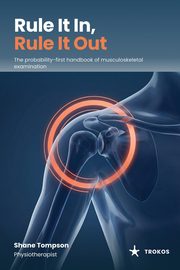
Get the book for the shoulder questions that matter: neck or shoulder, a painful cuff or a torn one, and an unstable joint or the labrum
These pages give the published figures. Rule It In, Rule It Out adds, for the tests in the chapter ‘The shoulder’: how to do each one, what counts as positive, how to read the result, and, where studied, whether combining tests helps.
Coming November 2026: 330 pages, paperback and PDF. Launch offer: subscribers get the PDF for A$39 instead of A$49, for the first two weeks after publication. Be first to know at launch
One study, one test, once a month
Rule It In is a free evidence letter for musculoskeletal clinicians: one recent study explained, one examination test with its real numbers. From Trokos, publisher of Rule It In, Rule It Out.
Free when you confirm your email: a one-page PDF of the strongest special tests to rule in and rule out, with tests that carry a caution flagged separately.
Launch offer for subscribers: the PDF edition of Rule It In, Rule It Out for A$39 instead of A$49, for the first two weeks after publication. Sign up free to get the code on launch day.
By subscribing you agree to receive Rule It In by email, about once a month. You will get a confirmation email first, and nothing is sent until you click it. Your address is stored by Kit (Kit.com, United States) and used only for this newsletter and the subscriber launch offer; Kit records which issues are opened and which links are clicked. Unsubscribe with one click in any issue. Privacy.