
Hip, groin & thigh special tests cheat sheet
24 hip, groin & thigh examination tests, grouped by the condition they test for, each with the published accuracy figures that exist for it. Click a test for what a positive and a negative result mean, and the source.
Before any test: Hip, groin & thigh red flags: the serious conditions you cannot afford to miss
Free printable version: this page as a one-page PDF, with the caution notes and sources. Sign up free to download it.
Chronic groin pain with pubic bone oedema (once fracture is excluded)
| Test | Sensitivity | Specificity | LR+ | LR− | Verdict |
|---|---|---|---|---|---|
| Squeeze test (adductor) | 49% | 88% | 4.2 | 0.58 | A weak test on its own ?Studied in Australian Rules footballers against chronic groin pain and MRI pubic bone marrow oedema, not today's adductor-related groin pain; the authors warn the specificity should be treated with caution. |
Verdicts: rule in when LR+ is 5 or more; rule out when LR− is below 0.2; both when both; weak when neither; treat with caution where the study behind the figures is weak enough that the verdict may not hold. A caution can appear with any verdict — tap ? to read it.
FAI syndrome (cam or pincer hip shape)
| Test | Sensitivity | Specificity | LR+ | LR− | Verdict |
|---|---|---|---|---|---|
| FADIR test | 96% | 11% | 1.08 | 0.36 | A weak test on its own ?Low-quality evidence that varies widely: specificity ranges from 10% to 100% across studies of labral tears and from 11% to 47% across studies of FAI, and in the study behind these figures the surgeon's diagnosis used the FADIR result itself, which inflates sensitivity. |
Verdicts: rule in when LR+ is 5 or more; rule out when LR− is below 0.2; both when both; weak when neither; treat with caution where the study behind the figures is weak enough that the verdict may not hold. A caution can appear with any verdict — tap ? to read it.
Gluteal tendinopathy (lateral hip pain)
| Test | Sensitivity | Specificity | LR+ | LR− | Verdict |
|---|---|---|---|---|---|
| 30-second single-leg stance test | 100% | 97.3% | 37 | 0 | Treat with caution ?Case–control study: cases had long-standing, MRI-proven tendon disease (most with tears) and controls had no hip pain, which tends to overestimate both sensitivity and specificity. |
| Resisted external derotation test | 88% | 97.3% | 32.6 | 0.12 | Treat with caution ?Case–control study: cases had long-standing, MRI-proven tendon disease (most with tears) and controls had no hip pain, which tends to overestimate both sensitivity and specificity. |
Verdicts: rule in when LR+ is 5 or more; rule out when LR− is below 0.2; both when both; weak when neither; treat with caution where the study behind the figures is weak enough that the verdict may not hold. A caution can appear with any verdict — tap ? to read it.
Gluteal tendon tear
| Test | Sensitivity | Specificity | LR+ | LR− | Verdict |
|---|---|---|---|---|---|
| Trendelenburg test/sign | 73% | 77% | 3.15 | 0.35 | A weak test on its own |
Verdicts: rule in when LR+ is 5 or more; rule out when LR− is below 0.2; both when both; weak when neither; treat with caution where the study behind the figures is weak enough that the verdict may not hold. A caution can appear with any verdict — tap ? to read it.
Hip abductor (gluteal) tendon damage on MRI
| Test | Sensitivity | Specificity | LR+ | LR− | Verdict |
|---|---|---|---|---|---|
| Hip lag sign | 89.5% | 96.6% | 25.95 | 0.11 | Treat with caution ?A single small study by the test's developers: 19 damaged hips in 26 patients, both hips of a patient counted, and almost half the hips with a hip replacement; a later, larger study of a modified version picked up only 30% of tears (Quintana 2025). |
Verdicts: rule in when LR+ is 5 or more; rule out when LR− is below 0.2; both when both; weak when neither; treat with caution where the study behind the figures is weak enough that the verdict may not hold. A caution can appear with any verdict — tap ? to read it.
Hip flexor tightness (hip extension deficit)
| Test | Sensitivity | Specificity | LR+ | LR− | Verdict |
|---|---|---|---|---|---|
| Modified Thomas test | — | — | — | — | No reliable published figures |
Verdicts: rule in when LR+ is 5 or more; rule out when LR− is below 0.2; both when both; weak when neither; treat with caution where the study behind the figures is weak enough that the verdict may not hold. A caution can appear with any verdict — tap ? to read it.
Intra-articular hip pain
| Test | Sensitivity | Specificity | LR+ | LR− | Verdict |
|---|---|---|---|---|---|
| Resisted straight leg raise (Stinchfield test) | 59% | 32% | 0.87 | 1.28 | A weak test on its own |
| Scour test / quadrant test | 50% | 29% | 0.7 | 1.72 | A weak test on its own |
Verdicts: rule in when LR+ is 5 or more; rule out when LR− is below 0.2; both when both; weak when neither; treat with caution where the study behind the figures is weak enough that the verdict may not hold. A caution can appear with any verdict — tap ? to read it.
Ischiofemoral impingement
| Test | Sensitivity | Specificity | LR+ | LR− | Verdict |
|---|---|---|---|---|---|
| Ischiofemoral impingement (IFI) test | 82% | 85% | 5.35 | 0.21 | Treat with caution ?Small retrospective study (30 patients) from the centre that developed the test; the reference standard partly used the tests themselves, which overstates accuracy. |
| Long stride walking test | 94% | 85% | 6.12 | 0.07 | Treat with caution ?Small retrospective study (30 patients) from the centre that developed the test; the reference standard partly used the tests themselves, which overstates accuracy. |
Verdicts: rule in when LR+ is 5 or more; rule out when LR− is below 0.2; both when both; weak when neither; treat with caution where the study behind the figures is weak enough that the verdict may not hold. A caution can appear with any verdict — tap ? to read it.
Meralgia paraesthetica
| Test | Sensitivity | Specificity | LR+ | LR− | Verdict |
|---|---|---|---|---|---|
| Pelvic compression test (lateral femoral cutaneous nerve) | 86.7% | 93.3% | 13 | 0.14 | Treat with caution ?Case–control study of 30 cases and 30 controls: tends to overestimate accuracy. |
| Tinel's/percussion sign over the lateral femoral cutaneous nerve at the inguinal ligament | 80% | 86.7% | 6 | 0.23 | Treat with caution ?Case–control study of 30 cases and 30 controls: tends to overestimate accuracy. |
Verdicts: rule in when LR+ is 5 or more; rule out when LR− is below 0.2; both when both; weak when neither; treat with caution where the study behind the figures is weak enough that the verdict may not hold. A caution can appear with any verdict — tap ? to read it.
Sciatic nerve entrapment in the buttock
| Test | Sensitivity | Specificity | LR+ | LR− | Verdict |
|---|---|---|---|---|---|
| Active piriformis test | 78% | 80% | 3.9 | 0.27 | A weak test on its own |
| Seated piriformis stretch test | 52% | 90% | 5.22 | 0.53 | Treat with caution ?Small retrospective study (33 patients, only 10 without the condition) from the group that described the test; the LR+ interval is very wide. |
Verdicts: rule in when LR+ is 5 or more; rule out when LR− is below 0.2; both when both; weak when neither; treat with caution where the study behind the figures is weak enough that the verdict may not hold. A caution can appear with any verdict — tap ? to read it.
Severe hip osteoarthritis
| Test | Sensitivity | Specificity | LR+ | LR− | Verdict |
|---|---|---|---|---|---|
| Reduced passive hip adduction (severe hip osteoarthritis) | 80% | 81% | 4.2 | 0.25 | A weak test on its own ?Single study with one examiner; figures apply to severe OA only (joint space 1.5 mm or less). |
| Severe hip osteoarthritis cluster (Bierma-Zeinstra, 7 signs) | 72% | 98% | 35 | 0.29 | Treat with caution ?Single study with one examiner and only 25 people with severe OA; never independently re-tested. |
Verdicts: rule in when LR+ is 5 or more; rule out when LR− is below 0.2; both when both; weak when neither; treat with caution where the study behind the figures is weak enough that the verdict may not hold. A caution can appear with any verdict — tap ? to read it.
Suspected hip fracture after trauma
| Test | Sensitivity | Specificity | LR+ | LR− | Verdict |
|---|---|---|---|---|---|
| Patellar-pubic percussion test | 95% | 86% | 6.79 | 0.06 | Treat with caution ?Later study, Smeets 2018 (hip or pelvic fracture): LR+ about 2.8, LR− about 0.21. |
Verdicts: rule in when LR+ is 5 or more; rule out when LR− is below 0.2; both when both; weak when neither; treat with caution where the study behind the figures is weak enough that the verdict may not hold. A caution can appear with any verdict — tap ? to read it.
Commonly taught, no reliable figures yet
These tests are widely taught, but no reliable accuracy figures have been published for them, so they have no verdict and are left out of the calculator and the strongest-tests list. Each page shows how the test is done and what the research says.
- Craig's test (Femoral anteversion (measuring the angle)): It estimates an angle rather than diagnosing a condition, so it has no sensitivity or specificity; studies comparing it with CT or MRI scans show agreement ranging from good in some studies of children with cerebral palsy to poor in others, and moderate at best in adults, with typical errors of about 6° to 14°.
- Ely's test (Rectus femoris tightness): For tightness there is no accuracy study, because there is no agreed reference test for a tight rectus femoris, only studies of reliability; for spasticity, the studies conflict.
- FAIR test (Sciatic nerve entrapment in the buttock): The widely quoted figures (sensitivity 88%, specificity 83%) are for a nerve-conduction measurement taken in the FAIR position in the developers' own study, not for the bedside pain test, and the one independent study of the bedside test found it positive in all 6 patients who did not have piriformis syndrome.
- Fulcrum test (Femoral shaft stress fracture): The only figures appear in a review, not in any primary paper that could be read; they are said to come from the developers' study, which had only 7 femoral shaft stress fractures, and with 7 fractures the quoted sensitivity of 93% is not possible as a simple share of fractures.
- Log roll test (Intra-articular hip pain (such as a labral tear)): No study measuring its accuracy for a labral tear or other intra-articular hip problem could be found; the only figures found are for a different problem (hip microinstability) and show no diagnostic value.
- Ober's test (Iliotibial band (ITB) tightness): No study measuring how accurately it diagnoses ITB tightness or ITB syndrome could be found, and a cadaver study suggests the result depends more on the gluteal muscles and hip capsule than on the ITB.
LR+ says how much a positive result moves the probability up; LR− how much a negative moves it down. Tests for the same problem are rarely independent, so their figures should not be multiplied together. To turn a figure into a probability for your patient, use the probability calculator.
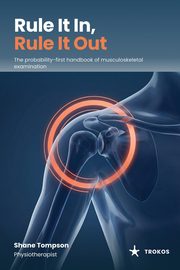
Get the book for telling the hip joint from the lateral hip, and ruling out the runner's stress fracture first
These pages give the published figures. Rule It In, Rule It Out adds, for the tests in the chapter ‘The hip and groin’: captioned drawings with the exact positions, the Rule-In / Rule-Out bar and evidence dots, a fuller interpretation of each test, and the clinical reasoning on which tests to use and in what order.
Look inside the book: free sample pages
Coming November 2026: 330 pages, paperback and PDF. Launch offer: subscribers get the PDF for A$39 instead of A$49, for the first two weeks after publication. Be first to know at launch
Condition pages: FAI syndrome (femoroacetabular impingement; cam or pincer hip shape) · Gluteal tendinopathy (lateral hip pain) · Intra-articular hip pain · Meralgia paraesthetica · Sciatic nerve entrapment in the buttock · Severe hip osteoarthritis · Suspected hip fracture after trauma · all, A to Z
One study, one test, once a month
Rule It In is a free evidence letter for musculoskeletal clinicians: one recent study explained, one examination test with its real numbers. From Trokos, publisher of Rule It In, Rule It Out.
Free when you confirm your email: this page as a one-page printable PDF, the same sheet for every other body region, and the one-page sheet of the strongest special tests to rule in and rule out.
Launch offer for subscribers: the PDF edition of Rule It In, Rule It Out for A$39 instead of A$49, for the first two weeks after publication. Sign up free to get the code on launch day.
By subscribing you agree to receive Rule It In by email, about once a month. You will get a confirmation email first, and nothing is sent until you click it. Your address is stored by Kit (Kit.com, United States) and used only for this newsletter and the subscriber launch offer; Kit records which issues are opened and which links are clicked. Unsubscribe with one click in any issue. Privacy.