
Special tests library › Hip, groin & thigh
Squeeze test (adductor)
Also called: groin squeeze test
For: Chronic groin pain with pubic bone oedema (once fracture is excluded)
Long-standing groin pain in athletes with bone marrow oedema (swelling seen on MRI) in the pubic bones at the front of the pelvis.
A weak test on its ownShort answer: On the published figures, a weak test on its own for chronic groin pain with pubic bone oedema (once fracture is excluded). In the source cited below, sensitivity was 49% and specificity 88%. See the notes below before relying on it.
How it is done
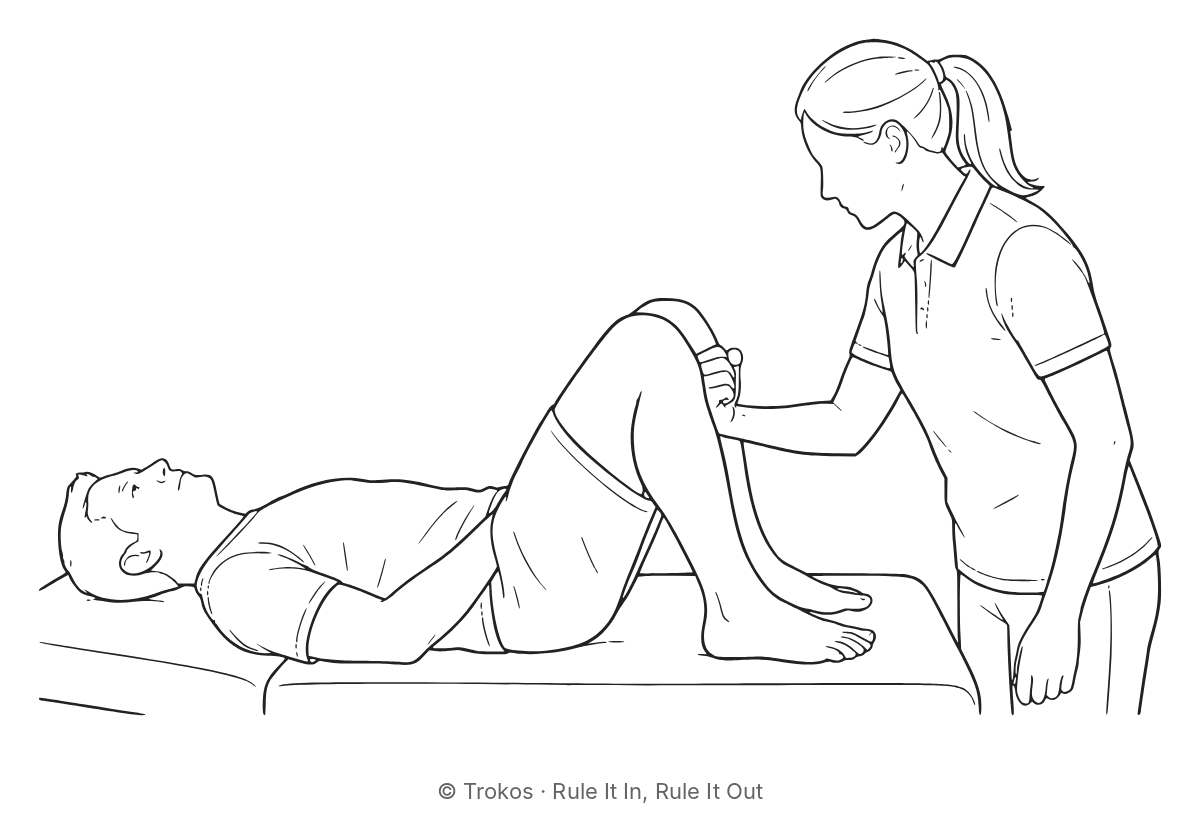
The patient lies supine with the hips flexed to about 45°, the knees to about 90° and the feet flat. The examiner places a fist or forearm between the knees, and the patient squeezes as hard as possible. Positive: Reproduction of the familiar groin pain. Reduced squeeze strength is worth recording, but it was not part of the original test.
What the numbers mean
- Positive result: a small shift: a positive result nudges the diagnosis up, but does not settle it.
- Negative result: barely informative: a negative result changes little.
The ladder: what a result does to your estimate
| If you thought | After a positive | After a negative |
|---|---|---|
| 10% | 32% | 6% |
| 30% | 64% | 20% |
| 50% | 81% | 37% |
Calculated from the likelihood ratios above, as in the book. Read the caution above before relying on these. For any other starting estimate, use the probability calculator.
Work out what a result means for your patient: probability calculator
How common is it? Starting probabilities by setting
Red flags to screen for before testing the hip, groin & thigh
Counts for chronic groin pain with pubic bone oedema: 18 of 37 with it and 6 of 52 without (Tables 1 and 2). Checked against the full paper on 15 October 2026.
Caution: Studied in Australian Rules footballers against chronic groin pain and MRI pubic bone marrow oedema, not today's adductor-related groin pain; the authors warn the specificity should be treated with caution.
Study details: patients, setting, confidence intervals, what was read
| Study | Verrall 2005 (cross-sectional prospective cohort) |
|---|---|
| Patients | 89 players; male Australian Rules footballers from three professional clubs, examined at the end of pre-season; deliberately weighted towards players with current or past groin pain (not a random sample); 37 had pubic bone stress injury, 52 did not |
| Compared against | pubic bone stress injury = chronic groin pain (6 weeks or more, with pubic symphysis or superior pubic ramus tenderness) PLUS unequivocal pubic bone marrow oedema on MRI (read by two radiologists blind to the clinical findings) |
| 95% confidence intervals | sensitivity 33–64%, specificity 77–95% (calculated from the study’s counts) |
| Counts | true positives 18, false positives 6, false negatives 19, true negatives 46 |
| Likelihood ratios | calculated from the study's counts (LR+ 18/37 ÷ 6/52 = 4.2; LR− 19/37 ÷ 46/52 = 0.58) |
| What we read | Full paper (Scand J Med Sci Sports 2005;15:36–42, via EBSCO), Table 1 (counts) and Table 2 (sensitivity 49%, specificity 88% for the squeeze test against pubic bone stress injury). Table 1 prints the squeeze-negative count in the stress-injury row as 29, a typo for 19 (row total is 37; 18/37 = 49% as Table 2 states). No LRs or CIs are published. |
| Things to bear in mind | A single blinded examiner tested players before taking their history, and every player had an MRI read blind, which is good. But the group was all male professional footballers chosen because many had groin pain, with no normal group and no other groin diagnoses analysed, so the authors themselves say the high specificity probably does not carry over to ordinary clinic patients. Only 37 had the condition, so the figures are imprecise. |
How these details are gathered and checked: Methods.
Source
Verrall GM, Slavotinek JP, Barnes PG, Fon GT. Description of pain provocation tests used for the diagnosis of sports-related chronic groin pain: relationship of tests to defined clinical (pain and tenderness) and MRI (pubic bone marrow oedema) criteria. Scand J Med Sci Sports. 2005;15(1):36–42. Journal article (DOI) · single study
Figures as they will appear in Rule It In, Rule It Out (Trokos, forthcoming). If a newer or better study changes them, this page changes with the book. Figures last updated from the book on 13 October 2026.
How to cite
Citing a figure? Cite the study it comes from. The main figures on this page come from:
Verrall GM, Slavotinek JP, Barnes PG, Fon GT. Description of pain provocation tests used for the diagnosis of sports-related chronic groin pain: relationship of tests to defined clinical (pain and tenderness) and MRI (pubic bone marrow oedema) criteria. Scand J Med Sci Sports. 2005;15(1):36–42.
Citing this page as a summary:
APA 7: Tompson, S. (2026, October 13). Squeeze test (adductor) for chronic groin pain with pubic bone oedema (once fracture is excluded). Trokos special tests library. Retrieved October 28, 2026, from https://trokos.com.au/tests/hip-squeeze.html
Vancouver: Tompson S. Squeeze test (adductor) for chronic groin pain with pubic bone oedema (once fracture is excluded) [Internet]. Sunshine Coast (QLD): Trokos; 2026 [updated 2026 Oct 13; cited 2026 Oct 28]. Available from: https://trokos.com.au/tests/hip-squeeze.html
Citing the whole library:
APA 7: Tompson, S. (2026). Trokos special tests library (Version November 2026) [Online reference library]. Zenodo. https://doi.org/10.5281/zenodo.23932041
Vancouver: Tompson S. Trokos special tests library [Internet]. Version November 2026. Geneva: Zenodo; 2026 [cited 2026 Nov 4]. Available from: https://doi.org/10.5281/zenodo.23932041
Get the book for telling the hip joint from the lateral hip, and ruling out the runner's stress fracture first
This page gives the published figures. Rule It In, Rule It Out adds captioned drawings with the exact positions, the Rule-In / Rule-Out bar and evidence dots, a fuller interpretation of each test, and the clinical reasoning on which tests to use and in what order.
Look inside the book: free sample pages
Coming November 2026: 330 pages, paperback and PDF. Launch offer: subscribers get the PDF for A$39 instead of A$49, for the first two weeks after publication. Be first to know at launch
One study, one test, once a month
Rule It In is a free evidence letter for musculoskeletal clinicians: one recent study explained, one examination test with its real numbers. From Trokos, publisher of Rule It In, Rule It Out.
Free when you confirm your email: a one-page PDF of the strongest special tests to rule in and rule out, with tests that carry a caution flagged separately.
Launch offer for subscribers: the PDF edition of Rule It In, Rule It Out for A$39 instead of A$49, for the first two weeks after publication. Sign up free to get the code on launch day.
By subscribing you agree to receive Rule It In by email, about once a month. You will get a confirmation email first, and nothing is sent until you click it. Your address is stored by Kit (Kit.com, United States) and used only for this newsletter and the subscriber launch offer; Kit records which issues are opened and which links are clicked. Unsubscribe with one click in any issue. Privacy.