
Special tests library › Hip, groin & thigh
Clinical tests for FAI syndrome (femoroacetabular impingement; cam or pincer hip shape)
A hip condition in which an unusual shape where the head of the femur joins its neck (cam), or of the hip socket (pincer), makes them press against each other during movement, causing hip or groin pain, often with deep bending or certain positions. The diagnosis needs symptoms, examination findings and imaging together.
The one test in the library with published accuracy figures for FAI syndrome (femoroacetabular impingement; cam or pincer hip shape), and what a positive or a negative result does to the probability. Click the test for how it is done, any caution, and the source.
Best to rule it in: no test in the library has a clean rule-in verdict for this condition.
Best to rule it out: no test in the library has a clean rule-out verdict for this condition.
Base it on your setting and the history. For published figures by setting, see How common is it?
| Test | Sensitivity | Specificity | LR+ | LR− | Verdict | If positive | If negative |
|---|---|---|---|---|---|---|---|
| FADIR test | 96% | 11% | 1.08 | 0.36 | A weak test on its own ?Low-quality evidence that varies widely: specificity ranges from 10% to 100% across studies of labral tears and from 11% to 47% across studies of FAI, and in the study behind these figures the surgeon's diagnosis used the FADIR result itself, which inflates sensitivity. | 32% | 13% |
‘If positive’ and ‘If negative’ are the probability after that one test, starting from 30%. A dash means the test page gives no likelihood ratio to calculate from.
Verdicts: rule in when LR+ is 5 or more; rule out when LR− is below 0.2; both when both; weak when neither; treat with caution where the study behind the figures is weak enough that the verdict may not hold. A caution can appear with any verdict — tap ? to read it.
Use one test at a time
Each probability above is for that test on its own, starting from the figure you set. Tests for the same problem are rarely independent, so a second positive adds much less than its own figure suggests. Do not multiply their figures together. Where a combination has been tested as a cluster or a decision rule, use that published result instead: see Studied combinations.
More: this condition in the I suspect… finder · Hip, groin & thigh tests · probability calculator · all condition pages, A to Z
These figures describe groups of patients in the cited studies, not the person in front of you. This page is a teaching aid for registered health practitioners and students, not clinical advice.
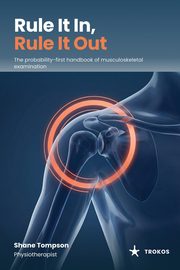
Get the book for telling the hip joint from the lateral hip, and ruling out the runner's stress fracture first
These pages give the published figures. Rule It In, Rule It Out adds, for the tests in the chapter ‘The hip and groin’: captioned drawings with the exact positions, the Rule-In / Rule-Out bar and evidence dots, a fuller interpretation of each test, and the clinical reasoning on which tests to use and in what order.
Look inside the book: free sample pages
Coming November 2026: 330 pages, paperback and PDF. Launch offer: subscribers get the PDF for A$39 instead of A$49, for the first two weeks after publication. Be first to know at launch
One study, one test, once a month
Rule It In is a free evidence letter for musculoskeletal clinicians: one recent study explained, one examination test with its real numbers. From Trokos, publisher of Rule It In, Rule It Out.
Free when you confirm your email: a one-page PDF of the strongest special tests to rule in and rule out, with tests that carry a caution flagged separately.
Launch offer for subscribers: the PDF edition of Rule It In, Rule It Out for A$39 instead of A$49, for the first two weeks after publication. Sign up free to get the code on launch day.
By subscribing you agree to receive Rule It In by email, about once a month. You will get a confirmation email first, and nothing is sent until you click it. Your address is stored by Kit (Kit.com, United States) and used only for this newsletter and the subscriber launch offer; Kit records which issues are opened and which links are clicked. Unsubscribe with one click in any issue. Privacy.