
Neck special tests cheat sheet
20 neck examination tests, grouped by the condition they test for, each with the published accuracy figures that exist for it. Click a test for what a positive and a negative result mean, and the source.
Before any test: Neck red flags: the serious conditions you cannot afford to miss
Free printable version: this page as a one-page PDF, with the caution notes and sources. Sign up free to download it.
Cervical myelopathy
Compare these tests side by side
| Test | Sensitivity | Specificity | LR+ | LR− | Verdict |
|---|---|---|---|---|---|
| Ankle clonus | 7% | 99% | 5.4 | 0.94 | Treat with caution ?Single study: only about 6 of 88 myelopathy patients were positive, so the figure is very imprecise. |
| Babinski sign | 7% | 100% | not calculable (specificity 100%) | 0.93 | Rule-in strength not calculable (no false positives seen) ?No false positives among the controls, but only 7% sensitivity; the lower confidence limit for LR+ is about 2.9. |
| Gait deviation / abnormality | 19% | 94% | 3.4 | 0.85 | A weak test on its own |
| Hoffmann's sign | 31% | 73% as printed (see test page) | 4.9 | 0.74 | A weak test on its own |
| Inverted supinator sign | 18% | 99% | 29.1 | 0.82 | Treat with caution ?Single study where the diagnosing clinicians also did the test; the likelihood ratio's plausible range is very wide. |
Verdicts: rule in when LR+ is 5 or more; rule out when LR− is below 0.2; both when both; weak when neither; treat with caution where the study behind the figures is weak enough that the verdict may not hold. A caution can appear with any verdict — tap ? to read it.
Cervical radiculopathy
Compare these tests side by side
| Test | Sensitivity | Specificity | LR+ | LR− | Verdict |
|---|---|---|---|---|---|
| Cervical distraction test | 44% | 90% | 4.4 | 0.62 | A weak test on its own ?From the original cluster study, Wainner 2003; in the 2026 validation by Grondin a positive moved probability little, LR+ 1.43. |
| Cervical rotation <60° (towards symptomatic side) | 89% | 49% | 1.75 | 0.22 | Treat with caution ?From the original cluster study, Wainner 2003; in the 2026 validation by Grondin a negative moved probability little, LR− 0.74. |
| Shoulder abduction relief sign | 49% | 76% | 2.08 | 0.66 | A weak test on its own |
| Spurling's test | 53% | 92% | 3.28 | 0.51 | A weak test on its own |
| Upper limb tension test (ULTT/ULNT A) | 70% | 71% | 2.45 | 0.42 | A weak test on its own ?Pooled at very low certainty (Thoomes 2026); the original study (Wainner 2003) reported LR− 0.12 and the 2026 validation (Grondin) LR− 0.54. |
| Valsalva test | 22% | 94% | 3.7 | 0.83 | Treat with caution ?One small 2003 study (about 19 people with radiculopathy), never repeated; its reference standard was nerve testing (EMG and nerve conduction), which the 2026 meta-analysis did not accept; the original paper could not be read, so the figures come from reviews that reprint them, the counts are not confirmed, and the likelihood ratios are calculated from rounded percentages. |
Verdicts: rule in when LR+ is 5 or more; rule out when LR− is below 0.2; both when both; weak when neither; treat with caution where the study behind the figures is weak enough that the verdict may not hold. A caution can appear with any verdict — tap ? to read it.
Cervical radiculopathy versus shoulder pain
| Test | Sensitivity | Specificity | LR+ | LR− | Verdict |
|---|---|---|---|---|---|
| Arm squeeze test | 96% | 91% | 10.6 | 0.04 | Treat with caution ?Case–control study in which every diagnosis was confirmed by imaging before the test was done, a design that tends to overestimate accuracy; LR+ 10.6 is the paper's own figure for its weakest comparison. |
Verdicts: rule in when LR+ is 5 or more; rule out when LR− is below 0.2; both when both; weak when neither; treat with caution where the study behind the figures is weak enough that the verdict may not hold. A caution can appear with any verdict — tap ? to read it.
Cervicogenic headache (C1–2)
| Test | Sensitivity | Specificity | LR+ | LR− | Verdict |
|---|---|---|---|---|---|
| Flexion-rotation test | 83% | 83% | 5 | 0.2 | Treat with caution ?Both ratios sit right on the moderate lines (LR+ 5, LR− 0.2), with wide confidence intervals: LR+ 2.6 to 9.5, LR− 0.1 to 0.4. |
Verdicts: rule in when LR+ is 5 or more; rule out when LR− is below 0.2; both when both; weak when neither; treat with caution where the study behind the figures is weak enough that the verdict may not hold. A caution can appear with any verdict — tap ? to read it.
Clinically important cervical spine injury after blunt trauma (need for imaging)
| Test | Sensitivity | Specificity | LR+ | LR− | Verdict |
|---|---|---|---|---|---|
| Canadian C-Spine Rule | 99.4% | 45.1% | 1.81 | 0.013 | Best used to rule out ?Developed and validated by the same research group in Canadian emergency departments; figures exclude the 10% of patients whose range of motion was not checked. |
Verdicts: rule in when LR+ is 5 or more; rule out when LR− is below 0.2; both when both; weak when neither; treat with caution where the study behind the figures is weak enough that the verdict may not hold. A caution can appear with any verdict — tap ? to read it.
Clinically significant cervical spine injury after blunt trauma (need for imaging)
| Test | Sensitivity | Specificity | LR+ | LR− | Verdict |
|---|---|---|---|---|---|
| NEXUS low-risk criteria | 99.6% | 12.9% | 1.14 | 0.03 | Treat with caution ?In a later head-to-head study (Stiell 2003) sensitivity was only 90.7% (LR− 0.25), so a negative may not rule injury out as reliably. |
Verdicts: rule in when LR+ is 5 or more; rule out when LR− is below 0.2; both when both; weak when neither; treat with caution where the study behind the figures is weak enough that the verdict may not hold. A caution can appear with any verdict — tap ? to read it.
Commonly taught, no reliable figures yet
These tests are widely taught, but no reliable accuracy figures have been published for them, so they have no verdict and are left out of the calculator and the strongest-tests list. Each page shows how the test is done and what the research says.
- Alar ligament stress tests (Alar ligament damage and upper neck instability): The only study that prints sensitivity and specificity is a tiny case-control study (7 people with alar ligament lesions on MRI and 11 healthy volunteers), whose authors say no conclusions can be drawn about clinical use; a larger study comparing the tests with MRI (Kaale 2008) prints only agreement figures, and MRI itself is a doubtful reference.
- Jackson's compression test (Cervical radiculopathy): No study of its diagnostic accuracy could be found; the neck compression tests that have been studied are versions of Spurling's test, and their figures do not apply to this test.
- Lhermitte's sign (Cervical myelopathy): No study measuring its accuracy for degenerative cervical myelopathy against a reference standard could be read, and the two latest reviews of myelopathy signs and symptoms give no accuracy figures for it.
- Sharp-Purser test (Atlantoaxial (upper neck) instability): Published studies flatly disagree (LR+ from about 0.7 to 22), and the latest systematic review advises against relying on it.
- Vertebral artery positional tests (VBI tests) (Vertebral artery problems before neck manual therapy): The only systematic review found just 4 poor-quality studies with widely conflicting results (sensitivity 0–57%, positive likelihood ratios from 0.22 to 83), and the international framework for examining the neck before manual therapy says therapists cannot rely on the result of any one clinical test.
LR+ says how much a positive result moves the probability up; LR− how much a negative moves it down. Tests for the same problem are rarely independent, so their figures should not be multiplied together. To turn a figure into a probability for your patient, use the probability calculator.
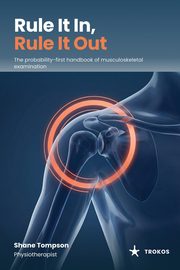
Get the book for the neck questions that matter: nerve root or referred pain, which myelopathy signs count, and when a neck after trauma needs imaging
These pages give the published figures. Rule It In, Rule It Out adds, for the tests in the chapter ‘The neck’: captioned drawings with the exact positions, the Rule-In / Rule-Out bar and evidence dots, a fuller interpretation of each test, and the clinical reasoning on which tests to use and in what order.
Look inside the book: free sample pages
Coming November 2026: 330 pages, paperback and PDF. Launch offer: subscribers get the PDF for A$39 instead of A$49, for the first two weeks after publication. Be first to know at launch
Condition pages: Atlantoaxial (upper neck) instability · Cervical myelopathy · Cervical radiculopathy · Cervicogenic headache (C1–2) · Clinically important cervical spine injury after blunt trauma (need for imaging) · Vertebral artery problems before neck manual therapy · all, A to Z
One study, one test, once a month
Rule It In is a free evidence letter for musculoskeletal clinicians: one recent study explained, one examination test with its real numbers. From Trokos, publisher of Rule It In, Rule It Out.
Free when you confirm your email: this page as a one-page printable PDF, the same sheet for every other body region, and the one-page sheet of the strongest special tests to rule in and rule out.
Launch offer for subscribers: the PDF edition of Rule It In, Rule It Out for A$39 instead of A$49, for the first two weeks after publication. Sign up free to get the code on launch day.
By subscribing you agree to receive Rule It In by email, about once a month. You will get a confirmation email first, and nothing is sent until you click it. Your address is stored by Kit (Kit.com, United States) and used only for this newsletter and the subscriber launch offer; Kit records which issues are opened and which links are clicked. Unsubscribe with one click in any issue. Privacy.