
Cervical distraction test
Also called: neck distraction test
For: Cervical radiculopathy
Irritation or compression of a cervical nerve root, usually by a disc bulge or bony narrowing. It causes arm pain, and sometimes pins and needles, numbness or weakness in the distribution of that nerve.
A weak test on its ownShort answer: On the published figures, a weak test on its own for cervical radiculopathy. In the source cited below, sensitivity was 44% and specificity 90%. See the notes below before relying on it.
How it is done
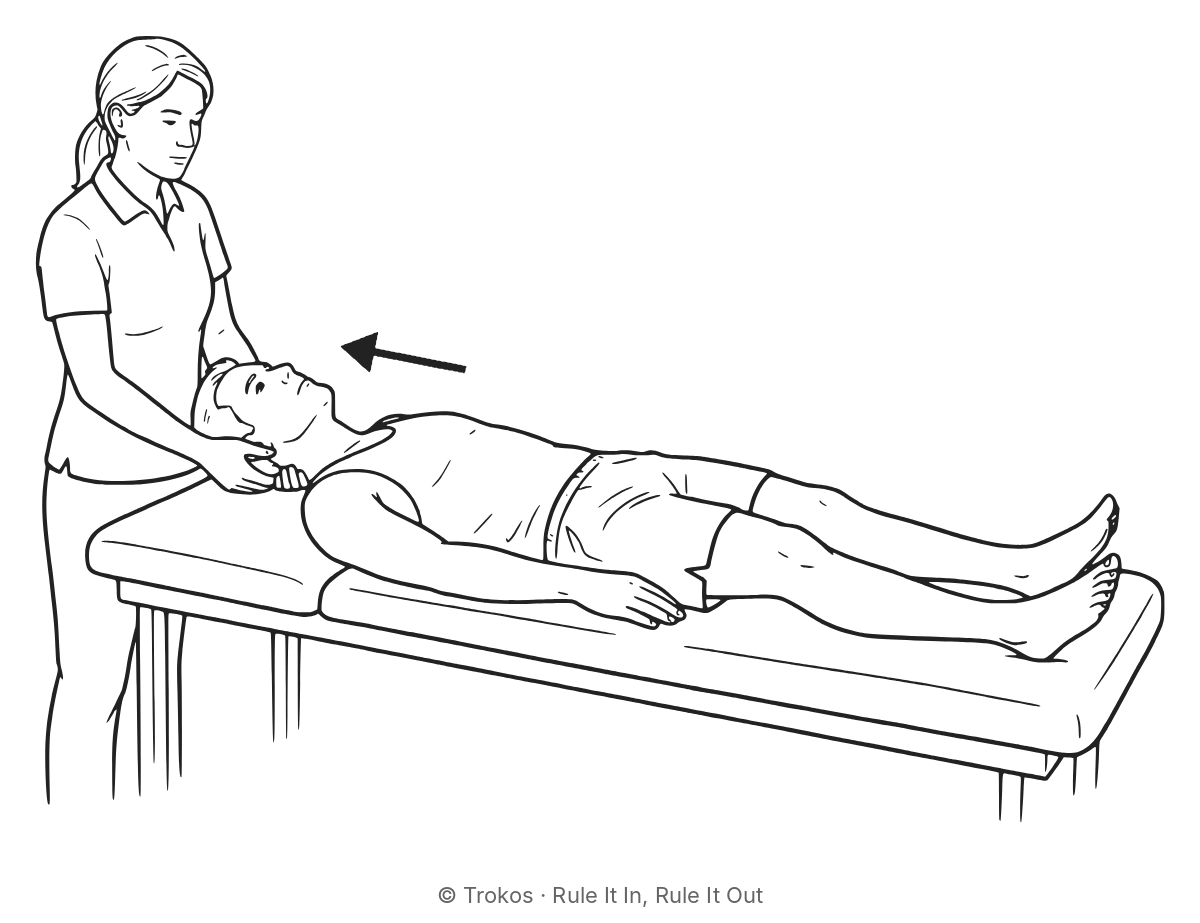
The patient is supine or seated. The examiner cups the base of the skull with both hands (or one hand at the base of the skull and one under the chin), applies gradual traction along the line of the neck to take the weight of the head, and holds this position. Positive: Easing or disappearance of the arm symptoms while the traction is held (a relief test).
What the numbers mean
- Positive result: a small shift: a positive result nudges the diagnosis up, but does not settle it.
- Negative result: barely informative: a negative result changes little.
The ladder: what a result does to your estimate
| If you thought | After a positive | After a negative |
|---|---|---|
| 10% | 33% | 6% |
| 30% | 65% | 21% |
| 50% | 81% | 38% |
Calculated from the likelihood ratios above, as in the book. Read the caution above before relying on these. For any other starting estimate, use the probability calculator.
Studied combinations: this test as part of a published cluster
The distraction test has been studied as one of four items in a cluster for cervical radiculopathy (Wainner 2003): upper limb tension test A positive, neck rotation of less than 60° towards the painful side, symptoms eased by neck distraction, and Spurling's test positive. In the original study of 82 patients (reference standard: nerve conduction and EMG testing), three of the four positive gave an LR+ of 6.1 and all four positive gave an LR+ of 30.3, with very wide confidence intervals (figures from secondary sources; original full text not seen). An independent study in 2026 of 85 patients (reference standard: MRI plus specialist diagnosis) found an LR+ of 7.7 (95% CI 3.2–20.7) with three of the four positive; all four positive picked up 18% of those with radiculopathy, with no false positives. These figures come from the tests as performed and scored in those studies.
Sources: Wainner RS et al. Spine 2003;28(1):52–62. Grondin F et al. Braz J Phys Ther 2026;30(3):101581.
Rule It In, Rule It Out covers how this cluster fits into the examination.
Work out what a result means for your patient: probability calculator
Sensitivity and specificity confirmed in the systematic review by Rubinstein 2007 (Table 4: 19 with and 63 without radiculopathy, needle electromyography (EMG) and nerve conduction studies as the reference).
Caution: From the original cluster study, Wainner 2003; in the 2026 validation by Grondin a positive moved probability little, LR+ 1.43.
Study details: patients, setting, confidence intervals, what was read
| Study | Wainner 2003 (prospective cross-sectional, blinded) |
|---|---|
| Patients | 82 patients; patients referred to an electrophysiology lab with suspected cervical radiculopathy or carpal tunnel syndrome, 4 US medical centres; 19 had radiculopathy |
| Compared against | needle EMG and nerve conduction studies |
| 95% confidence intervals | sensitivity 21–67%, specificity 82–98% (as published) |
| Likelihood ratios | calculated from the sensitivity and specificity above |
| What we read | Open-access review that tabulates the original study; Rubinstein 2007 Table 4 (PMC2200707, full text) tabulates Wainner's figures; Wainner's own abstract (PMID 12544957) gives no per-test figures and the Spine full text is paywalled |
| Things to bear in mind | Only 19 of the 82 patients had radiculopathy, so the sensitivity is very imprecise (21% to 67%). Examiners were blind to the nerve-test result, but the reference standard was nerve testing alone rather than imaging, and patients were already referred for nerve tests. |
How these details are gathered and checked: Methods.
Other tests in the library for cervical radiculopathy
- Cervical rotation <60° (towards symptomatic side)
- Spurling's test
- Upper limb tension test (ULTT/ULNT A)
Compare all the tests for cervical radiculopathy side by side
Red flags to screen for before testing the neck
Source
Wainner RS, Fritz JM, Irrgang JJ, Boninger ML, Delitto A, Allison S. Reliability and diagnostic accuracy of the clinical examination and patient self-report measures for cervical radiculopathy. Spine. 2003;28(1):52–62. PubMed · single study
Also cited: Rubinstein SM, Pool JJM, van Tulder MW, Riphagen II, de Vet HCW. A systematic review of the diagnostic accuracy of provocative tests of the neck for diagnosing cervical radiculopathy. Eur Spine J. 2007;16(3):307–319. Full text (PubMed Central)
Also cited: Grondin F, Cook C, Hall T, Maillard O, Perdrix Y, Freppel S. An independent validation of a clinical prediction rule for the diagnosis of cervical radiculopathy with radicular pain. Braz J Phys Ther. 2026;30(3):101581. Journal article (DOI)
Figures as they will appear in Rule It In, Rule It Out (Trokos, forthcoming). If a newer or better study changes them, this page changes with the book. Figures last updated from the book on 13 October 2026.
How to cite
Citing a figure? Cite the study it comes from. The main figures on this page come from:
Wainner RS, Fritz JM, Irrgang JJ, Boninger ML, Delitto A, Allison S. Reliability and diagnostic accuracy of the clinical examination and patient self-report measures for cervical radiculopathy. Spine. 2003;28(1):52–62.
Figures quoted in the notes from other studies are cited under Source above.
Citing this page as a summary:
APA 7: Tompson, S. (2026, October 13). Cervical distraction test for cervical radiculopathy. Trokos special tests library. Retrieved October 28, 2026, from https://trokos.com.au/tests/cervical-distraction.html
Vancouver: Tompson S. Cervical distraction test for cervical radiculopathy [Internet]. Sunshine Coast (QLD): Trokos; 2026 [updated 2026 Oct 13; cited 2026 Oct 28]. Available from: https://trokos.com.au/tests/cervical-distraction.html
Citing the whole library:
APA 7: Tompson, S. (2026). Trokos special tests library (Version November 2026) [Online reference library]. Zenodo. https://doi.org/10.5281/zenodo.23932041
Vancouver: Tompson S. Trokos special tests library [Internet]. Version November 2026. Geneva: Zenodo; 2026 [cited 2026 Nov 4]. Available from: https://doi.org/10.5281/zenodo.23932041

Get the book for the neck questions that matter: nerve root or referred pain, which myelopathy signs count, and when a neck after trauma needs imaging
This page gives the published figures. Rule It In, Rule It Out adds captioned drawings with the exact positions, the Rule-In / Rule-Out bar and evidence dots, a fuller interpretation of each test, and the clinical reasoning on which tests to use and in what order.
Look inside the book: free sample pages
Coming November 2026: 330 pages, paperback and PDF. Launch offer: subscribers get the PDF for A$39 instead of A$49, for the first two weeks after publication. Be first to know at launch
One study, one test, once a month
Rule It In is a free evidence letter for musculoskeletal clinicians: one recent study explained, one examination test with its real numbers. From Trokos, publisher of Rule It In, Rule It Out.
Free when you confirm your email: a one-page PDF of the strongest special tests to rule in and rule out, with tests that carry a caution flagged separately.
Launch offer for subscribers: the PDF edition of Rule It In, Rule It Out for A$39 instead of A$49, for the first two weeks after publication. Sign up free to get the code on launch day.
By subscribing you agree to receive Rule It In by email, about once a month. You will get a confirmation email first, and nothing is sent until you click it. Your address is stored by Kit (Kit.com, United States) and used only for this newsletter and the subscriber launch offer; Kit records which issues are opened and which links are clicked. Unsubscribe with one click in any issue. Privacy.