
Inverted supinator sign
Also called: inverted radial reflex
For: Cervical myelopathy
Compression of the cervical spinal cord, usually from degenerative narrowing. It can cause clumsy hands, an unsteady gait, symptoms in both arms or in the legs, and brisk reflexes, although these signs are often absent early.
Treat with caution (see below)Short answer: Treat results with caution when testing for cervical myelopathy: read the notes below before relying on one. In the source cited below, sensitivity was 18% and specificity 99%.
How it is done
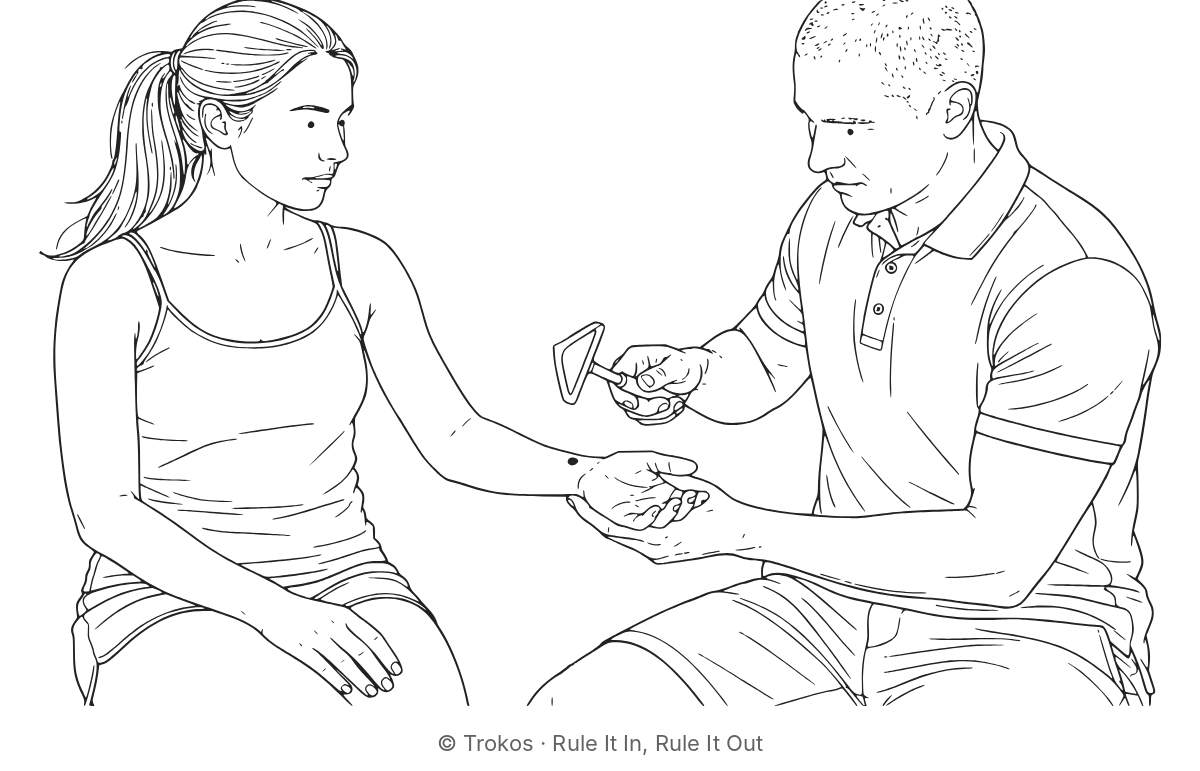
The examiner taps the brachioradialis tendon just above the wrist with a reflex hammer, with the forearm relaxed and supported. Positive: Flexion of the fingers, usually with a reduced brachioradialis response (an upper motor neuron sign around C5–6).
What the numbers mean
- Positive result: see the caution above before relying on this result.
- Negative result: barely informative: a negative result changes little.
The ladder: what a result does to your estimate
| If you thought | After a positive | After a negative |
|---|---|---|
| 10% | 76% | 8% |
| 30% | 93% | 26% |
| 50% | 97% | 45% |
Calculated from the likelihood ratios above. Read the caution above before relying on these. For any other starting estimate, use the probability calculator.
Work out what a result means for your patient: probability calculator
Likelihood ratios as published by Cook 2010 (Table 2), which fit 1 positive among 161 controls. Jiang et al. 2024 assumed 2 positives and got LR+ 14.64; both round to the printed 99% specificity. With so few positives the LR+ is very imprecise (95% CI 5.1 to 171.5). Checked against the full paper on 23 October 2026.
Caution: Single study where the diagnosing clinicians also did the test; the likelihood ratio's plausible range is very wide.
Study details: patients, setting, confidence intervals, what was read
| Study | Cook 2010 (consecutive spine-clinic patients; data recorded prospectively, analysed retrospectively) |
|---|---|
| Patients | 249 patients; spine centre: 88 with cervical myelopathy, 161 with neck pain or dysfunction diagnosed without myelopathy (the diagnosis was confirmed or ruled out with MRI in all 249) |
| Compared against | clinical diagnosis from symptoms, examination and imaging |
| 95% confidence intervals | sensitivity 14–19%, specificity 97–99%, LR+ 5.1–171.5, LR− 0.81–0.84, as printed in the paper |
| Counts | true positives 16, false positives 1, false negatives 72, true negatives 160 (not printed in the paper; these are the counts its likelihood ratios fit) |
| Likelihood ratios | as published by the study |
| What we read | Full paper; Cook 2010 Table 2 (publisher PDF and PubMed Central PMC3113267); Jiang 2024 Table 5 (PMC11289551 full text) also read. Cook 2010 full text (PMC3113267) Table 2 read directly on 23 October 2026 |
| Things to bear in mind | Only 1 or 2 of 161 controls were positive, so the LR+ is very imprecise and could be far lower or higher. The examination findings were part of the diagnosis, so the sign was partly judged against itself. |
How these details are gathered and checked: Methods.
Other tests in the library for cervical myelopathy
Compare all the tests for cervical myelopathy side by side
Red flags to screen for before testing the neck
Source
Cook C, Brown C, Isaacs R, Roman M, Davis S, Richardson W. Clustered clinical findings for diagnosis of cervical spine myelopathy. J Man Manip Ther. 2010;18(4):175–180. Journal article (DOI) · single study
Also cited: Jiang Z, Davies B, Zipser C, et al. The value of clinical signs in the diagnosis of degenerative cervical myelopathy: a systematic review and meta-analysis. Global Spine J. 2024;14(4):1369–1394. Full text (PubMed Central) · likelihood ratios as recalculated in this review
Likelihood ratios updated on 22 October 2026 to those printed in the original study (Cook 2010). Rule It In, Rule It Out (Trokos, forthcoming) will use the same figures.
How to cite
Citing a figure? Cite the study it comes from. The main figures on this page come from:
Cook C, Brown C, Isaacs R, Roman M, Davis S, Richardson W. Clustered clinical findings for diagnosis of cervical spine myelopathy. J Man Manip Ther. 2010;18(4):175–180.
Figures quoted in the notes from other studies are cited under Source above.
Citing this page as a summary:
APA 7: Tompson, S. (2026, October 22). Inverted supinator sign for cervical myelopathy. Trokos special tests library. Retrieved October 28, 2026, from https://trokos.com.au/tests/cervical-invertedsupinator.html
Vancouver: Tompson S. Inverted supinator sign for cervical myelopathy [Internet]. Sunshine Coast (QLD): Trokos; 2026 [updated 2026 Oct 22; cited 2026 Oct 28]. Available from: https://trokos.com.au/tests/cervical-invertedsupinator.html
Citing the whole library:
APA 7: Tompson, S. (2026). Trokos special tests library (Version November 2026) [Online reference library]. Zenodo. https://doi.org/10.5281/zenodo.23932041
Vancouver: Tompson S. Trokos special tests library [Internet]. Version November 2026. Geneva: Zenodo; 2026 [cited 2026 Nov 4]. Available from: https://doi.org/10.5281/zenodo.23932041
Get the book for the neck questions that matter: nerve root or referred pain, which myelopathy signs count, and when a neck after trauma needs imaging
This page gives the published figures. Rule It In, Rule It Out adds captioned drawings with the exact positions, the Rule-In / Rule-Out bar and evidence dots, a fuller interpretation of each test, and the clinical reasoning on which tests to use and in what order.
Look inside the book: free sample pages
Coming November 2026: 330 pages, paperback and PDF. Launch offer: subscribers get the PDF for A$39 instead of A$49, for the first two weeks after publication. Be first to know at launch
One study, one test, once a month
Rule It In is a free evidence letter for musculoskeletal clinicians: one recent study explained, one examination test with its real numbers. From Trokos, publisher of Rule It In, Rule It Out.
Free when you confirm your email: a one-page PDF of the strongest special tests to rule in and rule out, with tests that carry a caution flagged separately.
Launch offer for subscribers: the PDF edition of Rule It In, Rule It Out for A$39 instead of A$49, for the first two weeks after publication. Sign up free to get the code on launch day.
By subscribing you agree to receive Rule It In by email, about once a month. You will get a confirmation email first, and nothing is sent until you click it. Your address is stored by Kit (Kit.com, United States) and used only for this newsletter and the subscriber launch offer; Kit records which issues are opened and which links are clicked. Unsubscribe with one click in any issue. Privacy.