
Special tests library › Wrist & hand
Reverse Phalen's test
Also called: reverse Phalen test, prayer test
For: Carpal tunnel syndrome
Compression of the median nerve in the carpal tunnel at the front of the wrist. It causes tingling and numbness in the thumb, index and middle fingers, often at night.
No reliable published figuresShort answer: There are no reliable published accuracy figures for this test for carpal tunnel syndrome; the note below says why.
How it is done
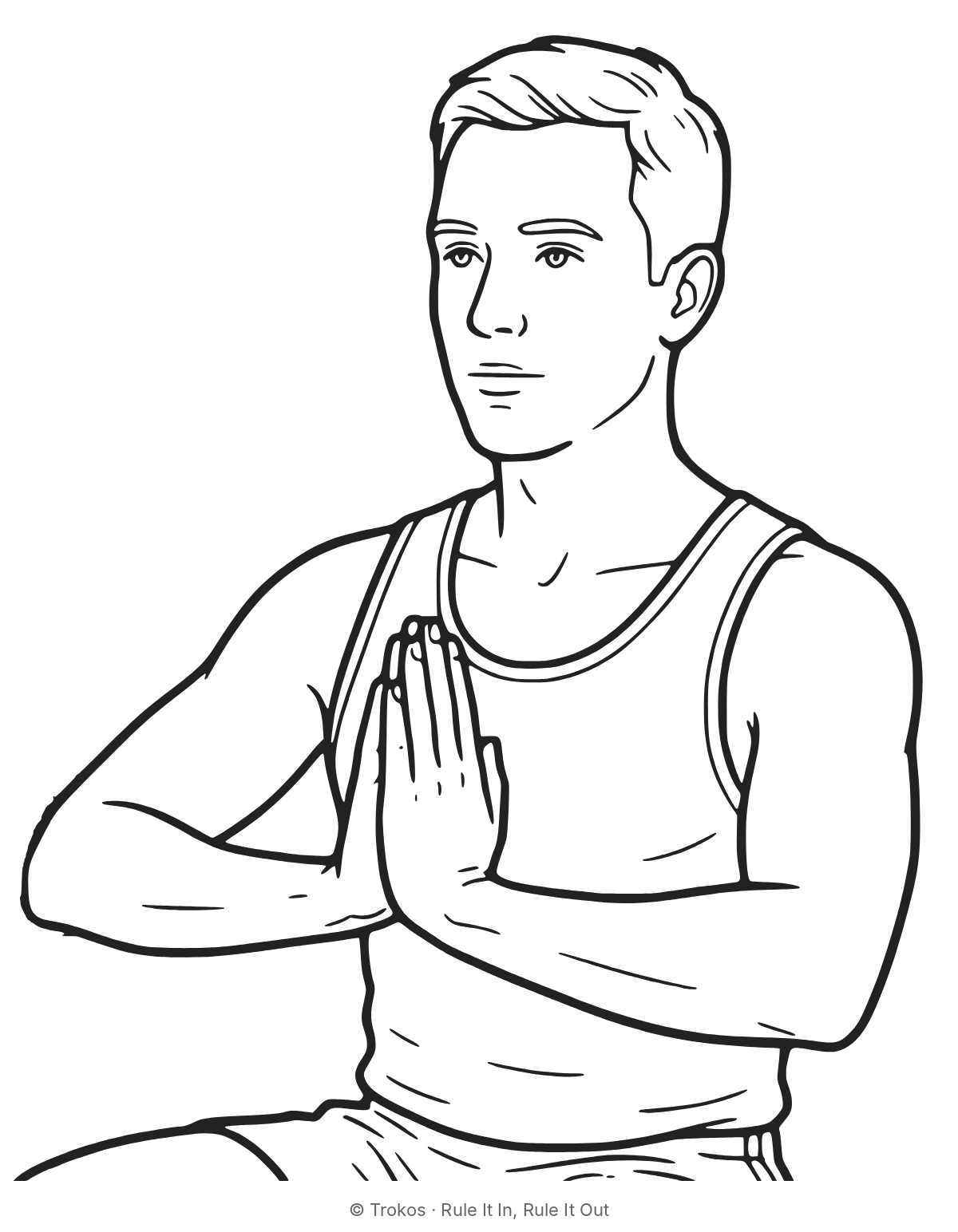
The patient presses the palms together with the wrists in full extension (the prayer position) and holds the position for up to 60 seconds. Positive: Median-territory tingling or numbness during the hold.
What the numbers mean
- The published figures conflict, so a positive or negative result cannot be given a weight. The standard Phalen’s test has published figures.
Published figures conflict. The 41% sensitivity and 55% specificity often quoted from de Krom 1990 are not in that study’s abstract and could not be confirmed. A 2023 review (Dabbagh 2023) reports one study (MacDermid 1997, 42 patients) at sensitivity 69% and specificity 96%, but that study’s own abstract says the wrist extension test had poor sensitivity (abstract source only). Neither set of figures is used.
Do two examiners agree?
Substantial or better (kappa above 0.71; 42 patients, 1 study) (abstract source only). Source: MacDermid 1997.
Rule It In, Rule It Out gives the full reliability detail: every study, the same examiner versus two examiners, and the patients tested.
Other tests in the library for carpal tunnel syndrome
Compare all the tests for carpal tunnel syndrome side by side
Red flags to screen for before testing the wrist & hand
Source
de Krom MC, Knipschild PG, Kester AD, et al. Efficacy of provocative tests for diagnosis of carpal tunnel syndrome. Lancet. 1990;335(8686):393–395. PubMed · single study
Also cited: Dabbagh A, MacDermid JC, Yong J, Packham TL, Grewal R, Boutsikari EC. Diagnostic test accuracy of provocative maneuvers for the diagnosis of carpal tunnel syndrome: a systematic review and meta-analysis. Phys Ther. 2023;103(6):pzad029. PubMed
Also cited: MacDermid JC, Kramer JF, McFarlane RM, Roth JH. Inter-rater agreement and accuracy of clinical tests used in diagnosis of carpal tunnel syndrome. Work. 1997;8(1):37–44. Journal article (DOI)
Rule It In, Rule It Out (Trokos, forthcoming) does not give this test a card, because its published figures conflict. Figures removed from this page on 28 October 2026.
How to cite
Citing this page? The study discussed here is:
de Krom MC, Knipschild PG, Kester AD, et al. Efficacy of provocative tests for diagnosis of carpal tunnel syndrome. Lancet. 1990;335(8686):393–395.
Citing this page as a summary:
APA 7: Tompson, S. (2026, October 13). Reverse Phalen's test for carpal tunnel syndrome. Trokos special tests library. Retrieved October 28, 2026, from https://trokos.com.au/tests/wrist-reversephalens.html
Vancouver: Tompson S. Reverse Phalen's test for carpal tunnel syndrome [Internet]. Sunshine Coast (QLD): Trokos; 2026 [updated 2026 Nov 11; cited 2026 Oct 28]. Available from: https://trokos.com.au/tests/wrist-reversephalens.html
Citing the whole library:
APA 7: Tompson, S. (2026). Trokos special tests library (Version November 2026) [Online reference library]. Zenodo. https://doi.org/10.5281/zenodo.23932041
Vancouver: Tompson S. Trokos special tests library [Internet]. Version November 2026. Geneva: Zenodo; 2026 [cited 2026 Nov 4]. Available from: https://doi.org/10.5281/zenodo.23932041

Get the book for the clinical reasoning behind each wrist and hand test it covers, and which carpal tunnel test to trust
This page explains why there are no reliable figures for this test. Rule It In, Rule It Out covers the tests for this region that do have published figures, how to read their results, and, where studied, whether combining tests helps.
Look inside the book: free sample pages
Coming November 2026: 330 pages, paperback and PDF. Launch offer: subscribers get the PDF for A$39 instead of A$49, for the first two weeks after publication. Be first to know at launch
One study, one test, once a month
Rule It In is a free evidence letter for musculoskeletal clinicians: one recent study explained, one examination test with its real numbers. From Trokos, publisher of Rule It In, Rule It Out.
Free when you confirm your email: a one-page PDF of the strongest special tests to rule in and rule out, with tests that carry a caution flagged separately.
Launch offer for subscribers: the PDF edition of Rule It In, Rule It Out for A$39 instead of A$49, for the first two weeks after publication. Sign up free to get the code on launch day.
By subscribing you agree to receive Rule It In by email, about once a month. You will get a confirmation email first, and nothing is sent until you click it. Your address is stored by Kit (Kit.com, United States) and used only for this newsletter and the subscriber launch offer; Kit records which issues are opened and which links are clicked. Unsubscribe with one click in any issue. Privacy.