
Special tests library › Wrist & hand
Phalen's test
Also called: Phalen test, Phalen's sign, wrist flexion test
For: Carpal tunnel syndrome
Compression of the median nerve in the carpal tunnel at the front of the wrist. It causes tingling and numbness in the thumb, index and middle fingers, often at night.
A weak test on its ownShort answer: On the published figures, a weak test on its own for carpal tunnel syndrome. In the source cited below, sensitivity was 57% and specificity 67%.
How it is done
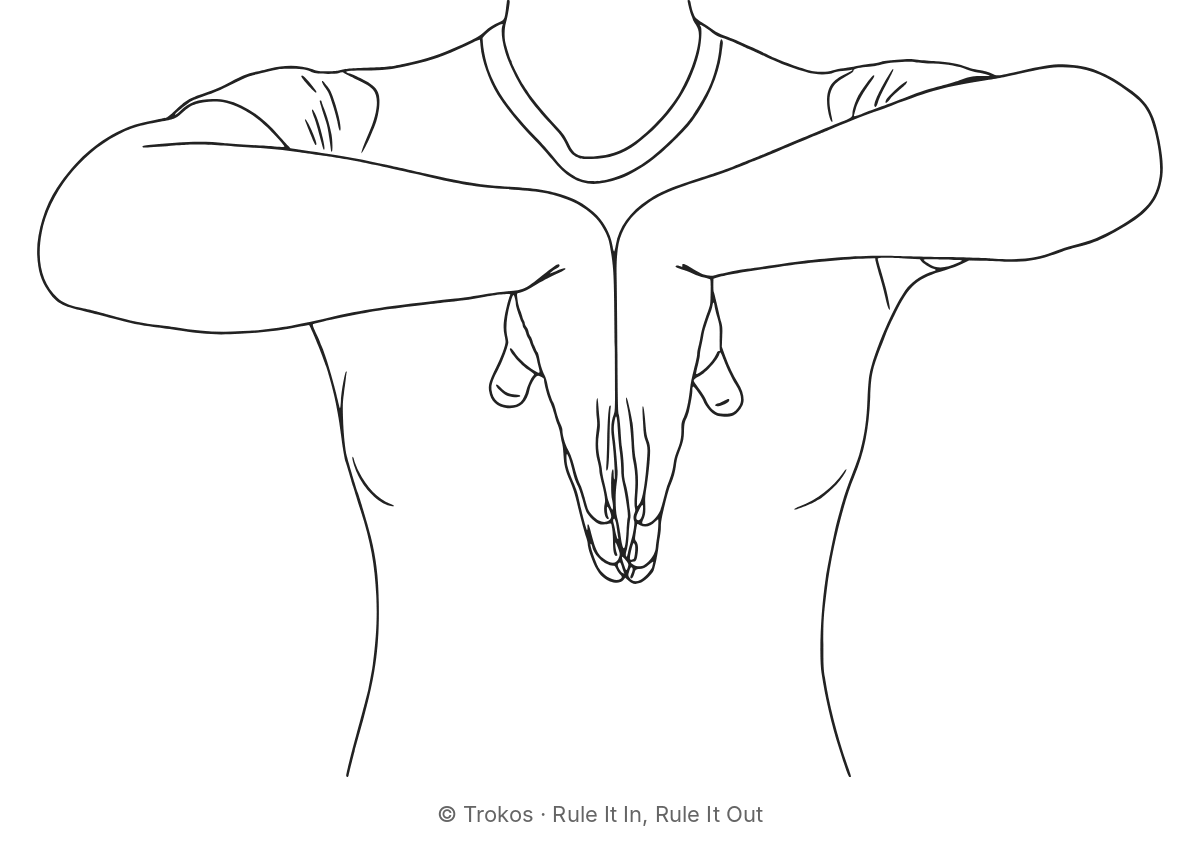
The wrists are held in full, unforced flexion for up to 60 seconds, either by letting the hands hang under gravity with the elbows flexed, or by resting the backs of the hands together without pressing. The studies behind these figures used unforced flexion. Positive: Numbness or tingling in the median distribution (thumb to the radial half of the ring finger) during the hold.
What the numbers mean
- Positive result: barely informative: a positive result changes little.
- Negative result: barely informative: a negative result changes little.
The ladder: what a result does to your estimate
| If you thought | After a positive | After a negative |
|---|---|---|
| 10% | 16% | 7% |
| 30% | 42% | 22% |
| 50% | 63% | 39% |
Calculated from the likelihood ratios above, as in the book. For any other starting estimate, use the probability calculator.
Work out what a result means for your patient: probability calculator
Likelihood ratios as published by the review's pooled model, so they differ slightly from the ratio of the pooled percentages. Checked against the full paper on 23 October 2026.
Do two examiners agree?
Substantial or better (kappa above 0.71; 42 patients, 1 study); a study of 160 keyboard workers reported 0.20-0.43 for Phalen's test and Tinel's sign together (abstract source only). Source: MacDermid 1997; Salerno 2000.
Rule It In, Rule It Out gives the full reliability detail: every study, the same examiner versus two examiners, and the patients tested.
Study details: patients, setting, confidence intervals, what was read
| Study | Dabbagh 2023 (systematic review/meta-analysis (bivariate random-effects)) |
|---|---|
| Patients | 604 patients; pooled from 7 studies of adults with symptoms suggesting carpal tunnel; studies using healthy people as controls were excluded |
| Compared against | electrodiagnostic testing and/or specialist clinical examination |
| 95% confidence intervals | sensitivity 44–68%, specificity 52–79% (as published) |
| Likelihood ratios | as published by the study |
| What we read | Full paper (Phys Ther 2023;103(6):pzad029); the same chapter was also read in the author's Western University thesis (ir.lib.uwo.ca/etd/9481) |
| Things to bear in mind | Pooled estimate from 7 studies of mixed quality: the authors rated the reference standard domain as at risk in most studies, and single-study results ranged from 12% to 92% sensitivity, so the pooled figure hides big differences between studies. Pooled LR+ 1.71 (1.18–2.50) and LR− 0.65 (0.50–0.84) are the model's own figures. |
How these details are gathered and checked: Methods.
Other tests in the library for carpal tunnel syndrome
Compare all the tests for carpal tunnel syndrome side by side
Red flags to screen for before testing the wrist & hand
Source
Dabbagh A, MacDermid JC, Yong J, Packham TL, Grewal R, Boutsikari EC. Diagnostic test accuracy of provocative maneuvers for the diagnosis of carpal tunnel syndrome: a systematic review and meta-analysis. Phys Ther. 2023;103(6):pzad029. PubMed · meta-analysis
Figures as they will appear in Rule It In, Rule It Out (Trokos, forthcoming). If a newer or better study changes them, this page changes with the book. Figures last updated from the book on 13 October 2026.
How to cite
Citing a figure? Cite the study it comes from. The main figures on this page come from:
Dabbagh A, MacDermid JC, Yong J, Packham TL, Grewal R, Boutsikari EC. Diagnostic test accuracy of provocative maneuvers for the diagnosis of carpal tunnel syndrome: a systematic review and meta-analysis. Phys Ther. 2023;103(6):pzad029.
Citing this page as a summary:
APA 7: Tompson, S. (2026, October 13). Phalen's test for carpal tunnel syndrome. Trokos special tests library. Retrieved October 28, 2026, from https://trokos.com.au/tests/wrist-phalens.html
Vancouver: Tompson S. Phalen's test for carpal tunnel syndrome [Internet]. Sunshine Coast (QLD): Trokos; 2026 [updated 2026 Oct 13; cited 2026 Oct 28]. Available from: https://trokos.com.au/tests/wrist-phalens.html
Citing the whole library:
APA 7: Tompson, S. (2026). Trokos special tests library (Version November 2026) [Online reference library]. Zenodo. https://doi.org/10.5281/zenodo.23932041
Vancouver: Tompson S. Trokos special tests library [Internet]. Version November 2026. Geneva: Zenodo; 2026 [cited 2026 Nov 4]. Available from: https://doi.org/10.5281/zenodo.23932041

Get the book for the clinical reasoning behind each wrist and hand test it covers, and which carpal tunnel test to trust
This page gives the published figures. Rule It In, Rule It Out adds captioned drawings with the exact positions, the Rule-In / Rule-Out bar and evidence dots, a fuller interpretation of each test, and the clinical reasoning on which tests to use and in what order.
Look inside the book: free sample pages
Coming November 2026: 330 pages, paperback and PDF. Launch offer: subscribers get the PDF for A$39 instead of A$49, for the first two weeks after publication. Be first to know at launch
One study, one test, once a month
Rule It In is a free evidence letter for musculoskeletal clinicians: one recent study explained, one examination test with its real numbers. From Trokos, publisher of Rule It In, Rule It Out.
Free when you confirm your email: a one-page PDF of the strongest special tests to rule in and rule out, with tests that carry a caution flagged separately.
Launch offer for subscribers: the PDF edition of Rule It In, Rule It Out for A$39 instead of A$49, for the first two weeks after publication. Sign up free to get the code on launch day.
By subscribing you agree to receive Rule It In by email, about once a month. You will get a confirmation email first, and nothing is sent until you click it. Your address is stored by Kit (Kit.com, United States) and used only for this newsletter and the subscriber launch offer; Kit records which issues are opened and which links are clicked. Unsubscribe with one click in any issue. Privacy.