
Special tests library › I suspect…
I suspect…: which tests to use for a condition
Choose the condition you suspect. The finder lists every test in the library for it, the best rule-in and rule-out tests first, and shows what a positive and a negative result would do to the probability for your patient. It uses the same figures as each test page.
Or choose a body region
Base it on your setting and the history. For published figures by setting, see How common is it?
Use one test at a time
Each probability above is for that test on its own, starting from the figure you set. Tests for the same problem are rarely independent, so a second positive adds much less than its own figure suggests. Do not multiply their figures together. Where a combination has been tested as a cluster or a decision rule, use that published result instead: see Studied combinations.
For one test at a time with your own figures, use the probability calculator.
See all 110 conditions in the finder
Neck: Alar ligament damage and upper neck instability · Atlantoaxial (upper neck) instability · Cervical myelopathy · Cervical radiculopathy · Cervical radiculopathy versus shoulder pain · Cervicogenic headache (C1–2) · Clinically important cervical spine injury after blunt trauma (need for imaging) · Clinically significant cervical spine injury after blunt trauma (need for imaging) · Vertebral artery problems before neck manual therapy
Shoulder & upper arm: AC joint pathology · Anterior instability · Anterior shoulder instability · Cervical radiculopathy · Frozen shoulder (adhesive capsulitis) · Full-thickness rotator cuff tear · Infraspinatus and other rotator cuff tears · Long head of biceps problems · Posteroinferior labral lesion · Restricted shoulder movement · Rotator cuff tear · Shoulder instability · Shoulder labral injury · SLAP lesion · SLAP lesion in shoulders with recurrent anterior dislocation · Subacromial pain · Subacromial pain and rotator cuff tear · Subscapularis tear · Thoracic outlet syndrome
Elbow & forearm: Any elbow fracture after injury · Complete distal biceps tendon rupture · Cubital tunnel syndrome · Lateral elbow tendinopathy · Medial elbow tendinopathy (golfer's elbow) · Posterolateral rotatory instability · UCL injury
Wrist & hand: Carpal tunnel syndrome · Complete tear of the thumb ulnar collateral ligament · De Quervain's tenosynovitis · Lunotriquetral ligament tear · Midcarpal instability · Poor collateral blood supply to the hand · Scaphoid fracture (occult) · Scapholunate ligament instability · TFCC injury · Thumb CMC osteoarthritis
Mid-back & ribs: Acute vertebral compression fracture · Scoliosis (curve of 10° or more on X-ray)
Low back & pelvis: Axial spondyloarthritis (ankylosing spondylitis) · Disc herniation with nerve root compression · Disc herniation with nerve root compression (sciatica) · Facet joint pain · Flagging low back pain patients who may need a fuller psychological assessment · Functional (non-organic) leg weakness · Lumbar disc herniation (on MRI) · Lumbar segmental instability · Lumbar spinal stenosis · Pregnancy-related pelvic girdle pain · Response to stabilisation exercise · Sacroiliac joint pain · Spondylolysis (pars stress fracture) · Upper lumbar (L2–L4) nerve root compression
Hip, groin & thigh: Chronic groin pain with pubic bone oedema (once fracture is excluded) · FAI syndrome (cam or pincer hip shape) · Femoral anteversion (measuring the angle) · Femoral shaft stress fracture · Gluteal tendinopathy (lateral hip pain) · Gluteal tendon tear · Hip abductor (gluteal) tendon damage on MRI · Hip flexor tightness (hip extension deficit) · Iliotibial band (ITB) tightness · Intra-articular hip pain · Intra-articular hip pain (such as a labral tear) · Ischiofemoral impingement · Meralgia paraesthetica · Rectus femoris tightness · Sciatic nerve entrapment in the buttock · Severe hip osteoarthritis · Suspected hip fracture after trauma
Knee: ACL rupture · Baker's (popliteal) cyst · Chondromalacia patellae at arthroscopy (knees without patellofemoral pain) · Iliotibial band (ITB) syndrome · Knee effusion · Knee fracture after an acute knee injury (need for X-ray) · Knee osteoarthritis · Lateral patellar instability · LCL sprain · MCL sprain · Medial plica syndrome · Meniscal tear · Osteochondritis dissecans (medial femoral condyle) · Patellar tendinopathy · Patellar tendinopathy (tendon abnormality on ultrasound) · Patellofemoral pain · Posterior cruciate ligament (PCL) tear · Posterolateral corner injury
Foot, ankle & calf: Achilles tendon rupture · Ankle fracture after an ankle injury (need for X-ray) · Anterior (anterolateral) ankle impingement · Calcaneofibular ligament injury · Deep vein thrombosis (DVT) of the leg · Lateral ankle ligament rupture · Lateral ligament (ATFL) injury · Mid-portion Achilles tendinopathy · Midfoot fracture after an ankle or foot injury (need for X-ray) · Morton's neuroma · Osteomyelitis under a diabetic foot ulcer · Plantar fasciitis · Syndesmosis (high ankle) sprain · Tarsal tunnel syndrome · Tibialis posterior tendon dysfunction
The finder describes groups of patients in the cited studies, not the person in front of you. It is a teaching aid for registered health practitioners and students, not clinical advice.
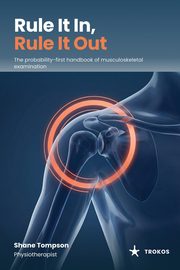
Get the book for the whole picture, test by test
Rule It In, Rule It Out gives every test with usable figures a ready-made ladder (the probability after a positive and a negative from 10%, 30% and 50%), a nomogram for the numbers in between, how to do the test and what counts as positive.
Look inside the book: free sample pages
Coming November 2026: 330 pages, paperback and PDF. Launch offer: subscribers get the PDF for A$39 instead of A$49, for the first two weeks after publication. Be first to know at launch
One study, one test, once a month
Rule It In is a free evidence letter for musculoskeletal clinicians: one recent study explained, one examination test with its real numbers. From Trokos, publisher of Rule It In, Rule It Out.
Free when you confirm your email: a one-page PDF of the strongest special tests to rule in and rule out, with tests that carry a caution flagged separately.
Launch offer for subscribers: the PDF edition of Rule It In, Rule It Out for A$39 instead of A$49, for the first two weeks after publication. Sign up free to get the code on launch day.
By subscribing you agree to receive Rule It In by email, about once a month. You will get a confirmation email first, and nothing is sent until you click it. Your address is stored by Kit (Kit.com, United States) and used only for this newsletter and the subscriber launch offer; Kit records which issues are opened and which links are clicked. Unsubscribe with one click in any issue. Privacy.