
Special tests library › Foot, ankle & calf
Matles test
Also called: Matles' test, knee flexion test
For: Achilles tendon rupture
A tear through the Achilles tendon, usually complete, typically during a sudden push-off. It is often felt as a sudden pop, or as if the patient had been kicked in the back of the heel.
Treat with caution (see below)Short answer: Treat results with caution when testing for Achilles tendon rupture: read the notes below before relying on one. In the source cited below, sensitivity was 88% and specificity 85%.
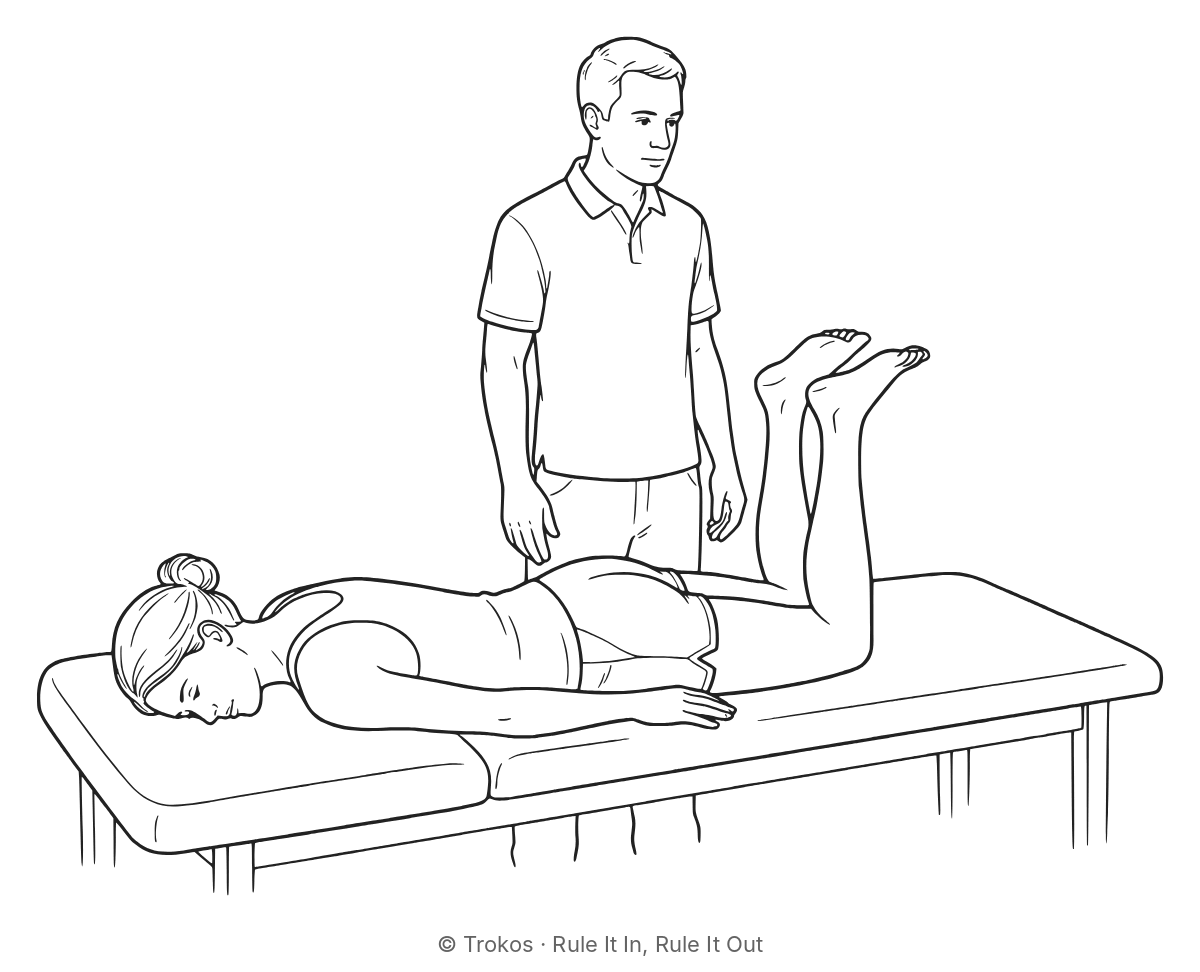
How it is done
With the patient prone and both knees flexed to 90°, the examiner observes the resting angle of both feet from the side. Positive: The injured foot falls into neutral or dorsiflexion rather than resting in slight plantarflexion.
What the numbers mean
- Positive result: see the caution above before relying on this result.
- Negative result: see the caution above before relying on this result.
The ladder: what a result does to your estimate
| If you thought | After a positive | After a negative |
|---|---|---|
| 10% | 41% | 2% |
| 30% | 73% | 6% |
| 50% | 86% | 12% |
Calculated from the likelihood ratios above, as in the book. Read the caution above before relying on these. For any other starting estimate, use the probability calculator.
Work out what a result means for your patient: probability calculator
Likelihood ratios as published by the review. Its LR+ fits a specificity of 86% (24 of 28 people without a rupture), the nearest value to the printed 85% that 28 people allow. Checked against the full paper on 23 October 2026.
Caution: One study at high risk of bias, with only 28 people without a rupture.
Study details: patients, setting, confidence intervals, what was read
| Study | Maffulli 1998 (in Reiman 2014 review) (prospective single study, tabulated in a systematic review (not pooled)) |
|---|---|
| Patients | 105 patients (77 with a tear, 28 without); 174 people with a clinically diagnosed complete Achilles tendon tear, collected over 13 years by 13 surgeons, compared with 28 people with a suspected but imaging-negative tear |
| Compared against | surgery for tears; MRI/ultrasound for the 28 without a tear |
| 95% confidence intervals | sensitivity 78–94%, specificity 66–95% (as published) |
| Likelihood ratios | as published by the study |
| What we read | Full paper; Reiman 2014 PMC4264655 full text, Table 4 (sensitivity 0.88, 95% CI 0.78–0.94; specificity 0.85, 95% CI 0.66–0.95; LR+ 6.29; LR− 0.14); the review's abstract prints a different specificity interval (0.72–0.98), so the paper is inconsistent with itself and Table 4 is used here. Maffulli 1998 AJSM abstract confirms 0.88/0.85 |
| Things to bear in mind | Single study rated high risk of bias by the review: people with a tear were compared with only 28 people without one, 13 different surgeons examined patients without blinding or a reliability check, and the yardstick (surgery for tears, imaging for the 28 controls) was not the same for everyone. The Matles test was done on only 77 of the people with a tear. |
How these details are gathered and checked: Methods.
Other tests in the library for Achilles tendon rupture
Compare all the tests for Achilles tendon rupture side by side
Red flags to screen for before testing the foot, ankle & calf
Source
Reiman M, Burgi C, Strube E, et al. The utility of clinical measures for the diagnosis of Achilles tendon injuries: a systematic review with meta-analysis. J Athl Train. 2014;49(6):820–829. Full text (PubMed Central) · Single study (1998), in a 2014 review
Figures as they will appear in Rule It In, Rule It Out (Trokos, forthcoming). If a newer or better study changes them, this page changes with the book. Figures last updated from the book on 13 October 2026.
How to cite
Citing a figure? Cite the study it comes from. The main figures on this page come from:
Reiman M, Burgi C, Strube E, et al. The utility of clinical measures for the diagnosis of Achilles tendon injuries: a systematic review with meta-analysis. J Athl Train. 2014;49(6):820–829.
Citing this page as a summary:
APA 7: Tompson, S. (2026, October 13). Matles test for Achilles tendon rupture. Trokos special tests library. Retrieved October 28, 2026, from https://trokos.com.au/tests/ankle-matlestest.html
Vancouver: Tompson S. Matles test for Achilles tendon rupture [Internet]. Sunshine Coast (QLD): Trokos; 2026 [updated 2026 Oct 13; cited 2026 Oct 28]. Available from: https://trokos.com.au/tests/ankle-matlestest.html
Citing the whole library:
APA 7: Tompson, S. (2026). Trokos special tests library (Version November 2026) [Online reference library]. Zenodo. https://doi.org/10.5281/zenodo.23932041
Vancouver: Tompson S. Trokos special tests library [Internet]. Version November 2026. Geneva: Zenodo; 2026 [cited 2026 Nov 4]. Available from: https://doi.org/10.5281/zenodo.23932041

Get the book for spotting a high ankle sprain, and knowing when the Achilles is torn
This page gives the published figures. Rule It In, Rule It Out adds captioned drawings with the exact positions, the Rule-In / Rule-Out bar and evidence dots, a fuller interpretation of each test, and the clinical reasoning on which tests to use and in what order.
Look inside the book: free sample pages
Coming November 2026: 330 pages, paperback and PDF. Launch offer: subscribers get the PDF for A$39 instead of A$49, for the first two weeks after publication. Be first to know at launch
One study, one test, once a month
Rule It In is a free evidence letter for musculoskeletal clinicians: one recent study explained, one examination test with its real numbers. From Trokos, publisher of Rule It In, Rule It Out.
Free when you confirm your email: a one-page PDF of the strongest special tests to rule in and rule out, with tests that carry a caution flagged separately.
Launch offer for subscribers: the PDF edition of Rule It In, Rule It Out for A$39 instead of A$49, for the first two weeks after publication. Sign up free to get the code on launch day.
By subscribing you agree to receive Rule It In by email, about once a month. You will get a confirmation email first, and nothing is sent until you click it. Your address is stored by Kit (Kit.com, United States) and used only for this newsletter and the subscriber launch offer; Kit records which issues are opened and which links are clicked. Unsubscribe with one click in any issue. Privacy.