
Special tests library › Wrist & hand
Anatomical snuffbox tenderness
Also called: snuffbox tenderness
For: Scaphoid fracture (occult)
A fracture of the scaphoid, a small wrist bone at the base of the thumb, that is not visible on the initial X-ray. It usually results from a fall on an outstretched hand.
A weak test on its ownShort answer: On the published figures, a weak test on its own for scaphoid fracture (occult). In the source cited below, sensitivity was 92% and specificity 48%. See the notes below before relying on it.
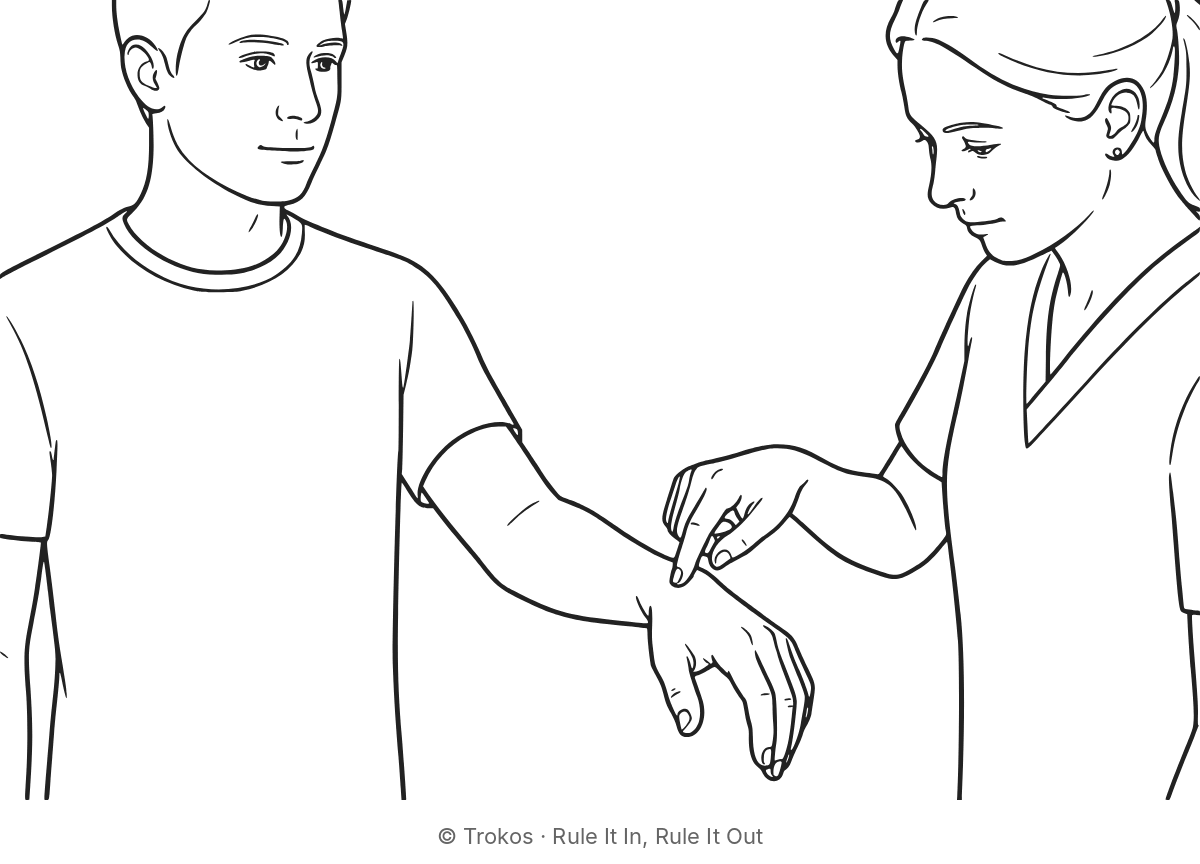
How it is done
The examiner ulnar-deviates the wrist slightly to open the anatomical snuffbox and presses into its floor, comparing both sides. Positive: Focal tenderness in the snuffbox after a fall on the outstretched hand.
What the numbers mean
- Positive result: barely informative: a positive result changes little.
- Negative result: a small shift: a negative result nudges the diagnosis down, but does not exclude it.
The ladder: what a result does to your estimate
| If you thought | After a positive | After a negative |
|---|---|---|
| 10% | 17% | 2% |
| 30% | 44% | 8% |
| 50% | 64% | 17% |
Calculated from the likelihood ratios above, as in the book. Read the caution above before relying on these. For any other starting estimate, use the probability calculator.
Studied combinations: this test as part of a published cluster
Snuffbox tenderness has been studied as one of three signs combined for scaphoid fracture: snuffbox tenderness, scaphoid tubercle tenderness and pain on thumb compression. In 215 patients with a suspected scaphoid fracture (Parvizi 1998), the three signs combined within 24 hours of injury gave a sensitivity of 100% and a specificity of 74% (abstract source only); the LR+ works out at about 3.8. In 154 patients with a normal first X-ray (Bergh 2014, MRI reference), a weighted score of the same three signs (4 or more of 6 points) gave a sensitivity of 77% and a specificity of 55% (LR+ 1.8, 95% CI 1.2–2.5) (figures from a 2023 review; original full text not seen). No independent validation study was found for either. These figures come from the tests as performed and scored in those studies.
Sources: Parvizi J et al. J Hand Surg Br 1998;23:324–7. Bergh TH et al. Emerg Med J 2014;31:659–64; Coventry L et al. Emerg Med J 2023;40:576.
Rule It In, Rule It Out covers how this cluster fits into the examination.
Work out what a result means for your patient: probability calculator
Both likelihood ratios as published by the review: LR+ 1.8 (95% CI 0.5 to 6.2) and LR− 0.2 (95% CI 0.0 to 0.7, an imprecise estimate); the ratio of the pooled percentages the review reports (92.1% and 48.4%) gives 1.79 and 0.16. Checked against the full paper on 23 October 2026.
Caution: Figures are for occult fracture (initial X-ray normal).
Study details: patients, setting, confidence intervals, what was read
| Study | Coventry 2023 (systematic review/meta-analysis) |
|---|---|
| Patients | 1,309 wrist injuries; pooled from 4 studies (1309 wrists; the fracture counts the review gives for these four studies in its Table 1 add up to 75) of emergency department patients with a suspected scaphoid fracture but normal first X-rays; the whole review pooled 8 studies and 1685 wrists |
| Compared against | delayed X-rays, CT, MRI or bone scan |
| 95% confidence intervals | sensitivity 83–97%, specificity 7–93% (as published) |
| Likelihood ratios | published (LR+ 1.8, LR− 0.2) |
| What we read | Full paper; Accepted manuscript PDF, University of Warwick repository (wrap.warwick.ac.uk/176007), Table 4 and Results |
| Things to bear in mind | Pooled from 4 emergency-department studies; the specificity interval is extremely wide (7% to 93%) because the studies disagreed sharply. Examiners were blinded to the final diagnosis, but one study used tenderness as an entry requirement and two used a mix of reference tests or counted some people as fracture-free without imaging. |
How these details are gathered and checked: Methods.
Other tests in the library for scaphoid fracture (occult)
Red flags to screen for before testing the wrist & hand
Source
Coventry L, Oldrini I, Dean B, Novak A, Duckworth A, Metcalfe D. Which clinical features best predict occult scaphoid fractures? A systematic review of diagnostic test accuracy studies. Emerg Med J. 2023;40(8):576–582. PubMed · systematic review
Figures as they will appear in Rule It In, Rule It Out (Trokos, forthcoming). If a newer or better study changes them, this page changes with the book. Figures last updated from the book on 13 October 2026.
How to cite
Citing a figure? Cite the study it comes from. The main figures on this page come from:
Coventry L, Oldrini I, Dean B, Novak A, Duckworth A, Metcalfe D. Which clinical features best predict occult scaphoid fractures? A systematic review of diagnostic test accuracy studies. Emerg Med J. 2023;40(8):576–582.
Citing this page as a summary:
APA 7: Tompson, S. (2026, October 13). Anatomical snuffbox tenderness for scaphoid fracture (occult). Trokos special tests library. Retrieved October 28, 2026, from https://trokos.com.au/tests/wrist-snuffboxtenderness.html
Vancouver: Tompson S. Anatomical snuffbox tenderness for scaphoid fracture (occult) [Internet]. Sunshine Coast (QLD): Trokos; 2026 [updated 2026 Oct 13; cited 2026 Oct 28]. Available from: https://trokos.com.au/tests/wrist-snuffboxtenderness.html
Citing the whole library:
APA 7: Tompson, S. (2026). Trokos special tests library (Version November 2026) [Online reference library]. Zenodo. https://doi.org/10.5281/zenodo.23932041
Vancouver: Tompson S. Trokos special tests library [Internet]. Version November 2026. Geneva: Zenodo; 2026 [cited 2026 Nov 4]. Available from: https://doi.org/10.5281/zenodo.23932041

Get the book for the clinical reasoning behind each wrist and hand test it covers, and which carpal tunnel test to trust
This page gives the published figures. Rule It In, Rule It Out adds captioned drawings with the exact positions, the Rule-In / Rule-Out bar and evidence dots, a fuller interpretation of each test, and the clinical reasoning on which tests to use and in what order.
Look inside the book: free sample pages
Coming November 2026: 330 pages, paperback and PDF. Launch offer: subscribers get the PDF for A$39 instead of A$49, for the first two weeks after publication. Be first to know at launch
One study, one test, once a month
Rule It In is a free evidence letter for musculoskeletal clinicians: one recent study explained, one examination test with its real numbers. From Trokos, publisher of Rule It In, Rule It Out.
Free when you confirm your email: a one-page PDF of the strongest special tests to rule in and rule out, with tests that carry a caution flagged separately.
Launch offer for subscribers: the PDF edition of Rule It In, Rule It Out for A$39 instead of A$49, for the first two weeks after publication. Sign up free to get the code on launch day.
By subscribing you agree to receive Rule It In by email, about once a month. You will get a confirmation email first, and nothing is sent until you click it. Your address is stored by Kit (Kit.com, United States) and used only for this newsletter and the subscriber launch offer; Kit records which issues are opened and which links are clicked. Unsubscribe with one click in any issue. Privacy.