
Special tests library › Low back & pelvis
Hoover test
Also called: Hoover's sign
For: Functional (non-organic) leg weakness
Leg weakness that is real to the patient but is not caused by damage to the nerves or muscles. It arises from a disturbance in how the brain controls movement (a functional neurological disorder).
Rule-in strength not calculable (no false positives seen)Short answer: For functional (non-organic) leg weakness, rule-in strength cannot be calculated because the study saw no false positives. In the source cited below, sensitivity was 63% and specificity 100%. See the notes below before relying on it.
How it is done
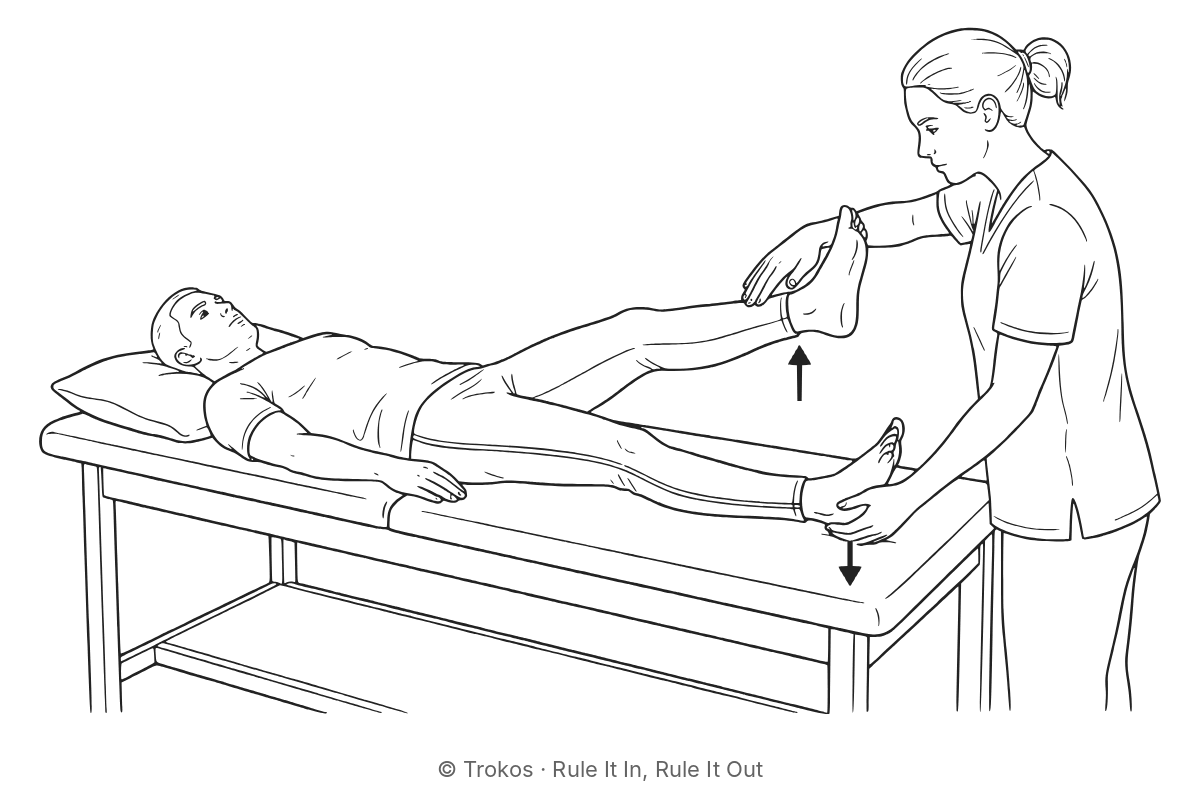
The patient lies supine. The examiner cups one hand under the heel of the weak leg and asks the patient to push that heel down (direct hip extension). The examiner then places the other hand on top of the strong leg's ankle and asks the patient to lift the strong leg against it, while feeling for downward pressure under the weak heel. Positive: Hip extension on the weak side is weak when tested directly, but the weak heel presses down firmly when the patient lifts the strong leg.
What the numbers mean
- Positive result: no false positives were seen in the study, so no likelihood ratio can be calculated. How far to trust that depends on how many people without the condition were studied.
- Negative result: a small shift: a negative result nudges the diagnosis down, but does not exclude it.
The ladder: what a result does to your estimate
| If you thought | After a positive | After a negative |
|---|---|---|
| 10% | — | 4% |
| 30% | — | 14% |
| 50% | — | 27% |
Calculated from the likelihood ratios above, as in the book. Read the caution above before relying on these. For any other starting estimate, use the probability calculator.
Work out what a result means for your patient: probability calculator
How common is it? Starting probabilities by setting
Red flags to screen for before testing the low back & pelvis
LR− calculated from the published sensitivity and specificity. Figures match the published abstract (McWhirter 2011).
Caution: Small unblinded study in patients with suspected stroke; sensitivity rests on only 8 people with functional weakness, and the diagnosing panel may have used the sign itself.
Study details: patients, setting, confidence intervals, what was read
| Study | McWhirter 2011 (prospective unblinded cohort) |
|---|---|
| Patients | 124 patients; hospital patients presenting with suspected stroke (337 recruited; 124 had leg weakness and were analysed; 8 had functional weakness) |
| Compared against | clinical diagnosis from history, examination, imaging and follow-up |
| 95% confidence intervals | sensitivity 24–91%, specificity 97–100% (as published) |
| Counts | true positives 5, false positives 0, false negatives 3, true negatives 116 |
| Likelihood ratios | calculated from the sensitivity and specificity above |
| What we read | Abstract only (full paper not available to us); Europe PMC/PubMed abstract only (PMID 22118379); Elsevier full text not accessible. Counts derived from 8 functional cases (63% = 5/8) and 116 non-functional (100%) |
| Things to bear in mind | Sensitivity rests on only 8 people with functional weakness, so the 63% is very uncertain (95% CI 24–91%). Examiners were not blinded, and the same clinical picture fed into the final diagnosis. Studied in suspected stroke, not in back-pain clinics. |
How these details are gathered and checked: Methods.
Source
McWhirter L, Stone J, Sandercock P, Whiteley W. Hoover's sign for the diagnosis of functional weakness: a prospective unblinded cohort study in patients with suspected stroke. J Psychosom Res. 2011;71(6):384–386. PubMed · single study
Figures as they will appear in Rule It In, Rule It Out (Trokos, forthcoming). If a newer or better study changes them, this page changes with the book. Figures last updated from the book on 13 October 2026.
How to cite
Citing a figure? Cite the study it comes from. The main figures on this page come from:
McWhirter L, Stone J, Sandercock P, Whiteley W. Hoover's sign for the diagnosis of functional weakness: a prospective unblinded cohort study in patients with suspected stroke. J Psychosom Res. 2011;71(6):384–386.
Citing this page as a summary:
APA 7: Tompson, S. (2026, October 13). Hoover test for functional (non-organic) leg weakness. Trokos special tests library. Retrieved October 28, 2026, from https://trokos.com.au/tests/lumbar-hoover.html
Vancouver: Tompson S. Hoover test for functional (non-organic) leg weakness [Internet]. Sunshine Coast (QLD): Trokos; 2026 [updated 2026 Oct 13; cited 2026 Oct 28]. Available from: https://trokos.com.au/tests/lumbar-hoover.html
Citing the whole library:
APA 7: Tompson, S. (2026). Trokos special tests library (Version November 2026) [Online reference library]. Zenodo. https://doi.org/10.5281/zenodo.23932041
Vancouver: Tompson S. Trokos special tests library [Internet]. Version November 2026. Geneva: Zenodo; 2026 [cited 2026 Nov 4]. Available from: https://doi.org/10.5281/zenodo.23932041

Get the book for telling radicular leg pain from referred pain, and knowing when cauda equina means send now
This page gives the published figures. Rule It In, Rule It Out adds captioned drawings with the exact positions, the Rule-In / Rule-Out bar and evidence dots, a fuller interpretation of each test, and the clinical reasoning on which tests to use and in what order.
Look inside the book: free sample pages
Coming November 2026: 330 pages, paperback and PDF. Launch offer: subscribers get the PDF for A$39 instead of A$49, for the first two weeks after publication. Be first to know at launch
One study, one test, once a month
Rule It In is a free evidence letter for musculoskeletal clinicians: one recent study explained, one examination test with its real numbers. From Trokos, publisher of Rule It In, Rule It Out.
Free when you confirm your email: a one-page PDF of the strongest special tests to rule in and rule out, with tests that carry a caution flagged separately.
Launch offer for subscribers: the PDF edition of Rule It In, Rule It Out for A$39 instead of A$49, for the first two weeks after publication. Sign up free to get the code on launch day.
By subscribing you agree to receive Rule It In by email, about once a month. You will get a confirmation email first, and nothing is sent until you click it. Your address is stored by Kit (Kit.com, United States) and used only for this newsletter and the subscriber launch offer; Kit records which issues are opened and which links are clicked. Unsubscribe with one click in any issue. Privacy.