
Special tests library › Low back & pelvis
Femoral nerve stretch test (prone knee bend)
Also called: prone knee bend test, reverse straight leg raise
For: Upper lumbar (L2–L4) nerve root compression
Compression of an upper lumbar nerve root (L2 to L4), which supplies the front of the thigh. It causes anterior thigh pain and sometimes quadriceps weakness.
Rule-in strength not calculable (no false positives seen)Short answer: For upper lumbar (L2–L4) nerve root compression, rule-in strength cannot be calculated because the study saw no false positives. In the source cited below, sensitivity was 50% and specificity 100%. See the notes below before relying on it.
How it is done
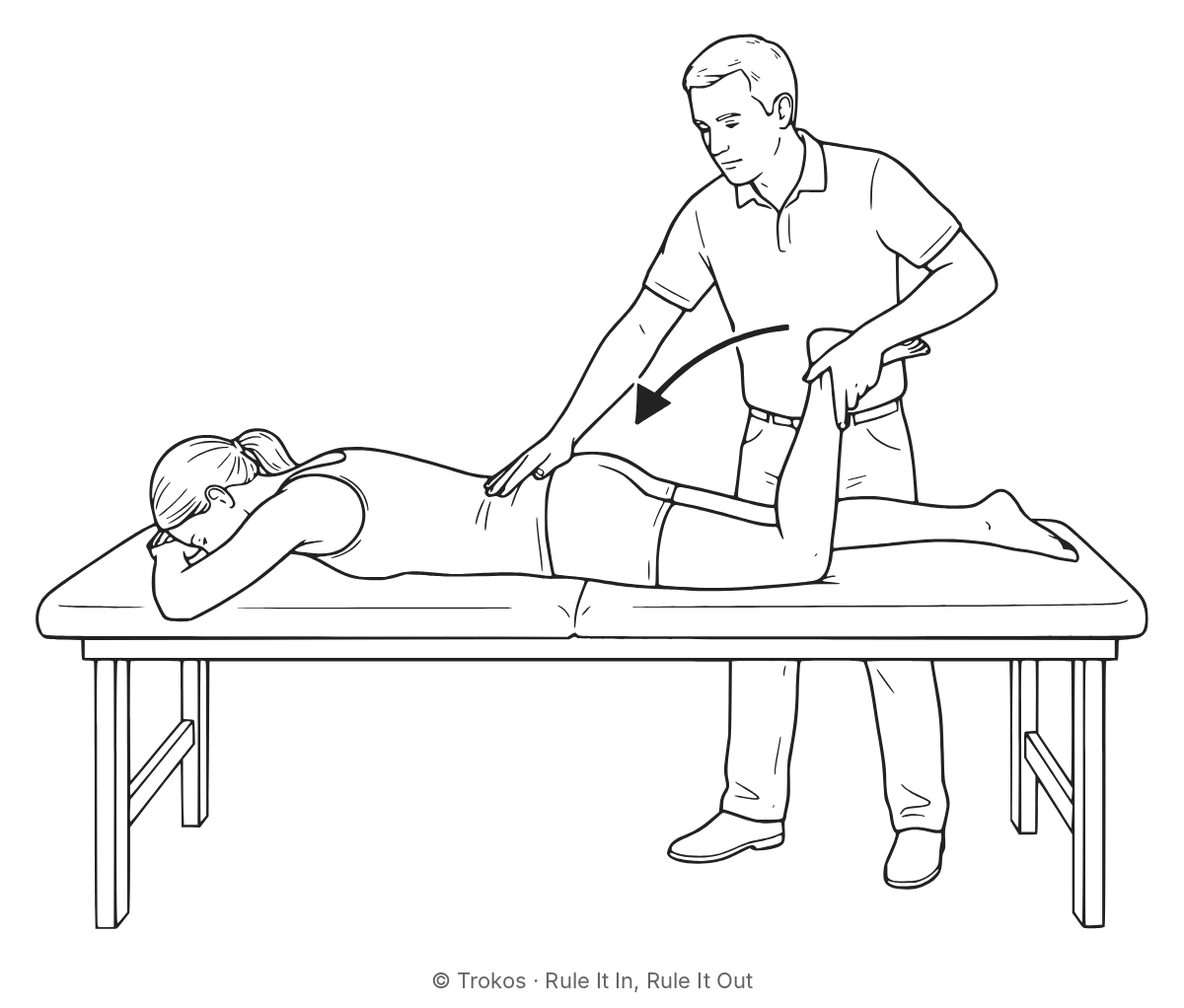
The patient lies prone with the pelvis flat. The examiner flexes the knee towards the buttock, adding gentle hip extension if needed. Positive: Reproduction of the patient's anterior or lateral thigh symptoms; quadriceps stretch alone does not count.
What the numbers mean
- Positive result: no false positives were seen in the study, so no likelihood ratio can be calculated. How far to trust that depends on how many people without the condition were studied.
- Negative result: a small shift: a negative result nudges the diagnosis down, but does not exclude it.
The ladder: what a result does to your estimate
| If you thought | After a positive | After a negative |
|---|---|---|
| 10% | — | 5% |
| 30% | — | 18% |
| 50% | — | 33% |
Calculated from the likelihood ratios above, as in the book. Read the caution above before relying on these. For any other starting estimate, use the probability calculator.
Work out what a result means for your patient: probability calculator
Checked against the full paper on 15 October 2026.
Caution: For upper lumbar (L2–L4) nerve roots only; it does not detect L5/S1 compression, where sensitivity was 0% in the same study.
Study details: patients, setting, confidence intervals, what was read
| Study | Suri 2011 (prospective cross-sectional) |
|---|---|
| Patients | 54 patients; hospital spine centre; consecutive patients with radiating leg pain for under 12 weeks; 25 had mid-lumbar (L2–L4) and 29 low lumbar (L5/S1) nerve root impingement on MRI |
| Compared against | MRI (most severe level of nerve root impingement, read by neuroradiologists) |
| 95% confidence intervals | sensitivity 31–69%, specificity 88–100% (as published) |
| Likelihood ratios | as published by the study |
| What we read | Full paper; PMC2978791 full text (author manuscript), Table 3 |
| Things to bear in mind | Small study (54 patients, only 25 with upper lumbar compression) in a specialist spine centre, so the confidence intervals are wide. Every patient had nerve root impingement on MRI (compression, displacement or contact), so the 100% specificity is against L5/S1 compression, not against having no compression. Examiners were blinded to the MRI. |
How these details are gathered and checked: Methods.
Other tests in the library for upper lumbar (L2–L4) nerve root compression
Red flags to screen for before testing the low back & pelvis
Source
Suri P, Rainville J, Katz JN, Jouve C, Hartigan C, Limke J, Pena E, Li L, Swaim B, Hunter DJ. The accuracy of the physical examination for the diagnosis of midlumbar and low lumbar nerve root impingement. Spine (Phila Pa 1976). 2011;36(1):63–73. Journal article (DOI) · single study
Figures as they will appear in Rule It In, Rule It Out (Trokos, forthcoming). If a newer or better study changes them, this page changes with the book. Figures last updated from the book on 13 October 2026.
How to cite
Citing a figure? Cite the study it comes from. The main figures on this page come from:
Suri P, Rainville J, Katz JN, Jouve C, Hartigan C, Limke J, Pena E, Li L, Swaim B, Hunter DJ. The accuracy of the physical examination for the diagnosis of midlumbar and low lumbar nerve root impingement. Spine (Phila Pa 1976). 2011;36(1):63–73.
Citing this page as a summary:
APA 7: Tompson, S. (2026, October 13). Femoral nerve stretch test (prone knee bend) for upper lumbar (L2–L4) nerve root compression. Trokos special tests library. Retrieved October 28, 2026, from https://trokos.com.au/tests/lumbar-femoralstretch.html
Vancouver: Tompson S. Femoral nerve stretch test (prone knee bend) for upper lumbar (L2–L4) nerve root compression [Internet]. Sunshine Coast (QLD): Trokos; 2026 [updated 2026 Oct 13; cited 2026 Oct 28]. Available from: https://trokos.com.au/tests/lumbar-femoralstretch.html
Citing the whole library:
APA 7: Tompson, S. (2026). Trokos special tests library (Version November 2026) [Online reference library]. Zenodo. https://doi.org/10.5281/zenodo.23932041
Vancouver: Tompson S. Trokos special tests library [Internet]. Version November 2026. Geneva: Zenodo; 2026 [cited 2026 Nov 4]. Available from: https://doi.org/10.5281/zenodo.23932041

Get the book for telling radicular leg pain from referred pain, and knowing when cauda equina means send now
This page gives the published figures. Rule It In, Rule It Out adds captioned drawings with the exact positions, the Rule-In / Rule-Out bar and evidence dots, a fuller interpretation of each test, and the clinical reasoning on which tests to use and in what order.
Look inside the book: free sample pages
Coming November 2026: 330 pages, paperback and PDF. Launch offer: subscribers get the PDF for A$39 instead of A$49, for the first two weeks after publication. Be first to know at launch
One study, one test, once a month
Rule It In is a free evidence letter for musculoskeletal clinicians: one recent study explained, one examination test with its real numbers. From Trokos, publisher of Rule It In, Rule It Out.
Free when you confirm your email: a one-page PDF of the strongest special tests to rule in and rule out, with tests that carry a caution flagged separately.
Launch offer for subscribers: the PDF edition of Rule It In, Rule It Out for A$39 instead of A$49, for the first two weeks after publication. Sign up free to get the code on launch day.
By subscribing you agree to receive Rule It In by email, about once a month. You will get a confirmation email first, and nothing is sent until you click it. Your address is stored by Kit (Kit.com, United States) and used only for this newsletter and the subscriber launch offer; Kit records which issues are opened and which links are clicked. Unsubscribe with one click in any issue. Privacy.